eHealth Magazine reports that Apollo Hospitals, working with Microsoft, has deployed an AI agent whose stated job is patient safety. The headline is about artificial intelligence, but the operational story underneath it is about record-keeping discipline. An agent can only flag a deteriorating patient or a late medication if the hospital is already capturing those events as structured, timestamped data — and that is the part a ~100-bed hospital should copy first.
What an AI safety agent actually reads
The framing in the Apollo announcement is worth pausing on. The agent is not positioned as a diagnostic second opinion or a transcription shortcut. It is pointed at a class of operational failure that every hospital recognises: the deterioration nobody escalated, the dose that went in ninety minutes late, the critical lab value that sat unread while the duty doctor was in theatre.
An agent of that kind does not reason over narrative. It reasons over events — a vitals entry with a time against it, a medication administration record, a result released at a known minute, a transfer from ward to ICU, an incident report filed and closed. Each of those has to exist as a row in a system before any model can see a pattern in it. Where a hospital writes the same event on a paper chart and transcribes it at the end of the shift, there is nothing for the agent to read, and the pattern it was built to catch has already resolved itself one way or the other.
So the practical question for a 100-bed hospital in Kerala, Tamil Nadu or Maharashtra is not whether to procure an AI patient safety agent this year. It is whether the hospital's own record, as it stands today, would be legible to one at all.
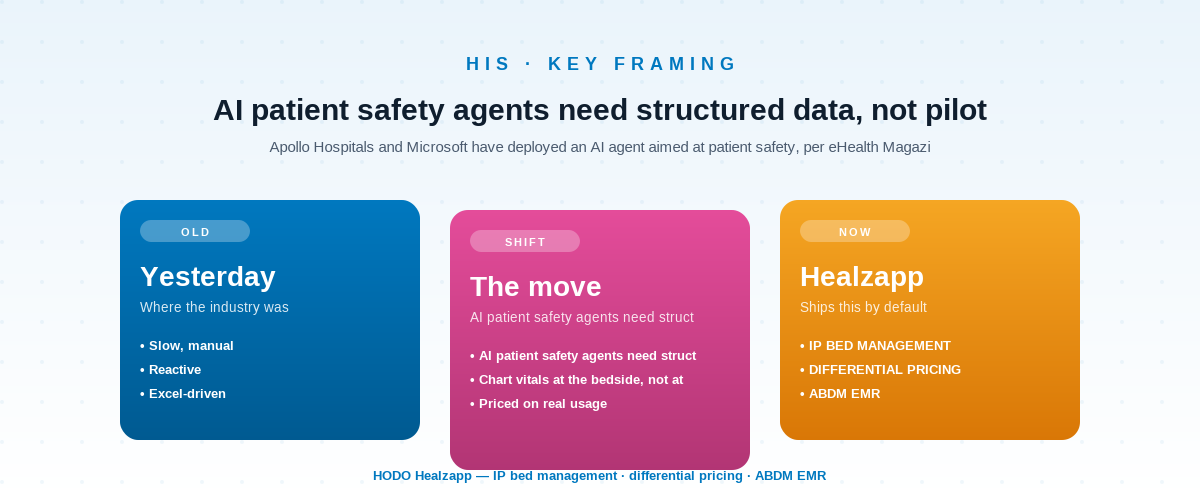
AI patient safety agents need structured data, not pilots.
At 100 beds, safety fails at handover
In most mid-sized Indian hospitals, safe care rests on the memory of two or three senior nurses. They know which patient in bed 14 is the one to watch, which post-op is not passing urine, which elderly admission has a dropping saturation trend that has not yet crossed any threshold. That knowledge is real and it is valuable. It is also verbal, and it transfers at shift change in a two-minute conversation at the nursing counter.
The failure mode is predictable. The incoming shift gets the three loudest items and not the fourth. The bed board on the whiteboard says one thing and the billing system says another, so a transfer gets missed in the round. A verbal escalation to the consultant is made, not logged, and nobody can later establish when it happened. None of this is negligence; it is the arithmetic of one duty doctor covering forty beds overnight.
This is precisely the gap an agent is supposed to close — but an agent inherits the gap rather than fixing it if the underlying capture is retrospective. Fixing the capture is not an AI project. It is a workflow decision about where and when charting happens, and it pays off immediately, with or without a model on top.
The four streams that have to be captured live
Four data streams carry almost all of a hospital's safety signal, and each has a well-known breakage point in Indian practice.
Nursing observations and vitals. Charted on paper at the bedside, entered into the system hours later or not at all. The trend — the thing that actually predicts deterioration — never becomes computable.
Medication administration. Pharmacy issue gets recorded because it is a billing event. Administration often does not, because it is not. The result is a system that knows what was dispensed and not what reached the patient, or when.
Diagnostics. Analysers print, staff type. Manual transcription introduces both delay and error, and the release timestamp — the clock that governs whether a critical value was acted on — is the time somebody got to the keyboard, not the time the machine produced the result.
Patient movement. Admissions, ward-to-ICU transfers, bed changes and discharges tracked on a whiteboard or in a register. Occupancy is then reconstructed at month end for the management report instead of being known at any given hour.
Close those four and a hospital has a usable safety substrate. Leave them open and every AI pilot sits on sand.
NABH and ABDM ask for the same substrate
There is a convenient alignment here. NABH assessors ask for evidence — incident reporting with closure, medication error tracking, documented handovers, timed nursing records. An assessment visit is, in effect, an audit of whether the hospital can produce a timestamped trail on demand. Hospitals that generate that trail as a by-product of daily work walk through assessment; hospitals that assemble it in the fortnight before, do not.
ABDM points in the same direction from a different angle. An ABDM-compliant EMR requires the clinical record to be structured and shareable rather than a scanned bundle. The structuring work that compliance forces is the same work that makes machine reasoning possible later. The hospital does not have to choose between regulatory readiness and AI readiness — they are the same investment, sequenced correctly.
Worth noting for procurement: a safety agent bolted onto an HIS that stores clinical events as free-text notes will deliver demonstrations, not outcomes. The structuring has to happen at the point of capture, inside the module the nurse or technician already uses.
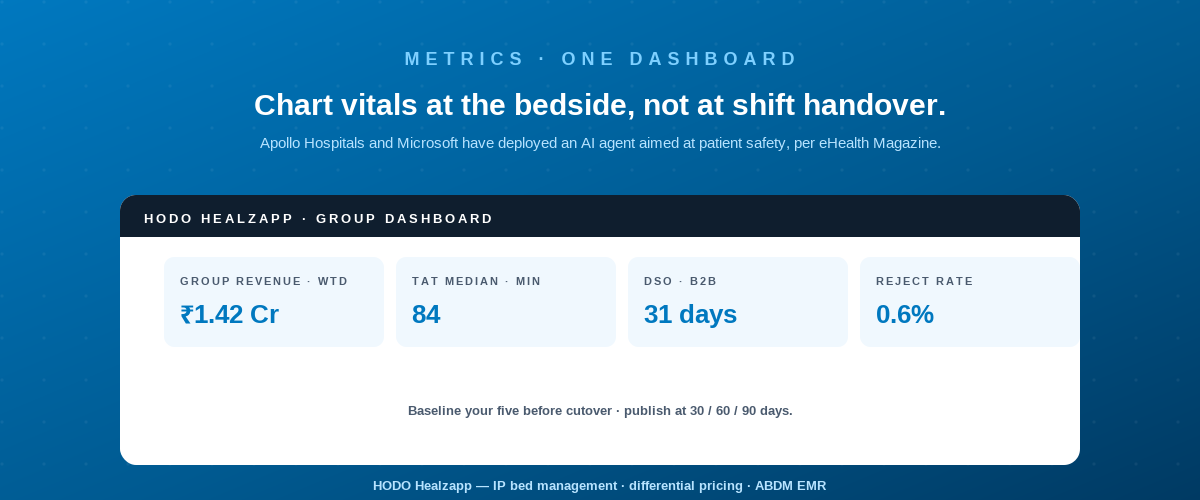
Chart vitals at the bedside, not at shift handover.
The cashflow case, not just the safety case
Patient safety arguments tend to stall at the board table because the benefit is a non-event. The cashflow argument travels further. An avoidable complication consumes extra bed-days in a hospital where occupancy is the binding constraint on revenue — and those bed-days are rarely reimbursed. Documentation gaps are a leading cause of TPA queries and PMJAY claim deductions, and the query cycle itself consumes administrative hours that nobody budgeted.
The same structured record that a safety agent would read is the record that answers a TPA query on the first pass: timed vitals, administration entries, result release times, transfer history. Capture it once, use it for clinical escalation, NABH evidence and claim defence. That is three returns on one workflow change, which is a more honest business case than any projection of incidents prevented.
What this means for HODO customers
The Apollo deployment is a signal about where mid-sized hospital IT has to get to, not a product a 100-bed hospital needs to buy this quarter. The groundwork is unglamorous and it is available now. Nursing Station moves vitals and observations into the record at the bedside, in the shift they happen, so trends become computable instead of anecdotal. Machine Interfacing removes the transcription step between analyser and record, which fixes both accuracy and the release timestamp that governs critical-result escalation. IP bed management turns occupancy and transfers into live system state rather than a whiteboard reconstructed at month end. With an ABDM-compliant EMR holding the structured clinical record underneath, the hospital is positioned for whatever agent layer arrives next — and is already better run in the meantime.