Aster DM Healthcare has told Gulf Business it plans to run more than 100 clinics across the UAE by 2030, roughly doubling its current UAE clinic footprint over the next five years. The announcement matters far beyond Aster's own P&L: the moment a well-capitalised chain commits to another fifty branded doors, every other polyclinic operator in Dubai, Abu Dhabi and the wider GCC gets benchmarked on cost per visit, doctor utilisation and claim TAT, whether they signed up for the comparison or not.
Why the 100-clinic target reshapes UAE polyclinic economics
Aster's UAE strategy is a density play. Gulf Business frames the expansion as clinic-led rather than hospital-led, which is the correct read: hospital beds in the UAE are broadly saturated in tier-one catchments, but clinics compete on how close they sit to residential pockets. Owning 100+ branded clinics means being within a 15-minute drive of most UAE residents, pushing volume through short-format visits, GP consultations, follow-ups, walk-in diagnostics, rather than long-stay admissions.
For a 2-to-20 branch polyclinic group watching this, two things change. Doctor supply gets tighter as Aster's payroll pull on GPs, dermatologists and paediatricians rises. Insurance panel positioning also shifts, because larger networks negotiate better rates with Daman, Thiqa, Nextcare and the major private carriers. The rational response is not to chase Aster's pace; it is to tighten cost per visit and remove the drag that keeps a 5-clinic group from becoming a 15-clinic group. Most of that drag lives in the software stack, records that do not move between branches, billing configured site-by-site, doctor rosters maintained in per-branch spreadsheets.
The multi-outlet HIS problem: one-click new-centre setup vs. rebuild
Every time a polyclinic group opens a branch, operations faces the same fork: extend the existing HIS to cover the new site, or configure a fresh install from zero. Configure-from-zero means rebuilding the fee master, rebuilding insurance payer mapping, rebuilding the doctor list with facility-level licensing, and retraining reception. Three months of onboarding lag per branch, and version drift across sites within the first year.
Aster's target implies roughly ten new UAE clinics per year on average. That pace makes rebuild-per-branch operationally impossible, which is why enterprise chains standardise their HIS across the entire footprint before scaling. The same logic applies at 5 clinics. An HIS that treats a new branch as a data unit within one instance, central fee master, central insurance panel, central doctor pool, with branch-level overrides for pricing and hours, costs the same to run today as five disconnected installs, but only the former lets the group grow to 15 branches without a rebuild. Smaller operators need this discipline more than Aster does, because they cannot absorb three-month lag on any single branch.
UAE polyclinic billing has three layers that most India-first HIS platforms handle poorly. First, the insurance mix, Daman, Thiqa, Nextcare, MetLife, AXA, Neuron, Oman Insurance and 20+ other carriers, each with distinct pre-authorisation flows, co-pay rules and claim formats. Second, multi-currency: medical tourism patients from GCC neighbours, CIS and East Africa often settle in USD or their home currency, and the fee master has to hold both AED and settlement currency cleanly. Third, VAT, 5% on non-exempt lines, with correct tax invoices generated at the point of billing.
Layer on DHA, MOHAP and DoH licensing. Every consultant is credentialled to specific facilities, not to the parent brand, and the HIS has to enforce that constraint at appointment booking, not discover it three weeks later when a claim gets rejected. A large chain has a compliance team to handle credential mapping across dozens of clinics. A 5-clinic operator does not; the stack has to enforce the rules automatically. Retrofitting an Indian HIS to handle DHA credentialling, VAT-compliant invoicing and 20-carrier claim submission almost always fails, the fee master schema and claim workflows do not compose after the fact.
Doctor scheduling across a growing branch footprint
One consultant working at three branches on rotating days is normal in a UAE polyclinic. At six branches it becomes a scheduling problem no receptionist should own. Central appointment scheduling, with doctor availability visible across every branch, patient-facing booking that respects doctor licence-per-facility, and teleconsultation slots sharing the same calendar as physical visits, is the operational minimum at any real scale.
The moment teleconsultation lives in a separate system, double-booking between physical and virtual slots becomes a weekly problem, and the patient experience fragments. The same principle applies to the patient health app: patients booking themselves and getting reminders reduces reception load, which is the single largest variable cost per branch after doctor payroll. Aster will invest here because it must. Smaller operators can install the same discipline on day one, and the cost gap between central scheduling for one branch and central scheduling for ten branches is close to zero if the HIS is built for it.
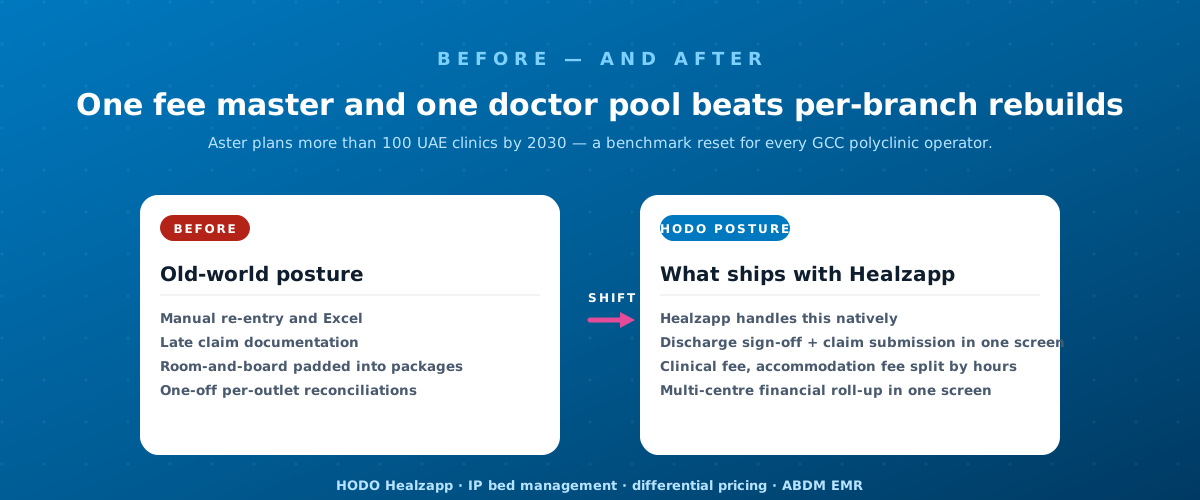
One fee master and one doctor pool beats per-branch rebuilds.
What smaller operators can copy from Aster without Aster's balance sheet
Aster's real advantages are capital, brand recall and insurance leverage. None of those are copyable by a 5-clinic operator. What is copyable is the operational discipline of running every branch off one system, one fee master, one doctor pool, one patient ID that follows the patient across branches, one insurance mapping, one reporting layer.
That is a stack decision, not a capital decision. Two clinics on the correct multi-outlet HIS have the same unit cost as two clinics on two disconnected installs, but only the first pair can add a third branch in two weeks instead of two months. Second copyable move: WhatsApp and SMS report delivery, plus reminder-driven appointment fill, Aster runs these at scale, and there is no reason a 3-clinic group cannot. Third: teleconsultation as a legitimate slot inside the same calendar, not as a bolt-on. Fourth: machine interfacing for in-clinic diagnostics, so a haematology analyser or ECG cart auto-posts results into the visit record.
What this means for HODO customers
UAE and wider GCC polyclinic groups already on HODO Healzapp have the multi-outlet primitives that Aster's expansion is now benchmarking the market on. One-click new-centre setup means adding a Sharjah or Doha branch does not restart the fee master and insurance mapping, it inherits the group's configuration and applies branch-level overrides. Multi-currency billing covers AED-first workflows plus USD and cross-border settlement for medical tourism patients, with VAT-compliant invoicing.
Appointments hold doctor availability across branches with licence-per-facility rules enforced at booking, and teleconsultation slots share the same calendar. WhatsApp/SMS report delivery and the Patient Health App handle the patient-facing layer that keeps reception load flat as branch count grows. For groups planning their next three to ten clinics across the UAE, Qatar, Kuwait or Bahrain, the stack decision made now is the one that determines whether year-three feels like scale or like a rebuild.