Aster DM Healthcare's merger with Quality Care India, reported by eHealth Magazine, creates one of the country's largest hospital networks, over 10,000 beds spread across multiple states, brands and legacy IT stacks. For any Indian hospital owner watching this from a 50-500 bed vantage point, the interesting story is not the deal value. It is the operational hangover that follows every large hospital merger, and the very ordinary things smaller chains can copy without a headline transaction.
The merger sets a template, not just a headline
The public story is two hospital groups combining, roughly 10,000-plus beds, spread across multiple states. It becomes a template because most Indian hospital chains, 50 beds today, 200 tomorrow, will do a smaller version of this in the next 24 months. Acquiring an outlet. Absorbing a diagnostic chain. Signing a corporate for OPD volume. The moment two entities merge, five things break: master data, billing tariffs, TPA cashflow, clinical documentation standards, and inventory codes. Every merged hospital network in India has spent 12 to 18 months cleaning these up post-signing, and the ones that finish faster tend to be the ones that started centralised in the first place.
The lesson smaller chains can copy without a merger: never let each outlet build its own tariff master, doctor list, item code, or lab test master. Start centralised even when it feels heavy for one hospital. The cost of retrofitting shared masters at outlet six is roughly ten times the cost of designing them at outlet one.
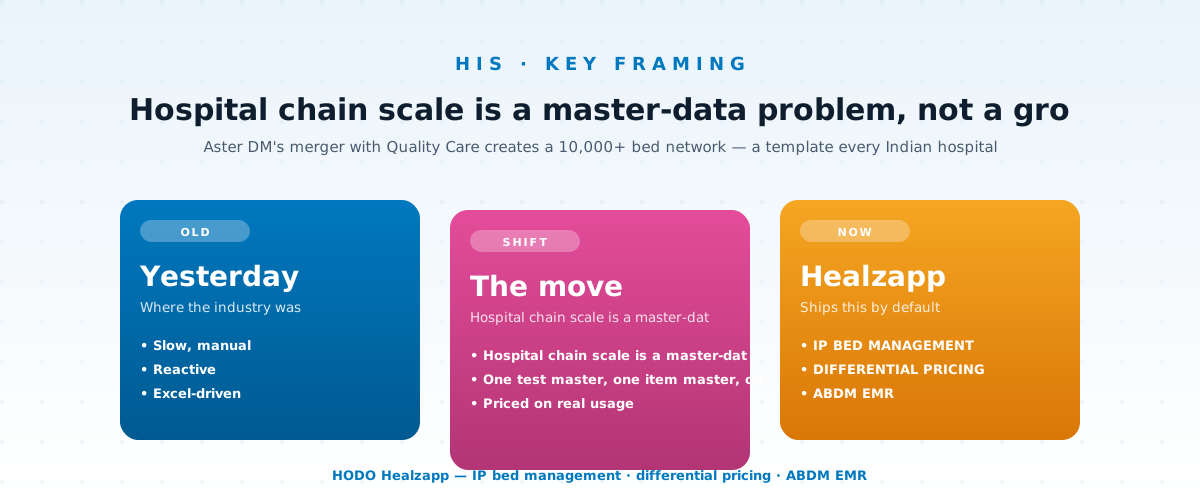
Hospital chain scale is a master-data problem, not a growth problem.
The IT integration bill nobody discloses
When a merger happens, the number in the press release is the deal value. The number that never appears is the IT integration cost, which typically runs 3 to 5 per cent of the deal for the first 18 months. It covers master data reconciliation, chart-of-accounts alignment, tariff mapping across brands, single sign-on, ABDM re-certification, and TPA re-empanelment under the merged entity.
For hospital owners not planning a merger, the same bill applies in miniature every time a new outlet is opened on a fresh HIS instance or a small clinic running on Excel is acquired. The way to keep the number small is architectural, not commercial: one HIS instance, one patient master, one item master, and per-outlet configuration sitting as a layer on top. A distributed HIS-per-outlet setup makes sense for the first two months and then costs money for a decade. Vendor negotiations usually focus on licence cost per bed. The line item that actually decides five-year TCO is integration and master-data ownership.
Master data, the silent killer of hospital M&A
Every merged hospital group in India tells the same story. Six months in, the CFO discovers that CBC costs Rs 250 in outlet A, Rs 320 in outlet B, and is billed as Complete Blood Count in outlet C, same test, three prices, three names, one merged P&L. Corporate contracts get charged the wrong rate. TPA claims get rejected because the test code does not match the empanelled panel. Doctors' commission calculations diverge across outlets for the same procedure.
Fix this early. A single test master, a single procedure master, a single doctor code, and a single item code across the entire network. Differential pricing per outlet or per corporate contract must sit as a layer above the master, not as a fork of it. Chains that get this right can add a new outlet in weeks. Chains that get it wrong end up with a rewrite project every 24 months, which is exactly the trap a mid-size Indian hospital owner cannot afford to walk into twice.
TPA cashflow across a merged network
TPA and insurance cashflow is where merger integration either pays off or drowns. Each hospital in a network typically has its own list of empanelled TPAs, its own pre-auth turnaround, its own claim rejection rate. Post-merger, corporate patients expect one experience: walk into any brand, get cashless, no repeat KYC. The back-office reality is different, separate TPA logins, separate claim queues, separate ageing reports, and finance teams that reconcile in Excel.
The playbook: unify the TPA master, publish a single pre-auth SLA, and route claims through one queue with outlet as a tag rather than one queue per outlet. Ageing reports should be viewable network-wide and per outlet in the same click. Any hospital chain planning to grow past three outlets should design for this from day one. Retrofitting it after outlet six is a six-month project that ties up the CFO and the IT head at the same time.
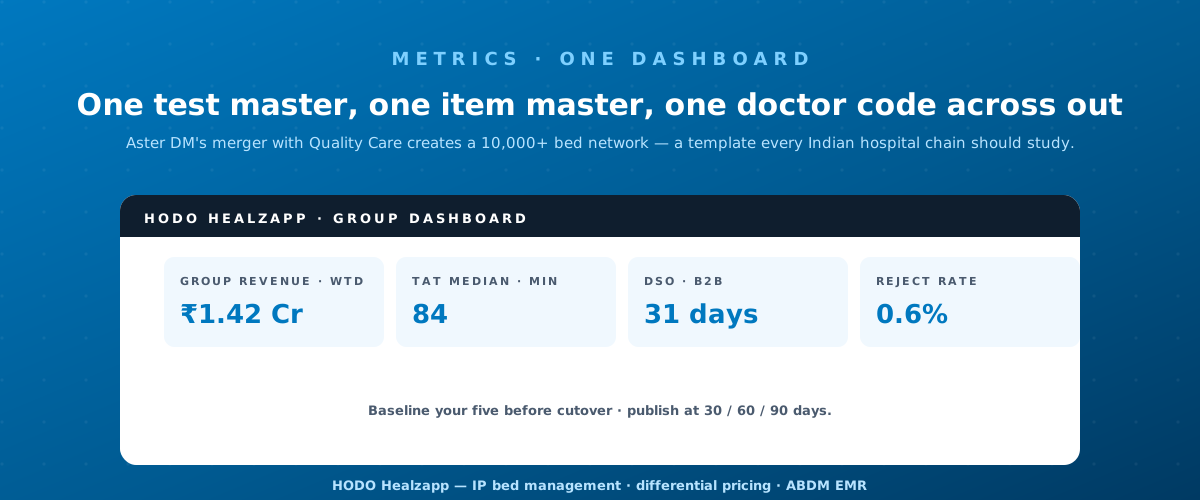
One test master, one item master, one doctor code across outlets.
ABDM compliance at outlet scale
ABDM integration is per-facility. Every outlet needs its HFR registration, its HPR-linked clinicians, and its ABHA-linked encounters. In a merged network with 200-plus facilities, this is not a one-time compliance task, it is an ongoing operations function. New doctor joins outlet 47, ABHA linking must happen the same day. New outlet opens, HFR must be live before the first OPD registration.
Smaller chains often treat ABDM as a we-will-get-to-it item and then scramble when a corporate customer or insurer asks for ABHA-linked discharge summaries. The correct design principle: ABDM linkage must be part of the standard patient registration and doctor onboarding flow, not a separate compliance workflow that someone runs weekly. Compliance done inside the primary workflow scales with outlets. Compliance done outside it does not.
What this means for HODO customers
The Aster-Quality Care deal is not a case study most 50-500 bed hospitals will replicate. But the operational discipline it forces on the combined entity, one master data model, one billing spine, one compliance function, is exactly the discipline that lets a two-outlet clinic become a fifteen-outlet chain without a rebuild.
HODO Healzapp is built for this trajectory. Multi-outlet scale-up with one-click new-centre setup means the master data, tariff, doctor list and item codes are inherited from the network, not rebuilt per outlet. Differential pricing handles the reality that outlet A and outlet B, or corporate X and cash-paying patient Y, are billed at different rates on the same master. ABDM-compliant EMR keeps HFR and ABHA linkage inside the standard registration flow, so compliance scales with outlets instead of becoming a separate project. Add Tally integration and B2B Referral / Corporate-partner logins on top, and the chain has the plumbing to absorb a new outlet or a small acquisition in weeks, not quarters.