
eHealth Magazine's recent feature, Enabling Automation-Led Care in Indian Hospitals, argues that Indian hospitals are moving past isolated digital pilots and towards automation that touches pharmacy, nursing, and machine workflows in one connected line. For an owner or administrator running a 50-500 bed hospital or a diagnostic chain, the useful question is not whether to automate, but which processes actually cut cost per patient and lift throughput inside the next two quarters.
Stripped of jargon, the piece makes three operational claims. First, that pharmacy management is the workflow where Indian hospitals lose the most money to manual handling — expired stock, unbilled dispenses, and TAT gaps between prescription and issue. Second, that nursing stations are the choke point where clinical orders, billing lines, and inventory movement have to reconcile in real time, and that most Indian hospitals still run this on paper or on disconnected screens. Third, that machine interfacing — pulling results directly from analysers, imaging kit, and monitors into the patient record — is now table stakes for any group planning to open new outlets without hiring proportional headcount.
These are not futuristic points. They are the same complaints hospital administrators file every quarter when they review shrinkage, revenue leakage, and consultant grievances. What has changed is that the compliance environment — ABDM registration, TPA turnaround expectations, insurance pre-auth cycles — now punishes hospitals that cannot produce a clean digital trail on demand.
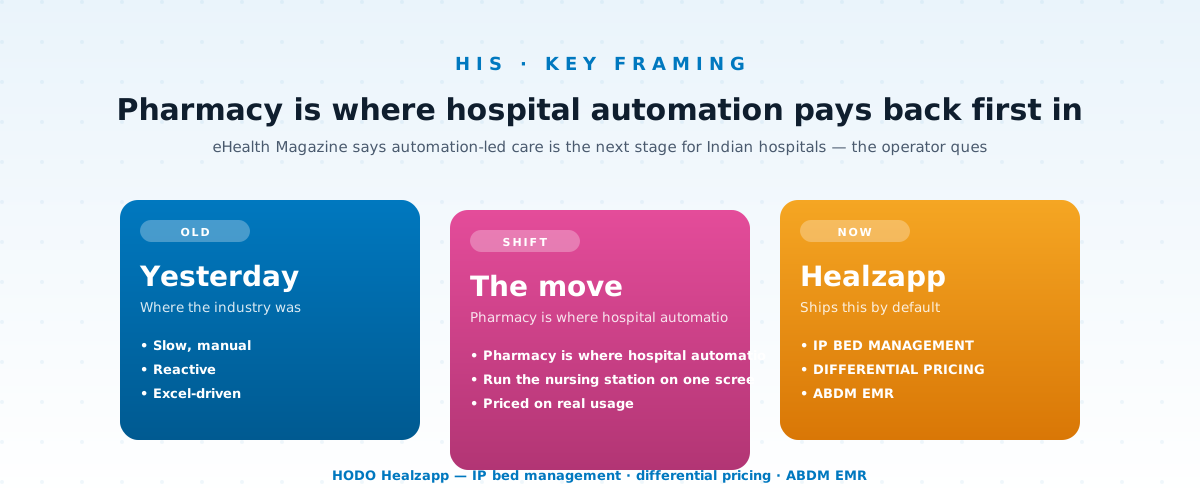
Pharmacy is the most common first project because the loss is measurable. In an average 200-bed hospital, expired-stock write-offs, uncharged IP dispenses, and manual reorder cycles routinely take 3-6 per cent off pharmacy revenue. An automated pharmacy layer inside the HIS closes this by tying every dispense to a specific IP or OP encounter, moving stock in real time, and blocking discharge until the pharmacy line is reconciled.
The operational benefit is not just financial. Consultants stop chasing nurses for stock, nurses stop chasing pharmacists for delivery, and the discharge lounge stops holding up beds because the pharmacy bill is unclear. For groups running multiple outlets, a single pharmacy master with per-centre pricing — so a tier-2 branch can price differently from the flagship without a parallel system — is what makes the model repeatable rather than a one-off flagship success.
The report is right that pharmacy is the wedge, but operators should push further: pharmacy without inventory-level barcoding and expiry-date automation is still a manual process wearing a digital coat.
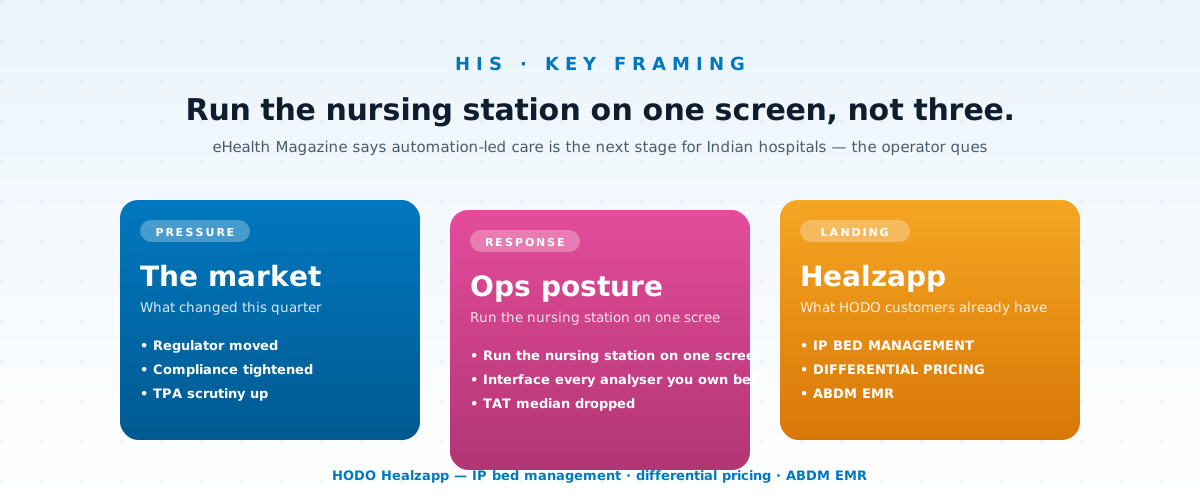
The nursing station is where every hospital's automation strategy either delivers or collapses. If the nurse has to open three screens to record vitals, raise a lab order, and confseam a drug administration, the automation project has failed regardless of what the boardroom slides say. The eHealth piece flags this indirectly by pointing to the role of unified digital workflows.
The practical fix is a nursing station module that reads directly from the admitting encounter, pushes charges to billing without a separate entry, and closes the loop with pharmacy and diagnostics on the same screen. For a 200-bed facility, moving nurses from paper-plus-screens to a single-screen flow typically returns 30-40 minutes per nurse per shift — time that either goes back to patient care or lets the facility hold headcount flat while volume grows.
The compliance angle is separate but reinforcing. ABDM-compliant EMR requires structured entries; a nursing station running on free text cannot feed a compliant record without a manual clean-up shift.
Machine interfacing — connecting haematology analysers, biochem lines, ECGs, and imaging modalities directly to the patient record — is the least glamorous piece of the automation stack and the one with the highest silent return. Every result that a technician does not have to key in is a TAT gap closed, a transcription error avoided, and a technician-hour redirected to actual bench work.
For diagnostic chains, this is existential. A pathology chain that still keys results manually cannot compete on TAT against one that streams results the moment the analyser posts them. For hospitals, the effect shows up in ER and IP TAT: consultants see results without waiting for the ward clerk to type them in, and that shows up in length-of-stay data within a quarter.
Operators should ask vendors two specific questions: how many analyser makes and models are already interfaced (not "interface-able"), and what the failure recovery flow looks like when the analyser drops a message. Vendors that cannot answer both cleanly are selling a demo, not a deployment.
The eHealth piece treats automation as a single-hospital story, but the more interesting operator question is how to repeat it across ten outlets. Groups scaling from three to ten centres typically discover that their first HIS deployment was hand-crafted — masters, workflows, and integrations built for one site — and cannot be cloned without a fresh implementation project each time.
The alternative is a HIS designed for multi-outlet from the start: shared masters, per-centre pricing, per-centre GST and Tally posting, and a template-driven new-centre setup that inherits the group configuration. This is the difference between opening a new outlet in four weeks and opening one in four months.
For diagnostic and pathology chains, the same logic applies to franchisee and partner-lab onboarding: automated barcoding, anonymised sample tracking, and a partner portal are what let a chain add a collection centre without adding a coordinator to manage it.
The eHealth report validates a direction HODO customers have been on for several years, and it sharpens the priority list for administrators reviewing their next twelve months.
Hospitals running HODO Healzapp already have the Pharmacy, Inventory, and Nursing Station running on a single record. The immediate opportunity is to tighten Machine Interfacing across the analysers and imaging kit that still post results by hand, because that is where the TAT and error saving is largest. Groups planning new outlets in the current financial year should audit whether their masters are structured for Multi-outlet scale-up with one-click new-centre setup — this is what decides whether the next branch opens in weeks or months.
See how Healzapp handles this — book a 30-min demo.
See how Healzapp, Labzapp and EReazy fit your speciality in a free 30-minute demo.
Book a Free Demo