Digital Health News reports that the government is planning an AI-led upgrade of Ayushman Bharat, covering both claims processing and digital health records. For the ~100-bed hospitals that carry PMJAY volume on thin working capital, this is not a policy story — it is a billing-desk story. When adjudication moves from a human scrutiny queue to software that reads structured fields, the hospital with clean records gets paid first and the hospital with scanned attachments waits.
What an AI-led claims engine actually reads
The reported plan has two halves: automation in claims processing, and a stronger digital health records backbone. The claims half bites first, because adjudication logic that today sits with human scrutinisers and TPA desks gets encoded into software. Software does not interpret a scanned discharge summary with a handwritten addendum. It reads fields — package code, diagnosis code, admission and discharge timestamps, procedure details, investigation results, implant particulars, length of stay measured against the package norm.
That quietly changes what a complete claim means. A hospital clearing claims today on the strength of a good relationship with the district office, or on a resubmission cycle where someone physically walks the file across, loses that buffer. The claim either carries machine-readable evidence or it gets flagged. And flagged claims in an automated queue do not sit politely waiting for a visit — they generate a query, a response clock, and an auto-rejection when that window closes. Hospitals that treat query response as a weekly chore rather than a daily one will see their rejection ratio climb for reasons that have nothing to do with the quality of care delivered.
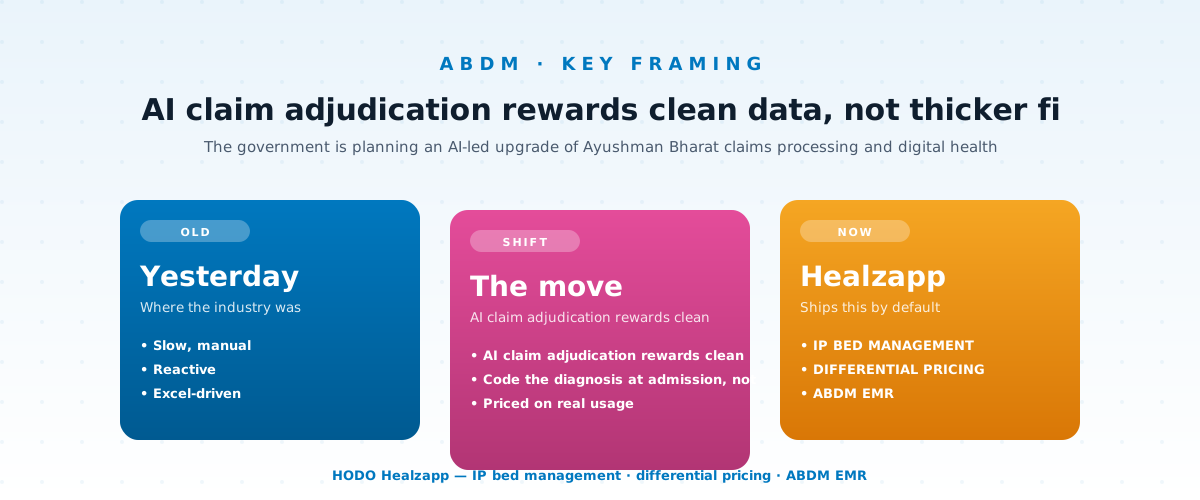
AI claim adjudication rewards clean data, not thicker files.
Rejection is a data problem, not a paperwork problem
Most 100-bed hospitals can recite their rejection reasons from memory: package mismatch, missing pre-authorisation evidence, investigation report not attached, diagnosis not supporting the procedure claimed, stay longer than the package allows without justification. Every one of those is a data-capture failure that happened days before the claim was filed, usually at a point where nobody was thinking about claims at all.
The pattern is consistent. The diagnosis gets coded at discharge, by a billing executive reconstructing the case from case sheets, instead of at admission by the treating unit. Lab and imaging results live in the lab's own register or on a machine printout, and get photographed into the claim later. Consumables and implants get entered in pharmacy and inventory but never link back to the specific episode. The claim is then assembled rather than generated, and assembly introduces exactly the inconsistencies an automated adjudicator is built to catch.
The operational shift is to stop treating the claim as a document produced at the end and start treating it as a by-product of the episode record. If the diagnosis, the orders, the results and the billed items all sit against one patient episode, the claim writes itself and survives scrutiny. If they sit in four systems, somebody will keep stitching, and software will keep rejecting.
The records half of the upgrade is the harder half
The digital health records component is where the longer-term exposure sits. ABDM-linked records are not a compliance badge to be collected once; they are the format in which the scheme will increasingly expect clinical evidence to arrive. A hospital whose EMR captures structured diagnoses, orders, results and discharge summaries can answer an automated query in minutes. A hospital running a paper case sheet with a thin digital billing layer on top cannot, no matter how many staff it throws at the problem.
This is also where HIS replacement decisions get forced. Many hospitals are running a billing-first system purchased years ago, with EMR bolted on and clinical adoption stuck at the front desk. That architecture was survivable while claims were adjudicated by people. It stops being survivable when the payer reads fields. The practical test for any existing system is simple: can it produce, for a randomly chosen PMJAY discharge from last month, a complete structured record with coded diagnosis, linked investigation results and itemised billing, without anyone opening a scanner? Most incumbents fail that test, and the failure is architectural rather than a configuration gap.
Cashflow arithmetic at a hundred beds
Consider a 100-bed hospital with 55 per cent of inpatient revenue coming through PMJAY and state schemes — a common enough mix in tier-2 and tier-3 India. At an average package realisation of ₹28,000 and 180 scheme discharges a month, that is roughly ₹50 lakh of monthly scheme billing. A rejection-plus-resubmission rate of 18 per cent, with each cycle adding 35–45 days, parks something close to ₹90 lakh in ageing receivables on a permanent rolling basis. That is salary runway, that is the CT upgrade deferred, that is the overdraft interest nobody budgets for.
Automated adjudication can cut both ways on that number. Clean claims should settle faster than they do today, because the human queue disappears. Dirty claims will fail faster and more completely, because there is no discretion in the loop. The spread between the two outcomes is where the next two years of hospital cashflow will be decided, and it is decided by data discipline at the ward and lab level rather than by anything the finance team does at month-end.
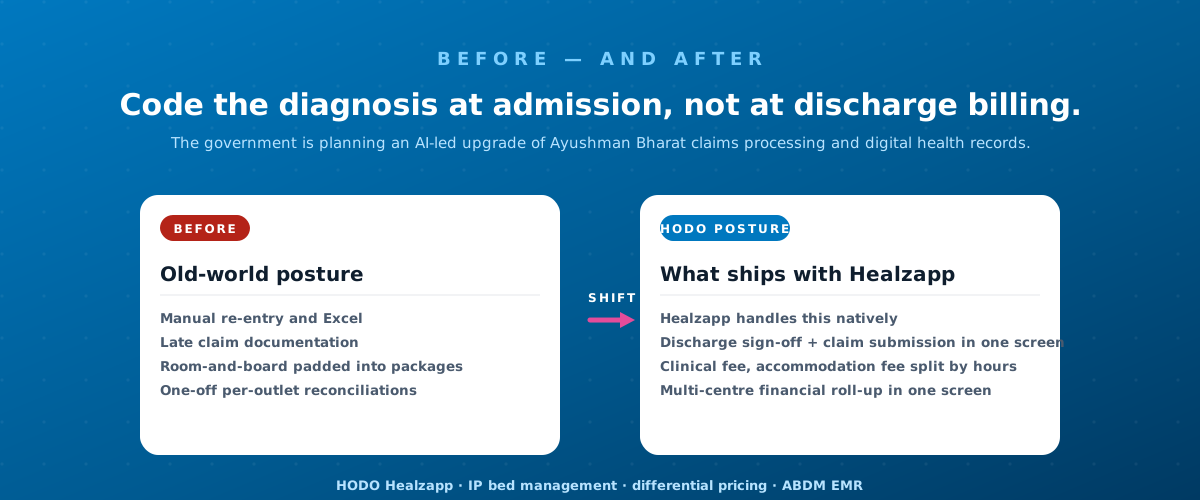
Code the diagnosis at admission, not at discharge billing.
A fix list for the next two quarters
Four moves are worth sequencing now, before the upgrade lands. First, move diagnosis coding upstream — the treating unit codes at admission and at any change in plan, not the billing desk at discharge. Second, close the gap between the lab or imaging machine and the patient record, so results land against the episode automatically instead of being keyed in or attached as images. Third, instrument the rejection data: a weekly report of rejection reason by package, by consultant and by coder turns a vague complaint into three fixable processes. Fourth, reconcile scheme receivables against the accounting ledger every week, not every quarter, so ageing is visible while it can still be acted upon.
None of this requires waiting for the government to publish the technical specification. Every one of these fixes pays for itself under the current manual regime too — the AI upgrade only raises the penalty for not doing them.
What this means for HODO customers
Healzapp was built around the assumption that the claim should fall out of the record rather than be reassembled from it. ABDM-compliant EMR keeps diagnoses, orders, results and discharge summaries in the structured form that an automated adjudicator can read, which is also the form an ABDM-linked record requires. EMR (AI-condensed history) gives the consultant and the coder the same condensed view of a long case, so what gets coded matches what was actually treated. Billing keeps scheme and cash patients on one ledger with the episode intact, and Tally integration pushes the receivables position into accounts weekly rather than at year-end, so ageing scheme claims stay visible.
The hospitals that come through this upgrade comfortably will not be the ones with the biggest billing teams. They will be the ones whose records were already clean enough that automation became an advantage.