
Business Today reports that Ayushman Bharat is being set up for an AI overhaul — faster claim processing, automated fraud detection and a stronger push on digital medical records. For the empanelled ~100-bed hospital, this is not a policy abstraction: it changes which claims get paid quickly, which get flagged, and how much of your documentation has to be machine-readable rather than scanned and uploaded at the end of the month.
The operational reading is simple. When a payer automates adjudication, the hospitals that get paid fastest are the ones whose data is already structured at the point of care. Everyone else waits in the query queue.
Hospital finance teams have spent years treating PMJAY receivables as a slow, semi-predictable trickle — 45 to 90 days, with a tail of queried claims that nobody really owns. An AI-assisted adjudication layer compresses the good cases and sharpens the bad ones. A clean claim with complete discharge documentation, correct package mapping and matching investigation records can clear considerably faster. A claim with a mismatch between the package billed and the procedure documented will now be caught in days, not quarters.
That changes the economics of sloppiness. Today a 100-bed hospital can absorb a 6–8 per cent query rate because the delay is averaged into a long receivables cycle anyway. Once the clean claims accelerate, the queried ones stand out as a visible, quantifiable working-capital drag. If 70 per cent of your PMJAY value settles in two weeks and 30 per cent sits unresolved for 90 days, the finance team can no longer hide behind a blended DSO number — and neither can the billing desk.
The practical step is to start measuring query rate by cause, not just by volume. Missing investigation report. Package-to-procedure mismatch. Incomplete discharge summary. Missing pre-authorisation attachment. Wrong admission or discharge timestamp. Four or five buckets will typically explain most of the backlog, and each one maps to a specific desk in the hospital — not to a vague instruction to "be more careful with claims".
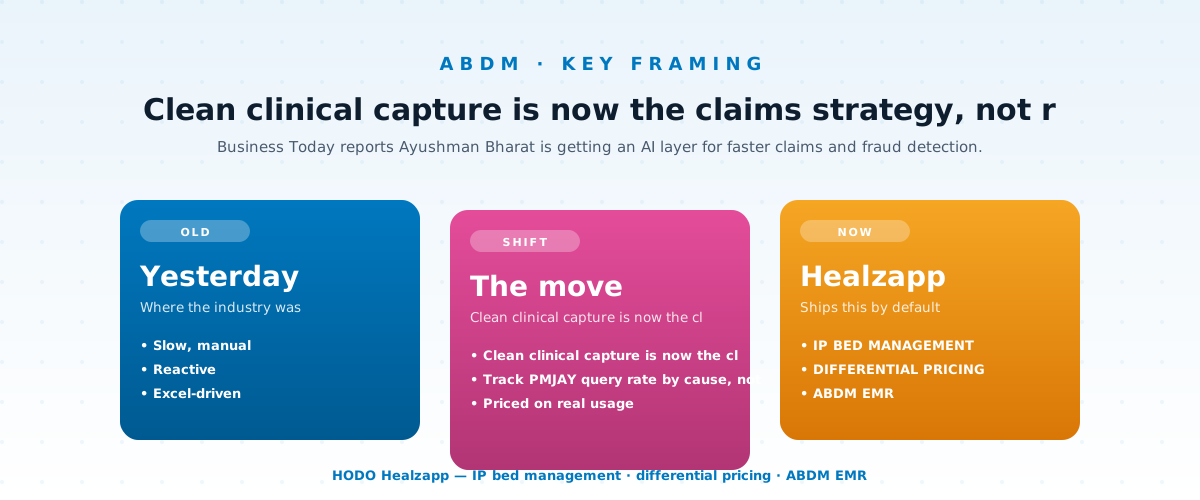
Automated fraud detection does not only look for deliberate abuse. It looks for patterns: unusual length-of-stay distributions, repeated high-value packages from a single empanelled centre, admissions that look clinically thin, investigation orders that do not match the diagnosis billed. Many legitimate hospitals will trip these filters simply because their records are weak — a discharge summary written three days late from memory, nursing notes that do not support the recorded stay, or a bed occupancy register that disagrees with the billed IP days.
The defence is not advocacy. It is a contemporaneous record. If the IP episode in your system shows admission time, bed and ward assignment, nursing entries across each shift, the OT note, the drugs issued from pharmacy against that episode, and the lab results that triggered each clinical decision — then a flag becomes a short clarification rather than a recovery notice.
This is where the quality of the HIS matters more than the quality of the claims executive. A system where IP bed management, Nursing Station entries, OT records, Pharmacy issue and lab results all hang off one patient episode produces a defensible audit trail by default. A system where each of those lives in a separate register or spreadsheet produces a reconstruction exercise every time a query lands. Hospitals running three or four disconnected modules plus manual registers should assume that reconstruction cost is about to rise.
ABDM-linked digital medical records have been treated by many hospitals as a registration exercise — get the facility ID, link ABHA numbers, generate the occasional health record, move on. If claims adjudication starts consuming structured clinical data directly, the record becomes the claim's supporting document rather than a parallel compliance artefact.
That has a workflow consequence. The clinical note cannot be a free-text blob typed at discharge. Diagnosis coding, procedure capture, investigation linkage and discharge summary generation have to happen inside the clinical workflow, as the episode progresses. Hospitals that have invested in structured EMR capture will find the transition mostly administrative. Hospitals still running paper case sheets with a data-entry operator transcribing at discharge are looking at a genuine redesign of how doctors and nurses record work.
The pragmatic sequencing matters here. Start with the highest-volume PMJAY packages — typically five to ten procedures covering the bulk of claim value — and make the record complete and structured for those first. Trying to digitise every speciality at once is how two-year HIS projects die.
In most empanelled hospitals the weakest join is between the clinical episode and the supporting services. Lab results arrive as PDFs that someone attaches manually. Pharmacy issues are billed at the counter without a hard link to the IP episode. Radiology reports sit in a separate folder. Each of these gaps becomes a query risk once adjudication is automated, because the payer can now check whether the investigations billed actually produced results.
Machine interfacing on analysers matters for exactly this reason — not merely for TAT, but because a result that flows from analyser to report to patient episode without manual re-entry is a result that reconciles cleanly. The same logic applies to pharmacy and consumables: issues posted against the IP episode reconcile with the package; issues posted against a counter bill do not. For hospitals running an in-house lab plus outsourced tests, partner-lab and outsource-lab routing needs to leave a trace that ties back to the ordering episode.
Hospital groups running multiple outlets should also watch for divergence. One centre with disciplined package mapping and another with ad-hoc billing will show up as an outlier pattern at the group level — and fraud filters typically score the empanelment, not the individual branch.
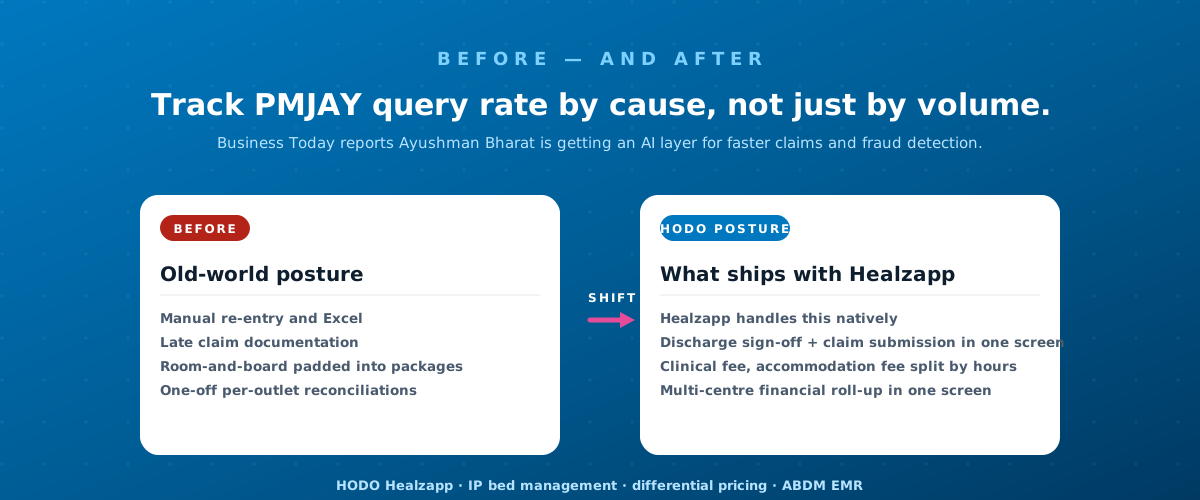
The shift is from claims as a back-office reconciliation job to claims as a by-product of clean clinical capture. That is a systems problem, not a staffing problem. ABDM-compliant EMR keeps the clinical record structured and linkable from the point of care rather than reconstructed at discharge, so a payer query is answered from the record instead of from memory. IP bed management and Nursing Station hold the contemporaneous occupancy and shift-level trail that supports billed IP days when a length-of-stay pattern gets flagged. Machine Interfacing closes the gap between analyser output and the patient episode, so investigations billed are investigations evidenced. And for groups adding centres, Multi-outlet scale-up with one-click new-centre setup keeps package mapping and billing discipline consistent across branches instead of letting each outlet invent its own practice.
See how Healzapp handles this — book a 30-min demo.
See how Healzapp, Labzapp and EReazy fit your speciality in a free 30-minute demo.
Book a Free Demo