A NITI Aayog member has argued that the data accumulating under Ayushman Bharat could transform how India plans, prices and delivers healthcare, NDTV reports. At national scale the argument holds — claims, diagnoses and utilisation patterns across crores of episodes are a genuine planning asset. The part that rarely gets said in the same breath is that every row in that dataset is typed by a registration clerk, a nurse or a lab technician in a 100-bed hospital, and the quality of the national picture is capped by the quality of that keystroke.
What the argument actually asks of a hospital
Policy conversations about health data usually sound like an infrastructure question — registries, exchanges, consent managers, interoperability standards. For a hospital in Kozhikode or Indore it is an operational question with a cost attached. Someone has to capture the ABHA number at the counter without adding ninety seconds to each registration. Someone has to make sure the diagnosis recorded at discharge is a coded, consistent value rather than free text that varies by consultant. Someone has to ensure the lab result that went out as a PDF on WhatsApp also exists inside the record as structured fields.
None of that is new work invented by the digital mission. It is the same documentation discipline that NABH assessors, TPA claim processors and PMJAY auditors have been asking for separately for years, now converging on one record. The hospitals that treat it as a compliance chore will keep doing it three times — once for the accreditation file, once for the claim, once for the health record. The ones that treat it as a single data pipeline do it once and reuse the output.
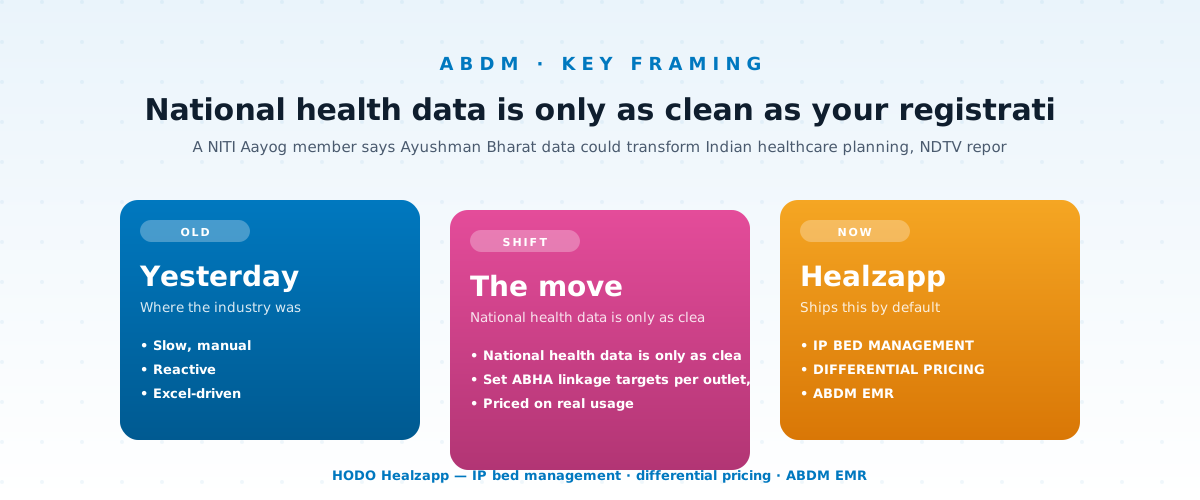
National health data is only as clean as your registration counter.
The record is created at the front desk, not in the cloud
Data quality in a hospital is overwhelmingly a registration problem. Duplicate patient records are the most common defect: the same person registered as three UHIDs across OP, IP and the lab because the mobile number was mistyped, or because a walk-in at the collection centre never got matched to the hospital file. Every duplicate breaks longitudinal history, inflates unique-patient counts, and quietly ruins any attempt to measure repeat visits or follow-up compliance.
The second defect is identifier drift. ABHA numbers captured on paper and entered later. Numbers captured for OP but not carried into IP admission, or captured at the main hospital but not at satellite collection points running a separate register. For a chain, this is where the dataset silently fragments — the central MIS looks healthy while branch-level linkage sits below forty per cent.
The fix is unglamorous and entirely procedural. Make ABHA capture part of the registration screen rather than a separate step. Enforce mobile-number verification at first contact so the deduplication logic has something reliable to match on. Run a weekly duplicate-merge review rather than an annual clean-up. And set linkage targets per outlet, not for the organisation as a whole, because an organisation-level average hides exactly the outlet that is failing.
A hospital that does these four things has a usable internal dataset within a quarter. One that does not will still file its reports, but the reports will describe a patient population that does not exist.
Structured results beat scanned PDFs
The weakest link in most Indian hospital and lab datasets is the result itself. A haematology analyser produces numeric values; a technician reads the printout and retypes them; the report is generated as a PDF; the PDF is the record. The numbers are present but not computable. Nothing downstream can trend haemoglobin across three visits, flag an abnormal creatinine against the previous value, or feed a referral analysis on which doctor orders which panel.
Direct instrument integration removes both the transcription error and the structural loss. Values arrive as fields, against a barcoded sample, with a timestamp that makes turnaround time measurable rather than estimated. For a lab running 400 to 1,200 tests a day across a hospital and its collection centres, that single change usually improves three things at once — error rate, TAT visibility and report dispatch speed — because the same structured record drives the automated SMS or WhatsApp delivery.
It also changes what the clinical record can do. An EMR that holds discrete values can condense a patient's history into something a consultant reads in thirty seconds before an OP consultation, instead of a stack of attachments nobody opens during a twelve-minute slot. The operational gain is consultation throughput; the data gain is a record that is actually worth contributing to any exchange.
Four numbers worth putting on a weekly sheet
Hospitals that get value from their own data tend to monitor a small, boring set of indicators. First, ABHA linkage rate per outlet — share of registrations with a verified identifier, reviewed branch by branch. Second, duplicate record rate — new UHIDs created for patients who already exist, which should trend below two per cent once mobile verification is enforced. Third, structured-result share — proportion of lab and radiology outputs stored as fields rather than only as documents. Fourth, discharge summary completion within 24 hours, which is the single best proxy for whether clinical documentation is happening at the point of care or being reconstructed later for a claim.
These four are deliberately chosen because each one has a named owner. Linkage belongs to the front-office supervisor. Duplicates belong to the medical records officer. Structured results belong to the lab in-charge. Discharge summaries belong to the consultants and the IP nursing station. Data quality collapses when it is assigned to "IT", because IT cannot type a diagnosis.
Review them weekly, in the same meeting where occupancy and collections are reviewed. A hospital that reports occupancy daily and data quality annually has already decided which one it cares about.
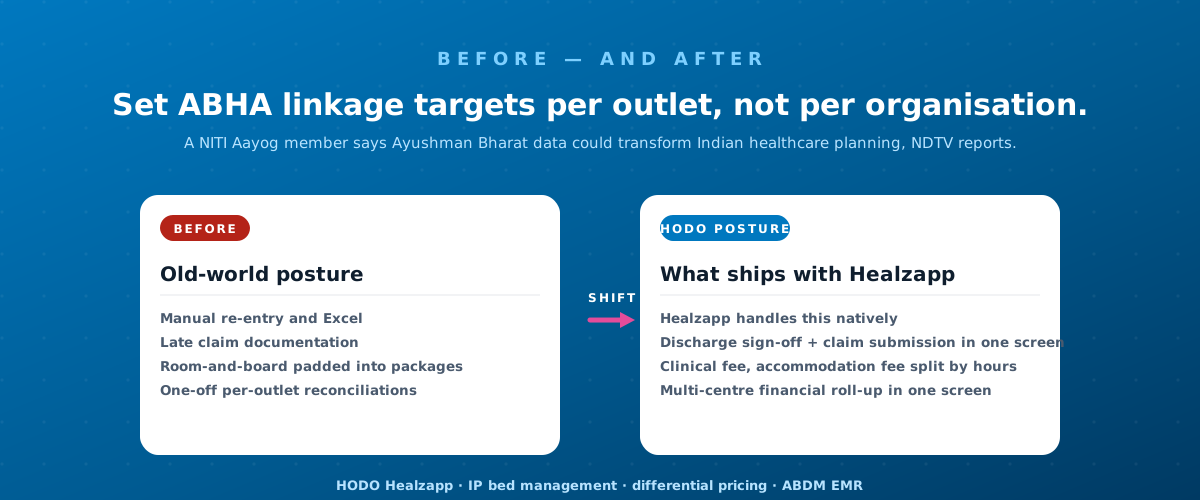
Set ABHA linkage targets per outlet, not per organisation.
What the hospital gets back before the national layer does
The return on this work is local and fairly quick. Clean patient identity makes repeat-visit and referral analysis possible, which is how an OP department finds out that a third of its diabetic patients never return for the second review. Structured results make TAT and cost-per-test defensible rather than anecdotal, which matters in every rate negotiation with a corporate client or TPA. Complete discharge documentation shortens claim cycles, because most PMJAY and TPA rejections are documentation failures rather than clinical disputes — and shorter claim cycles are cash, not compliance.
For multi-outlet groups there is a further gain. A clean, consistently structured dataset is what makes a new centre comparable to an existing one from the first month, instead of after a year of reconciling two different ways of recording the same event. Standardisation at setup is cheaper than harmonisation later.
The NITI Aayog framing will be read as a policy signal about where reporting obligations are heading. Read operationally, it is a reminder that the asset is produced locally, and the hospital generating it gets first access.
What this means for HODO customers
Data quality is a workflow property, not a reporting feature — it is decided by what the registration screen enforces, what the analyser sends and what the discharge process requires. ABDM-compliant EMR keeps identifier capture and record structure inside the normal registration and clinical flow rather than as a parallel compliance task. Machine Interfacing pulls analyser values in as discrete fields against barcoded samples, so turnaround time and result trends are measurable and report dispatch is automatic. EMR (AI-condensed history) turns that accumulated structured record into a usable summary at the point of consultation, and Multi-outlet scale-up with one-click new-centre setup carries the same masters and workflows to every new centre so a chain's data stays comparable as it grows.