The National Health Authority has de-empanelled 2,359 hospitals under Ayushman Bharat PM-JAY for scheme violations, according to MillenniumPost citing NHA data. For any hospital owner running PMJAY volumes, the takeaway is direct: claims documentation, billing hygiene, and audit trails have moved from a back-office task to an enforcement priority.
What the NHA action actually says
The 2,359 figure is not a warning list, these hospitals have been struck off the empanelled network, with over a thousand more suspended and penalties running past ₹122 crore. The grounds cited by NHA include package upcoding, ghost billing (procedures billed without a real admission), unbundling (splitting a single package into multiple claims), and admissions inconsistent with clinical need. Fraud analytics run by NHA now cross-check TMS data with beneficiary Aadhaar, hospital claim history, and geo-tagged patient photographs at admission. A hospital that clears the empanelment audit at Day 1 can still lose it on a quarterly review if the claim pattern shifts. For an owner, this is not a distant policy story. If a facility does 200 PMJAY cases a month at an average package of ₹28,000, that is roughly ₹67 lakh a quarter of receivables sitting at risk of clawback the moment a flag is raised. And clawback lands before appeals conclude, which is the part most CFOs underestimate.
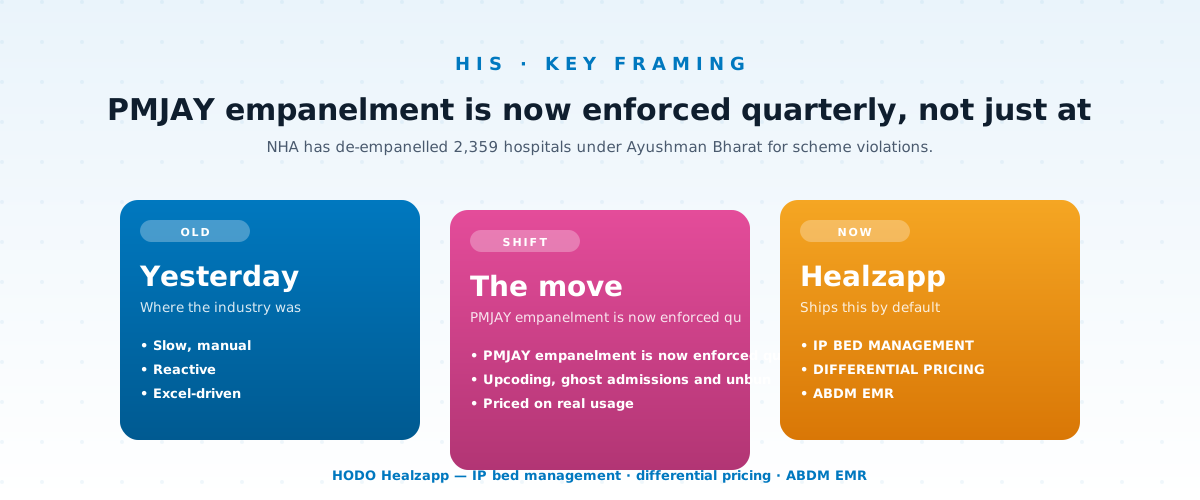
PMJAY empanelment is now enforced quarterly, not just at onboarding.
The three violations doing most of the damage
Reading the pattern across NHA case notes, three violations account for the bulk of de-empanelments. First, package upcoding, billing an ICU stay when the patient never left ward, or coding a higher-tier surgical package than what was performed. Second, ghost admissions, a claim is filed but there is no verifiable IP entry, no nursing notes, and no discharge summary matching the billed procedure. Third, unbundling, a joint replacement is split into pre-op, surgery, and post-op line items across separate claim IDs, inflating the total. All three trace back to a single root cause: a disconnect between what the OT or ward actually recorded and what the billing counter submitted to NHA. When the EMR, IP register, and billing engine sit in three different systems (or three different Excel sheets), the mismatch is not fraud in most cases, it is process debt. But NHA does not distinguish between the two when it de-empanels.
The cashflow shock is bigger than the fine
A de-empanelment penalty is a line item. The receivables freeze is the real hit. Once a hospital is flagged, all pending claims, including clean ones, enter review. For a 150-bed facility with 30-40% PMJAY case mix, this can lock up ₹1.5-2 crore in working capital for 60-90 days. Add reputational fallout in the district, where PMJAY beneficiaries move to competing hospitals, and the effect on the P&L compounds. Owners who have modelled TPA delays for private insurance are often surprised at how much harder a PMJAY freeze hits: private TPAs pay disputed portions and hold back the rest; NHA holds the whole envelope. Which is why the operational answer cannot be “we will get better at appeals.” The answer has to be upstream, making the claim indefensible from the point of admission, not from the point of dispute.
The documentation gap most hospitals still have
Walk into a typical mid-sized Indian hospital and ask for the full case file for a PMJAY patient discharged last week. The admission slip is in the IP register. The clinical notes are in a paper file at the nursing station. The pharmacy indent is in the pharmacy software. The OT note is a scan uploaded to a shared drive. The billing detail sits inside the HIS. The discharge summary is a Word document on the consultant’s laptop. Stitching that into an audit-defensible bundle takes a full day of hunting, and even then, timestamps rarely line up cleanly. NHA auditors, on the other hand, want the bundle in minutes with matching timestamps across systems, and increasingly with an ABHA-linked identity trail. The gap between what hospitals have and what auditors expect is where empanelment gets lost, not in the OT, but in the filing.
Building an audit-ready operation from Day 1
Audit-ready is not a compliance project, it is an operating model. A few practical shifts owners are making after this round of NHA action: one, a single source of truth for the entire encounter (admission, orders, nursing notes, OT, pharmacy, discharge) so that a claim can be reconstructed in one click. Two, coder-in-the-loop billing where the coder cannot submit a package without matching EMR line items and matching IP bed occupancy for the billed duration. Three, automated flags for pattern anomalies, the same package repeated across 60% of a consultant’s cases, LOS below package minimum, missing ICU vitals for an ICU-billed stay, so internal audit catches what NHA analytics will catch anyway. Four, an audit-export function that generates the full patient bundle (clinical, pharmacy, diagnostic, billing, ABDM consent trail) as a single reviewer-ready PDF. None of this is exotic; the hospitals losing empanelment are the ones that still treat each of these as a separate spreadsheet exercise.
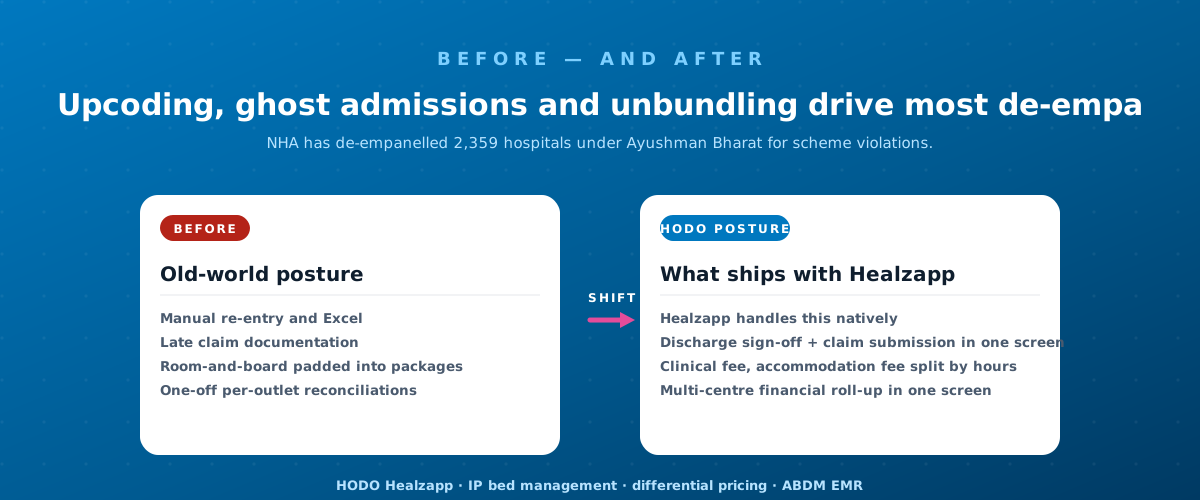
Upcoding, ghost admissions and unbundling drive most de-empanelments.
What this means for HODO customers
For Healzapp deployments, three modules do the heavy lifting on PMJAY defensibility. ABDM-compliant EMR ensures every clinical event carries a timestamp, a consented patient identity, and a linked ABHA reference, so any NHA cross-check against ABDM records lands cleanly instead of flagging a mismatch. Billing is coupled to the EMR line items and to IP bed management, which means a package cannot be billed for a stay that the ward register does not confirm, the two most common de-empanelment triggers, ghost admissions and LOS mismatch, get caught before the claim is submitted rather than after NHA raises it. EMR (AI-condensed history) pulls the full case bundle, admission, nursing, OT, pharmacy, discharge, into a single reviewer-ready summary, so responding to an NHA query stops being a day of file-hunting and becomes a one-click export. For owners running 30%+ PMJAY case mix, these stop being nice-to-haves after this de-empanelment round.