The News Himachal reports that the government has tightened Ayushman Bharat rules for private hospitals, with stricter conditions around empanelment, documentation and the scrutiny of submitted claims under the National Health Authority's framework. For a private ~100-bed hospital, this is not a policy story. It is a working-capital story, because every additional verification step the payer adds lands on the billing desk, the medical records room and the month-end collection figure.
Tighter rules are really tighter evidence requirements
The specifics of each circular vary, but the direction of travel under PMJAY has been consistent for three years now: more pre-authorisation scrutiny, more documentary proof per package, narrower definitions of what may be claimed against which code, and faster consequences — query, hold, suspension, recovery of amounts already paid — when the record does not support the claim. A tightening announcement is best read as a shift in the burden of proof rather than a change in clinical expectation.
That changes the unit of work inside the hospital. The operative question stops being whether the patient was treated correctly and becomes whether the file can defend itself with nobody from the hospital in the room. Most 100-bed hospitals in Tier-2 and Tier-3 India still answer that question with a mix of paper case sheets, a standalone billing module, and one experienced scheme coordinator who knows the portal better than anyone else on the payroll. That arrangement survives a forty-claim month. It does not survive a regime where a meaningful share of claims return with queries, each query carries a clock, and the coordinator is on leave for a week.
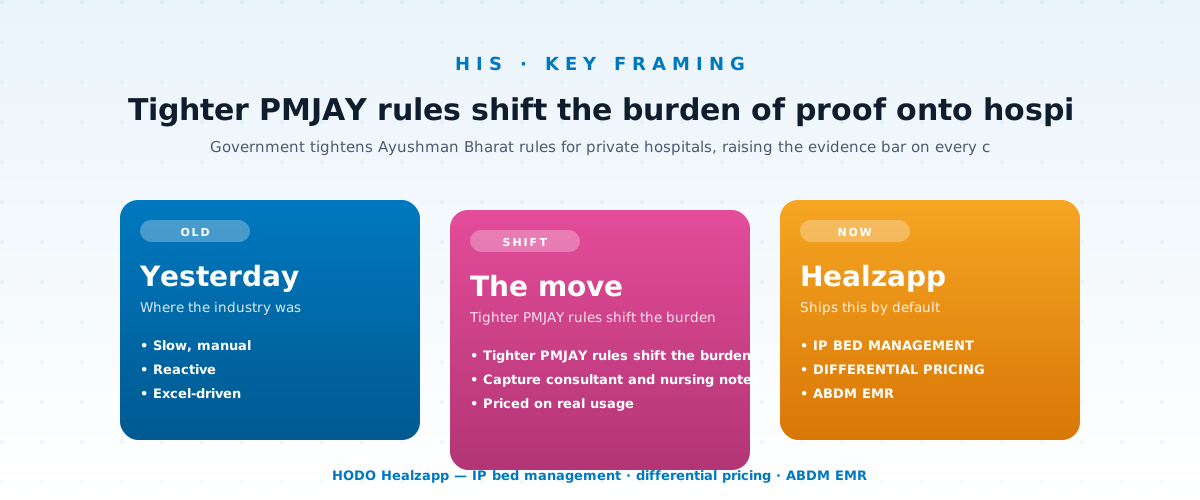
Tighter PMJAY rules shift the burden of proof onto hospitals.
The claims desk becomes a compliance desk
Under stricter scrutiny, the scheme desk changes character. Earlier it was a submission function: assemble, upload, follow up on payment. Now it is a compliance function that has to own three separate pipelines at once — pre-authorisation requests awaiting approval, admitted patients whose documentation must stay current while they are still in the bed, and submitted claims sitting in query or deduction status.
The hospitals that handle this well treat each pipeline as a queue with an owner and an age, not as a pile. A pre-auth older than a defined cut-off gets escalated to the duty medical officer, not left to the coordinator's memory. An admitted scheme patient without a signed consultant note for the day shows up on the nursing station worklist before the shift ends, not at discharge. A claim in query status older than its response window appears on the management review, with the specific missing artefact named.
None of this is exotic software. It is queue discipline applied to a payer relationship. What usually blocks it is that the data lives in three unconnected places: clinical notes on paper, charges in the billing system, and claim status on the payer portal with no reconciliation between the three. Until those three agree automatically, every query response is a manual reconstruction, and manual reconstruction is where the error rate and the deduction rate both live.
Documentation has to be born at the point of care
Retrofitted documentation is the single largest source of deductions. A discharge summary typed forty-eight hours after the patient has gone home will contradict the nursing chart somewhere — a date, a drug, an implant, an investigation that was ordered but never resulted. Under tighter scrutiny, that contradiction is no longer a minor inconsistency. It is grounds for a query, and repeated queries build a pattern that gets a hospital flagged.
The fix is structural: capture the record where and when care happens. Consultant notes entered on the ward round rather than reconstructed later. Nursing observations timestamped at the bedside. Investigation results arriving directly from the analyser instead of being transcribed from a printout. Pharmacy and consumable issues tied to the patient and the episode at the point of issue, so the bill and the clinical story cannot drift apart.
This also fixes the second problem that stricter rules expose — package-to-charge mapping. When the clinical record, the investigation set and the pharmacy issue sit in one episode, the hospital can see before submission whether what was done matches what is being claimed, and whether a differently coded package would have been both accurate and better reimbursed. Doing that check before submission costs minutes. Doing it after a deduction costs a quarter.
Run the cashflow maths before the quarter, not after
Tighter scrutiny lengthens the claim cycle even for clean files, because more claims get touched by a human at the payer end. For a 100-bed hospital where scheme patients occupy a substantial share of beds, a two-week extension in average realisation time is a serious cash event — salaries, consumable purchases and consultant payouts do not stretch to match.
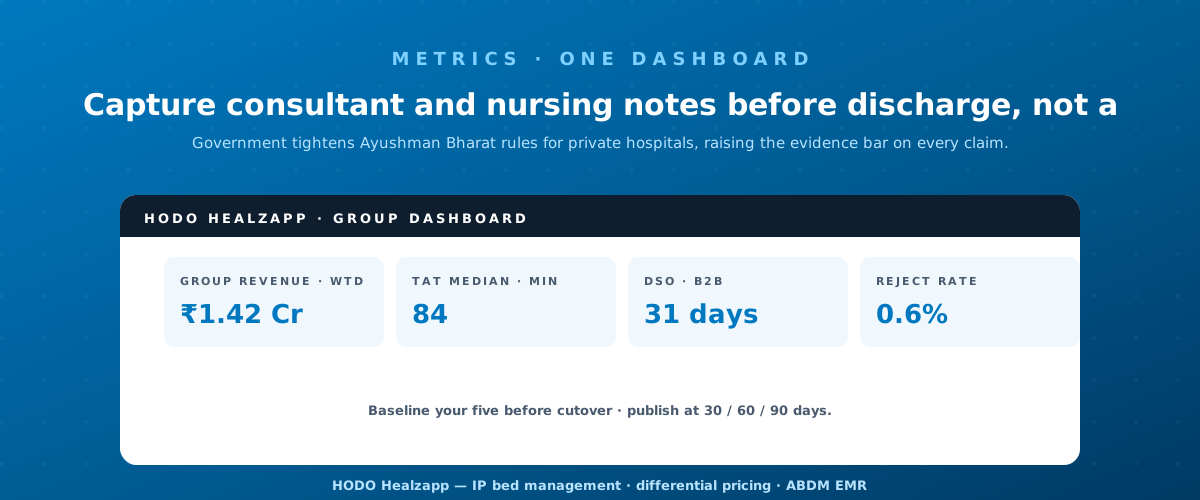
Three numbers deserve a permanent place on the management dashboard. First, claim ageing by bucket — submitted, in query, approved-unpaid, deducted — because an aggregate receivable figure hides the one bucket that is actually growing. Second, deduction rate by department and by package, which almost always concentrates in two or three specialties rather than spreading evenly. Third, realisation per occupied bed-day for scheme patients against cash and insurance patients, which is the only honest way to decide how much capacity to commit to the scheme.
That third number is where most operators are flying blind. Scheme cases absorb bed-days, OT slots and nursing hours at the same cost as any other case, but with a fixed package rate and a slower, now less certain, payment. Knowing the true figure by specialty lets a hospital make a deliberate case-mix decision rather than discovering the answer in an overdraft. It also informs differential pricing policy across payers, corporates and cash patients.
Capture consultant and nursing notes before discharge, not after.
Empanelment is an operational risk, not a certificate
The part of a tightening cycle that operators underrate is continuity of empanelment itself. Conditions typically extend beyond claims into infrastructure, manpower availability, equipment upkeep and display and record-keeping obligations — the same ground NABH inspections cover. A hospital can have an excellent clinical reputation and still get flagged because a biomedical service record was not retrievable, a mandatory register was incomplete, or staffing against a declared specialty could not be evidenced on the day of inspection.
Treat the empanelment file the way a finance team treats a statutory audit file: a live, owned, retrievable set of records rather than an annual scramble. Equipment service history, calibration status and warranty position should be queryable in seconds. Specialty-wise consultant availability should be derivable from the actual duty roster, not from a declaration made two years ago. Patient-facing obligations — rate display, grievance routing, discharge documentation handed to the patient — should be verifiable by sampling rather than by assumption. The hospitals that lose empanelment rarely lose it on clinical quality. They lose it on retrievability.
What this means for HODO customers
Stricter scheme rules reward hospitals whose clinical record, charges and asset history already live in one system. In HODO Healzapp, the ABDM-compliant EMR keeps the clinical narrative structured and timestamped at the point of care, so a discharge summary is assembled from what was actually recorded rather than reconstructed from memory, and EMR (AI-condensed history) shortens the time a consultant spends reading a long file before signing the day's note. IP bed management and the Nursing Station worklist make incomplete documentation on an admitted scheme patient visible while the patient is still in the bed, which is the only point at which it is cheap to fix. On the money side, Billing with Differential pricing keeps package rates, corporate rates and cash rates separate and auditable, while Warranty+AMC asset tracking turns equipment upkeep evidence into a query rather than a hunt through a drawer. Machine Interfacing closes the last transcription gap by pulling results straight into the episode.