Dainik Jagran MP CG reports that Chhattisgarh authorities have raided more than 100 hospitals over Ayushman Bharat claims, examining admission records, package billing and supporting patient documentation at empanelled private facilities. For a 100-bed hospital carrying a large PMJAY book, the real headline is not the fraud allegation. It is the reminder that a scheme claim is only as strong as the record sitting behind it, and that state anti-fraud units now read hospital documentation the way an auditor reads a ledger.
What the Chhattisgarh action actually targets
State anti-fraud units do not pick hospitals at random. The flags that pull a facility into a sweep are statistical and fairly boring: an average length of stay that sits two days above peers for the same package, a sudden concentration of high-value surgical packages in a single month, admissions billed as inpatient where no matching diagnostics or pharmacy consumption exists, and beneficiaries who, when telephoned by a verification cell, do not recall being admitted at all.
The powers available to a State Health Agency are broad. Desk audit of submitted claims, medical audit by an empanelled clinician, a field visit to the ward, recovery of amounts already paid, penalty, suspension of empanelment and, in serious matters, an FIR. The operational problem for an honest hospital is that the same sweep catches facilities whose treatment was entirely genuine but whose paperwork cannot prove it. A ward that treated the patient correctly and recorded it on loose sheets looks, to an auditor, much like a ward that billed for a bed nobody occupied. Being clean is necessary. Being able to demonstrate it on demand, fourteen months later, is what decides whether the claim money stays with the hospital.
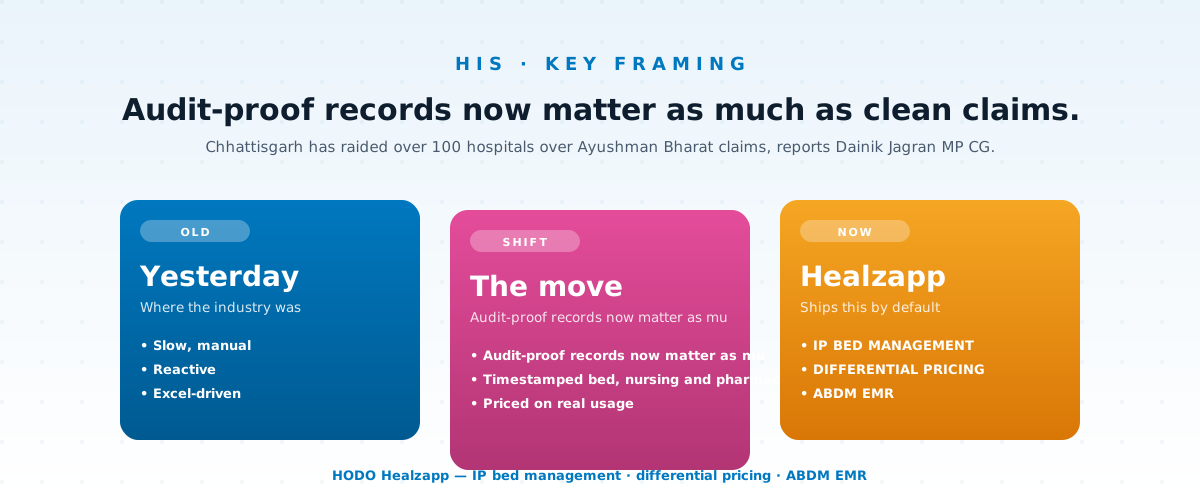
Audit-proof records now matter as much as clean claims.
The audit trail most hospitals cannot produce
Ask a typical 100-bed hospital to reconstruct one PMJAY admission from the previous financial year and the exercise usually touches five disconnected places. The bed register sits in a ward almirah, maintained in pencil. Nursing notes and the medication chart are in a physical case file, retrieved from medical records if the file has not already been borrowed by a consultant. Billing and the claim submission sit in the HIS. Lab reports live in separate laboratory software. Pharmacy issue slips sit in a fourth system or a bound book. Stitching these into one coherent narrative takes a clerk a full day per claim, and a desk audit rarely asks for one claim.
What an auditor is really testing is time. Did this patient occupy a bed for the number of nights claimed? Were drugs and consumables issued against those nights? Were investigations performed during the stay rather than before admission or after discharge? Paper cannot answer this convincingly, because paper has no reliable timestamp. Worse, the usual defensive reflex makes things worse: when a notice arrives, wards reconstruct missing notes. An audit trail where every nursing entry for a four-day stay was created on the discharge date is more damaging than a gap would have been. Records that are captured as events happen, with the system recording who entered what and when, are the only version that survives scrutiny.
Bed, nursing and pharmacy: where the proof actually lives
Claim defensibility is built in the ward, not in the billing counter. Four operational records carry most of the weight.
Admission, transfer and discharge events, recorded against a specific bed with timestamps, produce an occupancy ledger. That ledger is the single strongest answer to a disputed length of stay, and it also tells the hospital its real occupancy rather than the figure the ward reports at the morning meeting. Second, nursing observations, vitals, medication administration, procedure notes, entered at the bedside at the time of the event. A medication administration record that aligns with pharmacy issue timings is corroboration that no retrospective exercise can fabricate. Third, consumption. Drugs and consumables issued against the inpatient episode, drawn down from stock, create a second independent trail: an implant billed in a package should appear as a stock movement with a batch number. Fourth, diagnostics. Results pushed directly from analysers carry the device identity and the run time, which is far harder to dispute than a typed value on a letterhead.
None of this is extra work if the ward already records it. The difference is whether the record is captured once, at the point of care, or reassembled under pressure a year later.
Package selection is where honest hospitals slip
A good share of recovery notices come not from invented admissions but from package choice. PMJAY tariffs, TPA tariffs and cash rates are three different price lists for the same procedure, and billing staff under throughput pressure tend to pick the nearest-looking package rather than the correct one. Repeated across a quarter, an innocent habit reads as upcoding in an audit sample.
Two disciplines reduce this. First, keep tariffs structurally separate so a scheme patient cannot be billed on a cash rate list or the other way round, and so the scheme rate applied to each line is visible to the person raising the bill. Differential pricing by payer is a configuration question, not a clerical one. Second, insist that the clinical justification for the package is written in the record at the point of care, by the treating consultant, and that it matches what went into pre-authorisation. The commonest audit finding in scheme claims is internal inconsistency: a pre-auth that cites one diagnosis, progress notes that describe another condition, and a discharge summary that names a third. A condensed, readable clinical history for the episode, one that the consultant can check in under a minute before signing the discharge summary, closes most of that gap.
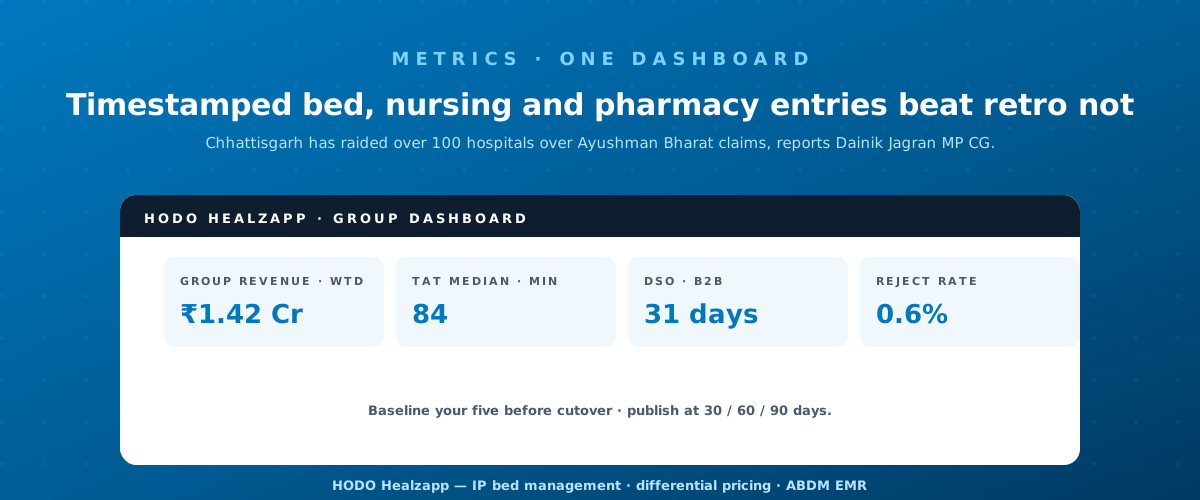
Timestamped bed, nursing and pharmacy entries beat retro notes.
Make the claim file a by-product of the ward, not a project
Hospitals that handle audits calmly share one habit: they do not assemble a claim file at submission time. The file assembles itself because every element, registration and beneficiary identity, bed events, nursing entries, lab and imaging results, pharmacy issue, package line items, discharge summary, is attached to one patient episode under one identifier from the moment of registration. Submission becomes a completeness check rather than a search. Pending claims, queries and recovery notices are then tracked as a pipeline with ageing, because scheme receivables are a cashflow matter long before they become a compliance matter, and a hospital that knows which claims are weak can fix them before a notice arrives rather than after.
It is also worth reading the Chhattisgarh action as a direction of travel. Scheme payers are moving from sample-based paper scrutiny to data-led triggers, and the hospitals that will be comfortable in that world are the ones whose electronic records are complete enough to be queried. ABDM-compliant records, consistent patient identity across outpatient, inpatient, laboratory and pharmacy, and timestamps that nobody edited after the fact are the practical form that readiness takes.
What this means for HODO customers
Audit resilience in HODO Healzapp comes from the ward modules rather than from a compliance add-on. IP bed management maintains the timestamped admission, transfer and discharge ledger that answers length-of-stay queries directly, while the Nursing Station captures vitals and medication administration at the bedside as events occur, so the clinical trail carries real times instead of discharge-day entries. Machine Interfacing brings analyser results in with their own device and run timestamps, and the ABDM-compliant EMR with AI-condensed history lets a consultant verify that pre-authorisation, progress notes and discharge summary describe the same episode before the claim goes out. Differential pricing keeps scheme, TPA and cash tariffs apart at the billing counter, which is where most upcoding findings begin.