Private hospitals across Madhya Pradesh have begun turning away Ayushman Bharat admissions from 8 October over pending dues, as reported by The Cliff News. The dispute is being read as a cashflow story, and it is one. But a stoppage of this kind also exposes a quieter gap in most ~100-bed hospitals: the inability to state, package by package, what a scheme case actually costs to deliver.
A payment protest with a costing problem underneath
The association's position is simple enough. Dues have accumulated past the point where member hospitals can carry them, so scheme admissions stop until the backlog moves. Delay is the trigger, and delay is a real operational injury, salaries, supplier credit and equipment EMIs do not wait for a payer cycle.
What the stoppage forces into the open is a second question that the delay had been masking: at what price is this volume worth having, even when it is paid on time? Hospitals usually answer that question at the level of the scheme. Ayushman is loss-making, or Ayushman fills beds that would otherwise sit empty. Both statements can be true of the same hospital in the same month, because a scheme is not a product. It is several hundred packages with very different consumable loads, theatre times and lengths of stay. Some of them clear their direct costs comfortably. Some do not clear them at all, and a few are being cross-subsidised by cash and insurance work without anyone having decided that this should happen.
A hospital that knows which packages fall into which bucket enters a payment dispute with a position. A hospital that does not can only choose between accepting everything and refusing everything, which is precisely the binary that Madhya Pradesh has landed in.
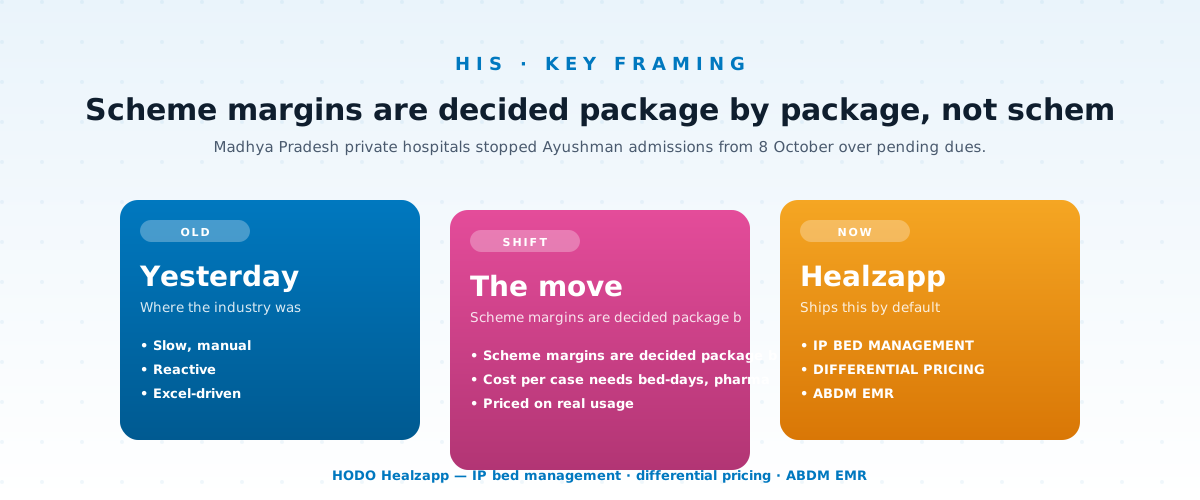
Scheme margins are decided package by package, not scheme-wide.
Package rate minus what, exactly?
Costing a scheme case does not require a cost accountant on the payroll. It requires that four direct inputs land against the case number rather than against the month.
The first is bed-days, priced by ward category, because the package assumes a length of stay and the hospital often delivers a longer one. The second is pharmacy and consumables issued to that patient, including the floor stock that is drawn in the ward and reconciled later. The third is diagnostics and imaging, at internal cost rather than list rate, since billing a scheme case at the published tariff tells a hospital nothing about what the test consumed. The fourth is theatre and procedure time, with implants and high-value items itemised separately, these are usually where a package either survives or collapses.
The output to track is contribution per case: package rate less direct cost. Full absorption costing, where building rent and administrative salaries are spread across cases, is the wrong tool for this decision. Those costs are already committed. The operational question is narrower, does this case pay for the material and capacity it consumes, and how much is left over to service the fixed base?
Once contribution is visible per package, the case mix stops being an accident. A hospital can see that its general surgery packages are workable, its orthopaedic implant packages are marginal, and a handful of medical packages with long stays are consuming bed-days that paying work was waiting for.
Bed-days are the line item nobody prices
Length of stay is the most underweighted variable in scheme costing. A package built around a three-day admission that routinely runs to five days has lost roughly two-thirds of its margin before a single consumable is counted, and in a 100-bed hospital running high occupancy, those two extra days also displace another admission entirely.
The causes are rarely clinical. Discharge summaries wait for a consultant round. Final bills wait for pharmacy returns to be posted. Scheme pre-authorisation extensions are applied for late. Cases that are clinically fit to go home on a Saturday leave on a Monday because the paperwork chain has no owner over the weekend.
This is measurable without a new project. Average length of stay by package, against the length of stay the package assumes, is a two-column report. Ward-wise and consultant-wise variance on the same measure usually shows that the problem is concentrated rather than general. Discharge-ready-to-discharge-done time, the hours between the clinical decision and the patient actually leaving the bed, is the single number most worth putting on a daily review, because it converts directly into bed-days that can be resold.
Where pharmacy and consumables leak
The second recurring leak is material that is consumed but never attributed. Ward floor stock issued without a patient reference, implants recorded in a procedure note but not in the inventory ledger, high-value drugs substituted at the point of care without the rate difference being captured, returns that are physically taken back but not credited.
Each of these is small. Together, in hospitals that have measured it, they routinely account for a material share of scheme case cost, and they are invisible in a monthly pharmacy consumption figure, because the month closes correctly even when no individual case does.
The fix is a workflow rule rather than an analytical one: nothing leaves the pharmacy or the store without a case number attached to it, and reconciliation happens at discharge rather than at month-end. For groups running more than one outlet, the same rule is what makes cross-outlet comparison meaningful. Without it, an apparent cost difference between two centres is usually just a difference in how diligently each one posts its indents.
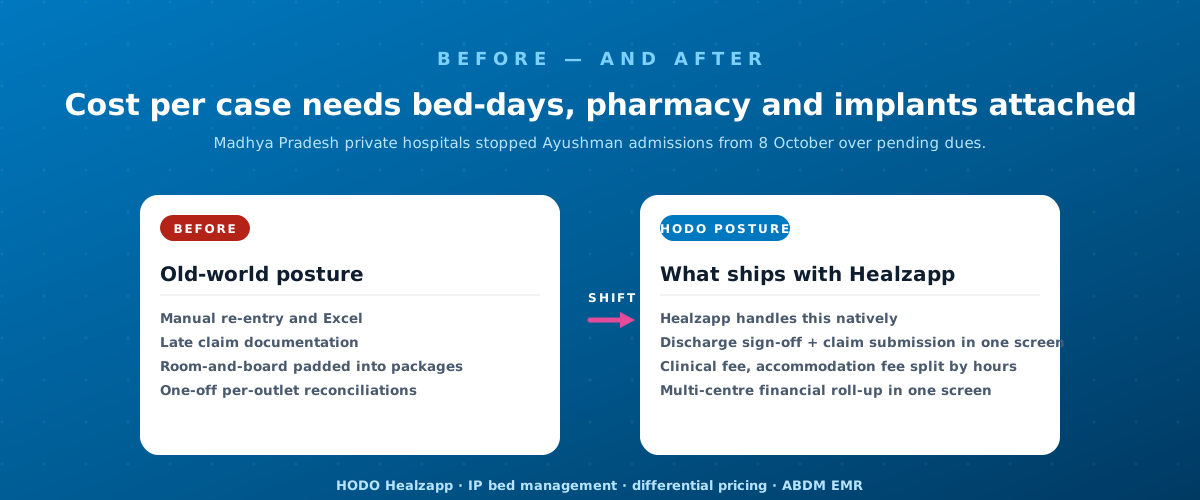
Cost per case needs bed-days, pharmacy and implants attached.
What costing changes about the negotiation
Costing does not make the dues arrive faster. It changes three decisions that hospitals are currently making on instinct.
It makes the restart selective. When the backlog clears, a hospital with package-level contribution data can resume the packages that work, cap the ones that are marginal, and route the loss-making ones to a referral partner rather than taking them because the empanelment exists.
It prices the delay honestly. A package with thin positive contribution, paid nine months late, is a loan the hospital is extending at its own borrowing rate. Applying a carrying cost to the contribution, even a rough one based on the working capital rate, reclassifies several packages that currently look acceptable on a tariff sheet.
And it gives the payer conversation an evidence base. Representations about package rates carry more weight when they arrive as case-level cost data from accredited hospitals than as a collective statement of difficulty. The same costing also informs the pricing of TPA and corporate panels, where rates are negotiable in a way scheme rates are not, and where a hospital that knows its floor can stop signing below it.
What this means for HODO customers
HODO Healzapp carries this as a reporting problem rather than a finance project. Differential pricing holds separate rate cards per scheme, TPA and corporate panel, so each case is billed and evaluated against the rate that actually applies to it. IP bed management gives ward-wise occupancy and length-of-stay data against package assumptions, which is where most scheme margin is won or lost. Tally integration pushes the posted pharmacy, inventory and billing entries into the books without a parallel reconciliation, so case-level cost and the general ledger agree. For multi-outlet groups, the same structure means a new centre inherits the rate cards and reporting on day one.