Private hospitals in Kolkata have told the authorities that they cannot keep treating patients at current Ayushman Bharat package rates, and have asked for the city to be moved to a higher tier so that reimbursement goes up, as reported by The Times of India. The demand itself is familiar — empanelled hospitals in several states have made the same argument through successive Health Benefit Package revisions. What separates the hospitals that get heard from the ones that only complain is whether they can produce a costed case for every package they object to.
The complaint behind the tier upgrade request
Ayushman Bharat PM-JAY pays empanelled hospitals a fixed amount per package, modulated by factors such as city classification, hospital type and accreditation status. A tier upgrade therefore works as a blunt but effective lever: it raises realisation across the entire package book without renegotiating individual rates. Kolkata's hospitals are arguing that manpower cost, consumable cost and cost per bed-day in the city have moved well past what the present classification assumes.
For a ~100-bed hospital, the stakes are more immediate than for a large corporate chain. A 300-bed tertiary unit can absorb loss-making scheme work across a wider base of cash and corporate business. A 100-bed hospital running a meaningful share of its inpatient beds on scheme cases has far less cushion — one quarter of underpriced surgical packages plus a delayed claim cycle is enough to force salary payments onto an overdraft. That is why the tier question gets framed as survival rather than margin optimisation.
The operational catch is that tier revisions and HBP revisions happen on their own schedule. Between two revisions, the only variables a hospital actually controls are its own case mix, length of stay, consumable discipline and claim hygiene. Those are measurement problems before they are policy problems.
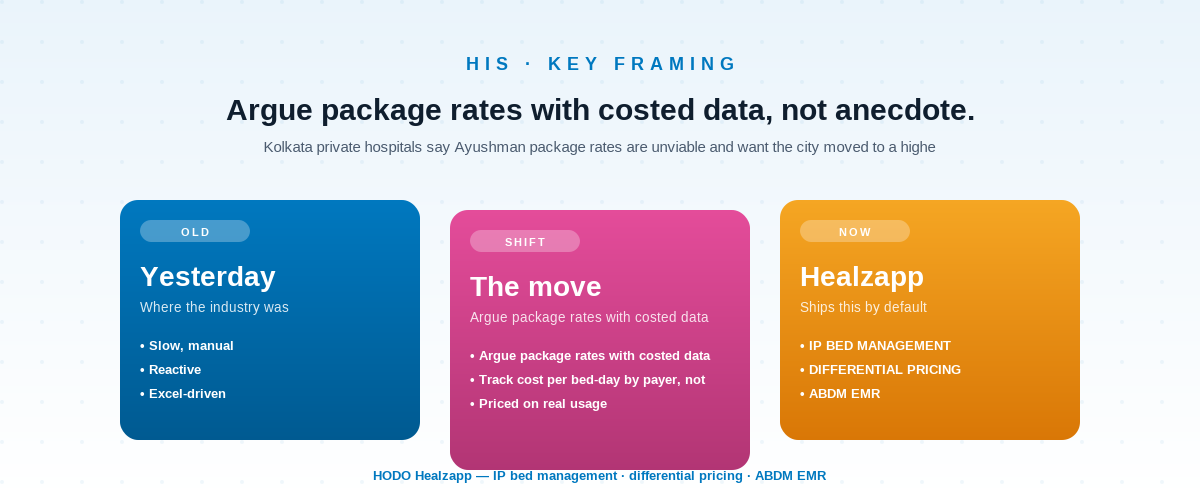
Argue package rates with costed data, not anecdote.
Package rate versus actual cost: the gap most hospitals cannot quantify
Ask a 100-bed hospital what a specific scheme package costs to deliver and the answer usually arrives as a hospital-level margin, not a case-level number. That is not good enough for either a rate submission or an internal decision. A defensible cost per case needs consumables and implants issued against the specific admission, OT minutes with anaesthesia time, bed-days split by ward class, nursing hours, pharmacy indents reconciled to the case, and investigations marked as in-house or outsourced.
Most of that data already exists inside the hospital — it is simply scattered across the pharmacy register, the OT logbook, the store issue slips and the billing module, with no common case identifier. The reconciliation then happens once a year in a spreadsheet, by which point the numbers are too stale to argue with.
The hospitals that submit usable evidence to state health agencies tend to do three things differently. They tag every consumable issue and every investigation to the admission number rather than to a department. They measure actual average length of stay per package against the length of stay the package rate assumes — a two-day overrun on a fixed package is a pure loss that no tier upgrade recovers. And they separate the cost of delivering care from the cost of chasing payment for it, because the second is often larger than management expects.
Scheme mix is a management decision, not a given
Payer mix at a 100-bed hospital is frequently treated as whatever walks in. In practice it is a choice expressed through bed allocation, specialty focus and referral relationships. If scheme cases occupy a large share of inpatient bed-days at thin or negative contribution, the cash and corporate business is cross-subsidising them, and the hospital should at least know by how much.
Useful instrumentation here is contribution per bed-day by payer, not revenue per case. Revenue per case flatters long-stay scheme admissions; contribution per bed-day exposes them. Once that view exists, the available moves become concrete: cap scheme beds per specialty rather than hospital-wide, shift eligible procedures to day-care packages, tighten discharge planning on packages where the rate assumes a shorter stay, and concentrate on packages where existing in-house capability — own lab, own imaging, own pharmacy — makes the fixed rate workable.
The same logic applies to lab chains and diagnostic arms attached to these hospitals. A scheme package that includes investigations is only viable if those investigations run on owned machines at a known cost per test. Outsourcing them to a reference lab at retail-adjacent rates converts a workable package into a loss quietly, one sample at a time.
Realisation timing matters as much as the rate
A package rate is only half the economics. The other half is when the money actually lands. Hospitals arguing about rates often have a bigger problem in query handling, part payments and rejections — claims that are technically approved but sit in a queue because a discharge summary, an implant sticker or a pre-authorisation note was incomplete at the point of discharge.
Three numbers are worth putting on a weekly review: claim ageing by payer bucket, first-pass acceptance rate, and denial reasons grouped by cause. Claim ageing tells the finance team how many months of salary are parked in receivables. First-pass acceptance shows whether the problem is the rate or the paperwork. Denial reasons, grouped properly, almost always cluster into a handful of fixable documentation failures rather than a long tail of genuine clinical disputes.
This is also where TPA and corporate business should be reviewed on the same sheet as PM-JAY. A hospital may discover that its commercial insurance realisation cycle is the actual constraint, and that scheme work — slower but more predictable in its rules — is not the worst payer on the list. That conclusion can only come from data that is maintained continuously, not assembled during a crisis.
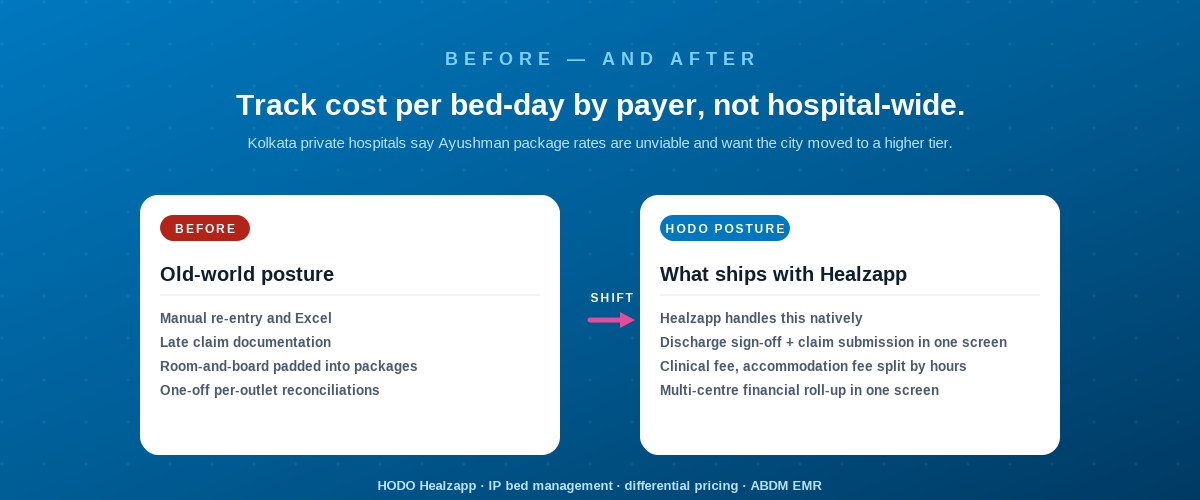
Track cost per bed-day by payer, not hospital-wide.
What this means for HODO customers
The Kolkata tier demand is a reminder that scheme economics are negotiated periodically and lived daily. A 100-bed hospital that can put cost per bed-day, actual length of stay per package, consumable issue per admission and claim ageing on one screen is in a position both to argue for better rates and to decide which packages are worth accepting in the meantime.
Inside Healzapp, Differential pricing keeps scheme, TPA, corporate and cash rate cards separate so that contribution per payer is visible without manual reconciliation. IP bed management ties occupancy and length of stay to the admission, which is where fixed-package overruns show up first. Inventory and Machine Interfacing attach consumable issues and in-house investigation results to the case, and Tally integration carries the same figures into the books without a parallel spreadsheet. The point is not more reporting — it is having the costed answer ready before the next rate revision round opens.