The Haryana chapter of the Indian Medical Association has warned the Ayushman Bharat Health Protection Authority that empanelled private hospitals may withdraw from the scheme entirely from September 16 if payment dues are not substantially cleared, ETHealthworld reports. For India's ~100-bed hospitals and multi-outlet lab chains, the letter is less a political flashpoint and more a working-capital alarm bell, one that has been ringing quietly across Rajasthan, Punjab and Madhya Pradesh for the better part of a year.
Why the Haryana standoff matters beyond Haryana
PMJAY was designed to be the volume floor for tier-2 and tier-3 private hospitals. In practice, once a 100-bed facility crosses roughly 30-40 percent PMJAY IP mix, the arithmetic of the scheme starts running the hospital instead of the other way around. When settlement moves from a planned 15-day window to 90, 120, or 180 days, salaries and pharmacy payables do not stretch with it. The Haryana IMA letter names the pain directly: hospitals are financing the state's health cover out of their own overdraft.
This is the second-order lesson for operators in Bihar, UP, Karnataka and Kerala reading the news. The Haryana pattern, quiet accumulation of dues, one public IMA letter, a suspension deadline, is now a template. Any hospital that carries PMJAY on its payer mix without a live receivables dashboard is one state-level cashflow crunch away from the same conversation with its own bankers, and the same headline in its local press.
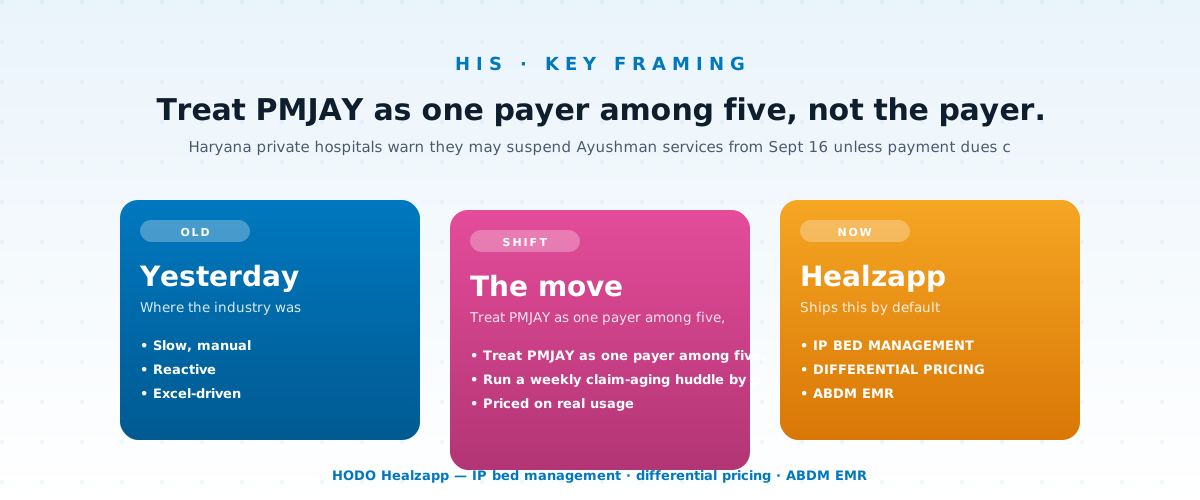
Treat PMJAY as one payer among five, not the payer.
The receivables timeline no one plans for
The public conversation focuses on package rates. The operational conversation should be about the claim clock. A PMJAY claim runs through pre-authorisation, admission, discharge summary, photograph and document upload, coding, submission, TMS query cycle, and finally release. Each hand-off is a place where the clock stops. Hospitals that do not measure the age of every open claim by state, by package, and by owning department end up surprised quarterly rather than steering the number weekly.
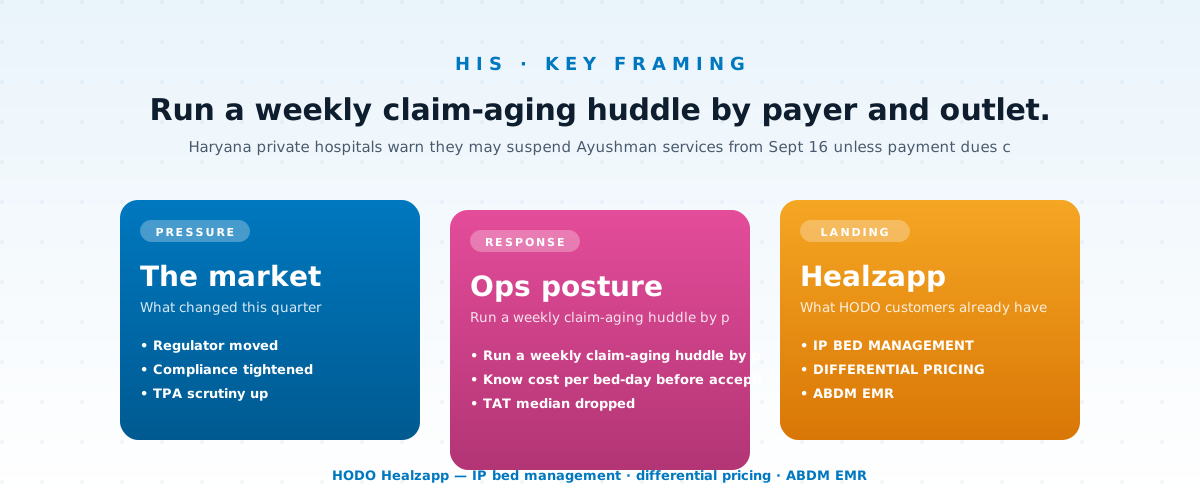
Three metrics deserve a weekly huddle: average age of unpaid claims broken down by payer, query rate per hundred claims (a proxy for documentation quality), and rejection rate per package family. If the query rate is climbing on ortho or cardiac packages, the fix is upstream, usually a missing intra-op image or a mismatch between the discharge summary and the ICD code, not downstream chasing with the TMS. Monthly review is too slow; by then the AR aging bucket has already tipped past 90 days.
Package rates versus actual cost per bed-day
Package rates have moved little in five years. Bed-day cost, nursing salaries, consumables, oxygen, housekeeping, biomedical AMC, has moved a lot. The gap is the silent margin killer. A hospital that cannot pull cost per procedure and cost per bed-day for its top twenty packages is effectively betting the house every time it admits a PMJAY case, because it does not know whether the package covers cost, breaks even, or loses money before the delayed payment is even factored in.
The remedy is not to refuse PMJAY. It is to know the case mix. Some packages are structurally profitable even at a 120-day delay; others lose money on day one. Once operators can see which is which, they can steer OP-to-IP conversion, empanelment specialties, and even OT scheduling toward the mix that keeps the P&L intact while the receivables sort themselves out.
TPA, PMJAY and cash, three cashflow buckets, one hospital
The most common finance-office mistake in Indian ~100-bed hospitals is treating all receivables as one pile. TPA cycles run 45-90 days with their own query pattern. PMJAY runs its own clock, state by state. Corporate empanelment is contract-driven with negotiated rate cards. Cash and OP walk-ins settle same day. Blending them in one AR report hides which bucket is actually funding the hospital's payroll this week.
Multi-outlet chains have the added question of which centre carries what payer risk. A Gurugram unit heavy on corporate and cash can absorb a Rewari unit heavy on PMJAY, but only if the group CFO can see the split by outlet, by payer, by month, on demand. Without that view, the group ends up making capacity investments in the wrong location and cutting staff in the wrong one, both at the same time.
Run a weekly claim-aging huddle by payer and outlet.
What a 100-bed hospital can do this month
Short-term levers do exist. Tighten the pre-admission checklist so that eligibility, package fit and likely query points are cleared before the patient is wheeled in. Run a weekly aging huddle with billing and clinical in the same room, the clinician often has the missing detail the biller cannot reach. Send claim-status WhatsApp updates to the patient's family; it cuts the phone-call load on the TPA desk and improves NPS at the same time. Build an escalation matrix by claim age, 30, 60, 90 days, with named owners rather than a generic billing team.
The strategic lever is payer diversification. Rebuilding OP throughput, adding corporate empanelments, formalising a B2B referral network with nearby standalone labs and clinics, and reactivating cash-paying specialties (health checks, cosmetic dermatology, dental) all reduce the share of revenue held hostage to any single scheme. The hospital that survives 2026 is the one that treats PMJAY as one payer among five, not the payer.
What this means for HODO customers
Healzapp is built for exactly this operational shape. The Billing module tags every encounter by payer class, PMJAY, TPA, corporate, cash, and pipes each into its own aging bucket, so a group CFO can see receivables by outlet, by payer, by age in a single view rather than reconciling four spreadsheets. Differential pricing lets the same procedure carry different rates per scheme and per partner, so package-versus-cost analysis is native rather than a monthly Excel exercise. B2B Referral / Outsource Lab / Corporate-partner logins formalise the diversification channels, referring doctors, corporate HR desks and partner labs each get their own login, their own rate card and their own report delivery, which is the fastest way to grow non-PMJAY revenue without adding front-office headcount. Tally integration closes the loop with finance so claim-level receivables reconcile to the general ledger without manual re-entry.