Private hospitals in parts of Madhya Pradesh have said they will stop treating Ayushman Bharat patients from 8 October, citing pending dues and a new NABH accreditation condition attached to empanelment, as reported by the Free Press Journal. For a 100-bed hospital, that decision is a payer-mix event before it is a policy event. The question that lands on the administrator's desk is narrow and immediate: if scheme admissions stop for a month or a quarter, what fills those beds, and at what contribution?
A stoppage exposes how concentrated the payer mix really is
Most 100-bed hospitals in district and tier-2 towns know their payer mix as a revenue pie, scheme so much per cent, cash so much, insurance the rest. That picture understates dependence, because scheme package rates are lower than cash or insurance tariffs for the same procedure. A ward can be running two-thirds of its bed-days on scheme patients while scheme contributes only a third of billed value. Stop the admissions and the revenue dip looks survivable on paper, while the occupancy dip is severe.
The useful denominator is bed-days, not admissions or billed value. Pull twelve months of discharges and compute bed-days by payer, by ward, by month. Then compute contribution per bed-day: amount actually realised, minus direct cost of consumables, implants, pharmacy issues and OT time, divided by bed-days consumed. Two things usually become visible. First, dependence is concentrated in two or three wards rather than spread evenly. Second, a scheme bed-day whose payment arrives nine months later is not comparable to a cash bed-day settled at discharge, even when the rupee figure matches. Until realisation timing sits in the same table as volume, any decision about stopping or resuming scheme work is being taken half-blind.
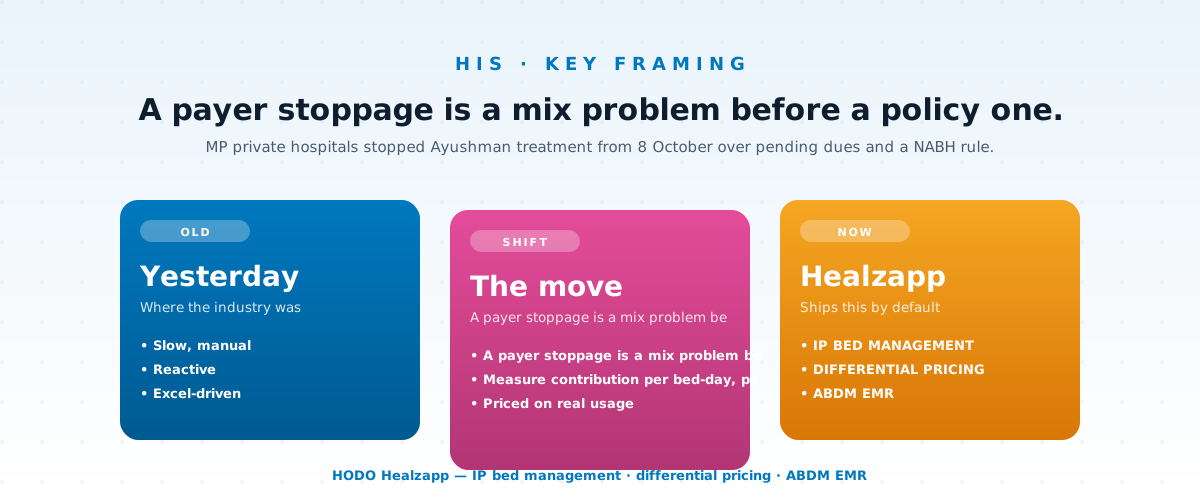
A payer stoppage is a mix problem before a policy one.
The arithmetic of replacing scheme bed-days
Replacement does not have to be one patient for one patient. A hospital that gives up 300 scheme bed-days a month does not need 300 insurance bed-days; it needs enough contribution to cover fixed cost on those beds, from work that is collectable inside a predictable cycle. That usually means a mix: elective surgical lists that were being deferred because scheme cases were occupying OT slots, insurance cashless admissions, corporate health check volume, and daycare procedures.
The trap is swapping one slow receivable for another. Insurance cashless work carries its own pre-authorisation and query cycle, and a hospital that is not already empanelled with the relevant TPAs cannot turn that tap on in a fortnight. Empanelment paperwork, tariff sheets and pre-auth desk capacity are the rate-limiting steps, not patient demand. Three practices make the shift measurable: maintain a separate rate card per payer in the system rather than in a printed sheet at the billing counter; age receivables in buckets by payer and by TPA, reviewed weekly; and record query reasons by cause so the top two causes can be fixed at source. Hospitals that did this before the dispute are now choosing their payer mix. Hospitals that did not are discovering their tariffs live in someone's spreadsheet.
Corporate panels and referral partners fill beds sooner than new specialities
Adding a speciality takes quarters, a consultant, equipment, a ramp-up period. Adding partners takes weeks. Local employers need pre-employment and annual health checks. Nursing homes and single-doctor clinics in the catchment need beds, OT time, imaging and pathology they do not own. Accredited neighbours that have just absorbed excluded hospitals' scheme volume now need overflow capacity of their own.
Each of these relationships collapses into the same operational need: an agreed rate card, a way for the partner to raise a request and see its status, and billing that lands on a partner account rather than on a patient receipt. Run through WhatsApp messages and phone calls, a dozen partners will generate disputes that consume more front-office time than the revenue justifies. Run through partner logins, the same dozen become a reportable line of business, volume per partner per month, realisation per partner, days sales outstanding per partner, credit limit enforced at the point of billing instead of at a quarterly review. That last control matters in a month when hospitals in the region are already short of working capital: extending open-ended credit to a partner who is himself waiting on scheme dues simply moves the problem one step down the chain.
OP throughput and daycare move faster than bed capacity
When IP volume drops, the OP block is where capacity can be converted quickly. Three numbers are worth putting on a weekly sheet: consulting minutes actually used per doctor per session against minutes scheduled, no-show rate by slot and by speciality, and OP-to-procedure conversion, how many OP visits turn into a daycare or IP episode within thirty days. Hospitals routinely find that mid-morning slots run 40 per cent idle while evening slots overflow, which is a scheduling fix rather than a demand problem.
Daycare is the other lever. Dialysis, chemotherapy, endoscopy, cataract and minor surgical work use OT and recovery capacity without blocking beds overnight, and they settle faster than inpatient packages. Scheduling them against freed OT slots turns a scheme-driven occupancy gap into throughput. Two support flows protect the gains. Teleconsultation absorbs follow-ups that would otherwise consume a physical slot, particularly for post-discharge reviews. Report delivery over WhatsApp or SMS, plus a patient app that holds history and prescriptions, removes a tranche of counter visits whose only purpose was collecting paper, which keeps the front desk free for the new insurance and corporate registrations that the mix shift is bringing in.
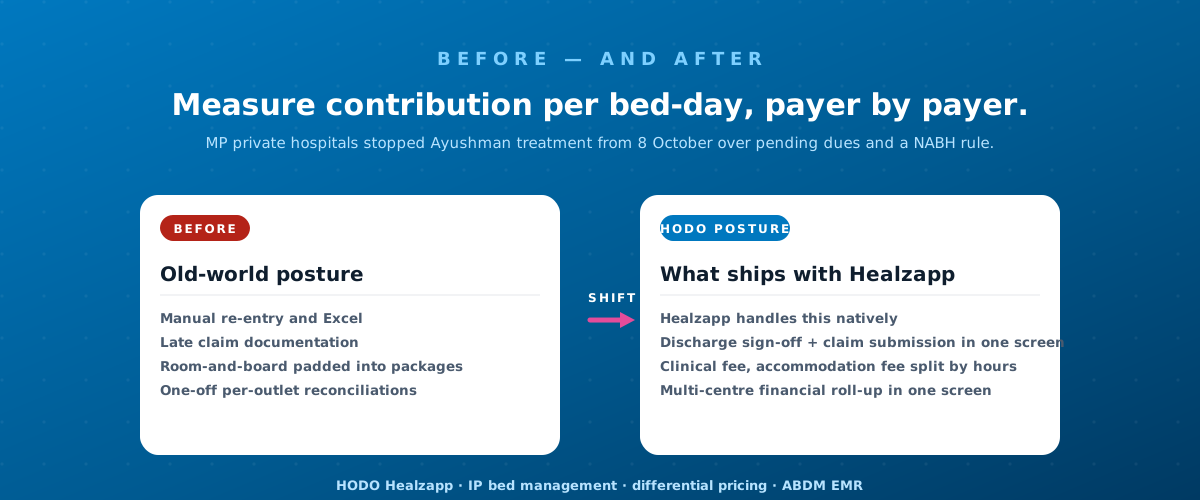
Measure contribution per bed-day, payer by payer.
The accreditation clock does not pause during the dispute
Whatever happens to the dues, the NABH condition is the part of this story that persists. Accreditation assessment looks for indicators computed consistently over months, infection rates, mortality and re-admission figures, medication error reporting, calibration and maintenance records for equipment, nursing documentation at the bedside. None of that can be assembled retrospectively in the fortnight before an assessment, and a period of lighter inpatient load is the cheapest time to build the habit.
The practical test is whether a quality indicator can be produced as a report rather than a project. If the denominator, admissions, patient-days, procedures, comes from the same system that does billing and discharge, the numbers are defensible and repeatable. If the numerator depends on a register maintained in one ward and a file in the quality manager's cupboard, the indicator will not survive questioning. The same logic applies to equipment: warranty and AMC dates held in an asset register that raises alerts will pass an assessment; dates held in an email folder will not. Hospitals treating accreditation as a data problem rather than a documentation drive tend to clear Entry Level without a scramble.
What this means for HODO customers
A payer-mix shift is mostly a configuration problem. In Healzapp, Differential pricing keeps a separate tariff per scheme, TPA, corporate and partner on the same ward and the same procedure, so a stoppage or a resumption is a cut-off date in the system rather than a circular at the billing counter. B2B Referral / Outsource Lab / Corporate-partner logins give employers, referring doctors and neighbouring nursing homes their own entry point, with volume and outstanding tracked per partner. IP bed management reports occupancy and bed-days by payer and ward, which is the measurement this decision actually turns on, while Warranty+AMC asset tracking keeps the accreditation evidence current alongside it.