Private hospitals in Madhya Pradesh have put their threatened boycott of Ayushman Bharat admissions on hold, but the dispute over mandatory NABH certification has not been settled, Ground Report says in its coverage of the stand-off. The association has stepped back from a stoppage; the state has not withdrawn the accreditation condition, and pending dues are still being cleared in instalments. For a 100-bed hospital, that is the most awkward of the three possible positions: scheme volume keeps flowing, and the rule that could end that volume is still live.
A hold is not a settlement
When a payer dispute is resolved, a hospital can plan. When it collapses into a boycott, a hospital at least knows what it is dealing with and can switch its case mix accordingly. A hold gives neither. Admissions continue, receivables keep building, and the condition that may disqualify the hospital from empanelment sits in the background with no published cut-off date that the finance team can plan against.
The practical response is to treat the deferral as a deadline whose date has not yet been announced. That means working backwards from the worst credible case — the accreditation condition being enforced within two or three quarters — rather than waiting for a circular. Two numbers decide how urgent this is for any given hospital: the share of inpatient revenue that comes from the scheme, and the amount of scheme money currently unpaid. A hospital at 15 per cent scheme share with sixty days of ageing is in a different position from one at 45 per cent with claims sitting past 120 days, even though both are reading the same news.
Neither number should require a week of spreadsheet work to produce. If it does, that is the first finding of this episode, and it is an internal one.
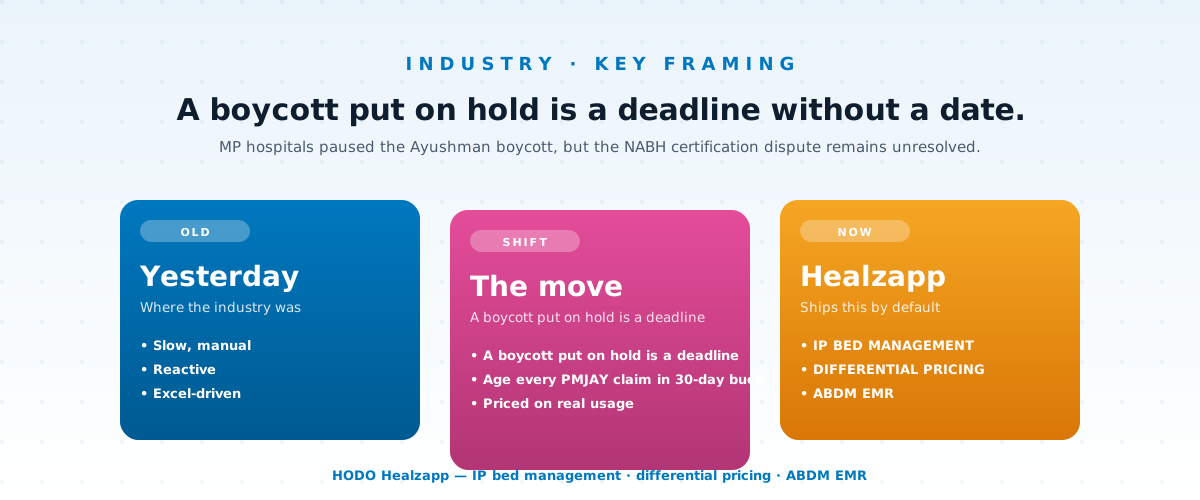
A boycott put on hold is a deadline without a date.
Two disputes that need separate tracking
The protest bundled two grievances — delayed payments and the accreditation condition — because bundling them raised the pressure. Inside a hospital, bundling them is a mistake. They have different owners, different time horizons and completely different fixes.
The dues problem is a working capital problem. It is fixed with claim-level discipline: clean documentation at discharge, same-day submission, query response within a defined window, and a named person who owns ageing. Most of the delay that hospitals attribute to the payer is partly self-inflicted — claims submitted late, queries answered after a fortnight, discharge summaries missing the one investigation report that supports the package claimed.
The accreditation problem is a process and evidence problem. NABH entry-level standards ask whether defined processes exist and whether records show they were followed: patient assessment within a stated time, consent before procedures, medication administration recorded, incidents reported, equipment maintained and calibrated on schedule. No amount of claim follow-up moves that needle, and no amount of accreditation preparation collects an old claim. Tracking them in one register means both get managed at the pace of the louder one.
Exposure starts growing again the moment admissions resume
A hospital that resumes scheme admissions during a hold is choosing to extend credit to a payer with a demonstrated payment delay and an unresolved eligibility rule. That can be a reasonable choice — bed occupancy has to come from somewhere, and in many districts the scheme is the only reliable source of inpatient volume. It stops being reasonable when nobody has put a ceiling on it.
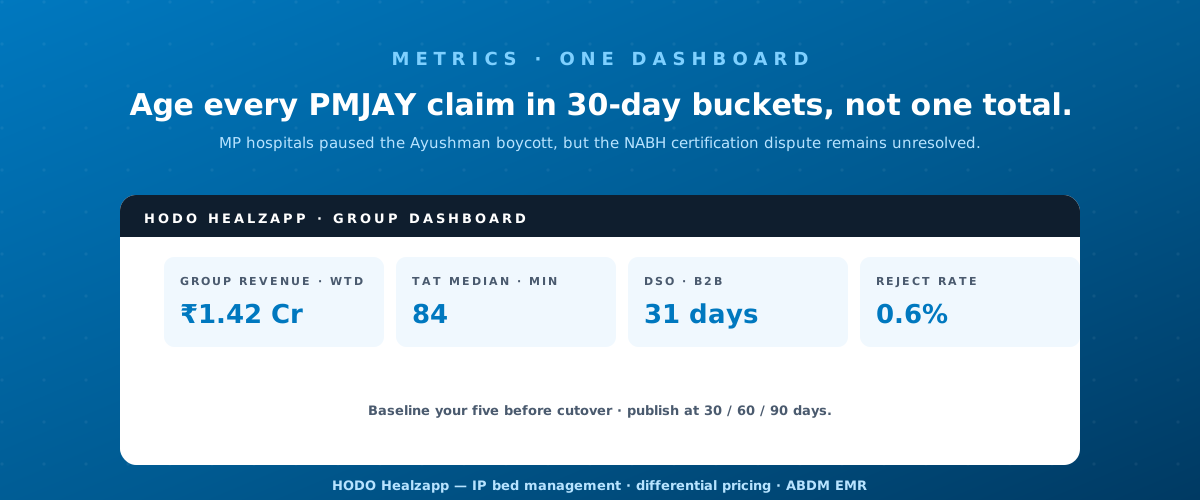
A ceiling is a rupee figure, reviewed monthly, for total uncollected scheme receivables the hospital is willing to carry. Underneath it sit three reports that should be standing, not requested. First, claim ageing in 30-day buckets rather than a single outstanding total, because a crore spread across 0 to 30 days is a business and the same crore past 120 days is a bad debt waiting to be recognised. Second, rejection and query reasons grouped by cause, so repeat documentation failures get fixed at source instead of being re-argued claim by claim. Third, contribution by package — what each scheme package actually earns after implants, consumables, pharmacy and the bed-days consumed.
That third report is what allows a hospital to narrow rather than stop. Specific packages routinely run at or below cost once length of stay is counted honestly; others hold up. Knowing which is which turns a political decision about boycotting a scheme into an operational decision about which cases to keep taking and at what volume.
Accreditation evidence should fall out of daily work
The reason the NABH condition frightens smaller hospitals is not the fee or the consultant. It is the realisation that eighteen months of records which should already exist will have to be reconstructed before an assessor arrives. Hospitals that run assessments, vitals, nursing notes, consent and medication administration on paper discover that compliance is a project — pulled together by borrowed staff over several weeks, at the cost of the normal work those staff were doing.
Hospitals where the same activity is captured in the system as it happens discover that compliance is a report. The underlying records are identical; only the retrieval cost differs. Nursing documentation, bed-wise occupancy and transfer history, equipment service and calibration dates, incident entries and discharge documentation either accumulate as searchable data or they accumulate as files in a cupboard.
This is also where the two disputes quietly converge. The documentation that satisfies an accreditation assessor is close to the documentation that survives a claim audit. A discharge summary with the investigations, procedure notes and consent attached is both an accreditation record and a defensible claim. Hospitals that build the record once, at the point of care, pay for it once. Hospitals that reconstruct it twice — once for the payer, once for the assessor — pay for it every quarter, in overtime and in deferred collections.
Age every PMJAY claim in 30-day buckets, not one total.
What to carry into the next round of negotiation
The hold will end in a circular, a court order or another agitation, and when it does, associations that arrive with data will do better than those that arrive with sentiment. The useful numbers are hospital-level and they aggregate cleanly: beds, scheme admissions per month, rupees pending by ageing bucket, average days from claim submission to payment, query turnaround on both sides, and a realistic estimate of what entry-level accreditation costs a 50 to 100-bed facility in fees, consultancy, staffing and capital works.
Each hospital also needs its own scenario sheet. If empanelment is lost, what percentage of inpatient revenue disappears, how many beds go empty, and what mix of cash, TPA and corporate business would have to replace it? That calculation usually reveals that the accreditation spend is cheaper than the revenue at risk — which is worth knowing before the deadline is announced rather than after.
What this means for HODO customers
The systems question behind this news is narrow: can the hospital produce its scheme exposure, its claim ageing and its accreditation evidence on demand, without a special effort? In Healzapp, Billing holds claim-level status and ageing for scheme, TPA and cash business in one place, so a ceiling on uncollected exposure can be monitored rather than estimated. Tally integration carries those figures into the books without re-entry, which is what makes a monthly exposure review a five-minute report instead of a reconciliation exercise. Nursing Station and IP bed management capture assessments, nursing records and bed-wise occupancy as the work happens, which is the same evidence an entry-level NABH assessment and a claim audit both ask for. Accreditation readiness is mostly a retrieval problem, and retrieval is a software decision made long before the assessor is booked.