
The Association of Healthcare Providers India (AHPI) has directed member hospitals to suspend cashless treatment for Bajaj Allianz General Insurance policyholders, and LawChakra reports that over 20,000 hospitals have already fallen in line. For hospital owners the immediate question is not who wins the legal fight, it is how quickly the front desk, billing team and MRD can switch a large book of patients from cashless to reimbursement mode without dropping revenue or losing the patient's trust.
The AHPI notice cites unilateral revisions to reimbursement tariffs, delayed settlements and denial of claims that were originally approved under pre-authorisation. Member hospitals are asked to stop offering the cashless facility to Bajaj Allianz policyholders until the insurer resolves these commercial disputes. Patients can still be admitted; they will simply have to pay upfront and then file for reimbursement themselves.
That single change moves the credit risk from the insurer's balance sheet to the patient's, and the operational risk to the hospital's front office. The receptionist must now identify a Bajaj Allianz policy at the counter, explain why the earlier promise of cashless no longer applies, collect a deposit, and hand out a discharge summary that will withstand insurer scrutiny six months later. Multiply that conversation across a 300-bed hospital doing 40 admissions a day, and the real exposure is not the legal dispute — it is the daily friction at admission and discharge.
Most mid-sized Indian hospitals see 25 to 45 per cent of IP revenue come through cashless channels, and Bajaj Allianz is often in the top five insurers by ticket volume. When that channel closes overnight, three cashflow lines get hit at once: pre-authorisation receivables that were already booked but not yet settled, discharge-day settlements that now shift to reimbursement mode, and the working capital tied up in the deposit-refund cycle for patients who eventually recover their claim.
Finance teams that run monthly TPA reconciliations without a live dashboard will spot the gap only when the next receivables ageing report lands. By then two weeks of admissions have gone through on the old workflow. The hospitals that will handle this cleanly are the ones whose HIS can flag every Bajaj Allianz patient at registration, route them through a modified billing template, and push the corresponding AR bucket to a separate ageing line so the CFO sees the exposure by insurer in real time rather than at month-end.
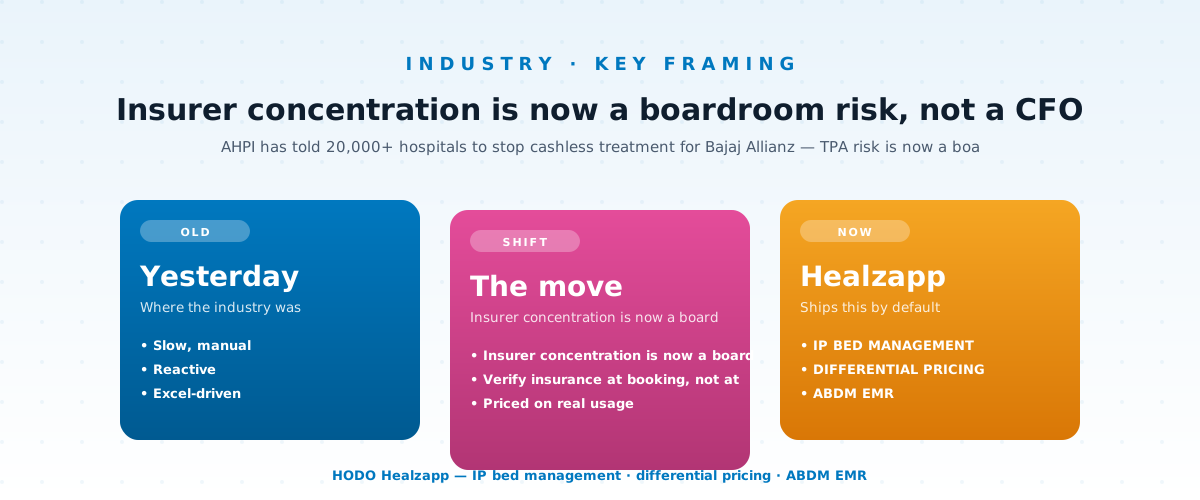
The AHPI-Bajaj Allianz standoff will get resolved, one way or another. What it exposes is a structural weakness that most Indian hospital groups have quietly ignored: a large share of IP revenue depends on the goodwill of two or three insurers and their empanelled TPAs. If any one of them changes tariffs or suspends cashless — as has now happened — the working capital hit is immediate and there is no fallback channel to absorb it.
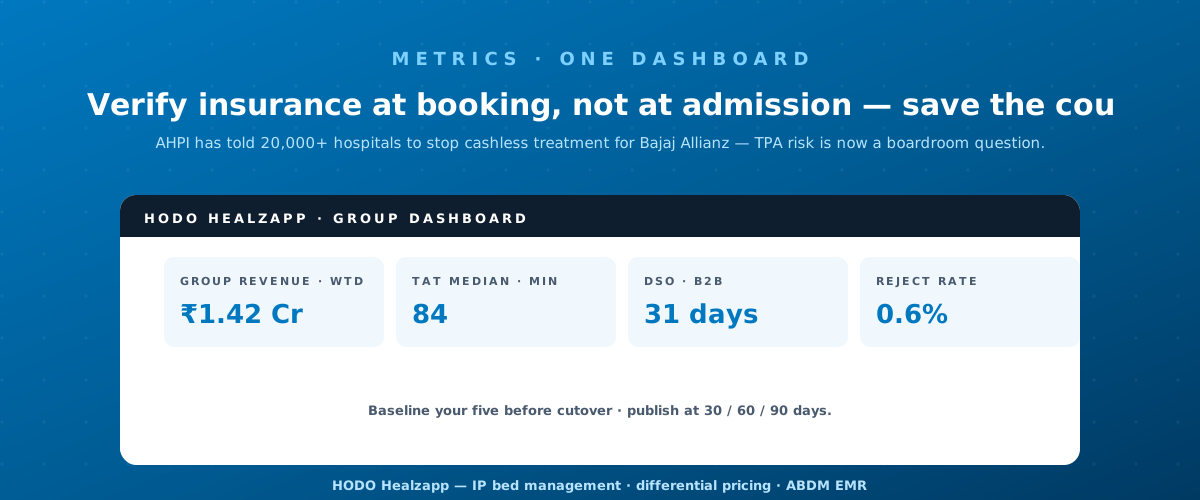
The Boards that come out of this will be asking harder questions of the CFO. What is our exposure by insurer, by TPA, by corporate tie-up? Which single payer accounts for more than 15 per cent of IP receivables? How long is the average settlement cycle by TPA? Which corporate clients pay within 30 days versus which drag it out to 120? Without a HIS that maintains separate ledgers per payer and produces this cut on demand, the answers take the finance team a week to compile — by which point the next crisis is already in the news.
The reception counter is where this fight is won or lost. A patient who was promised cashless by the insurer's mobile app and turned away at the hospital counter is a patient who will complain publicly, and one whose next admission will be at the competitor across the road. The workflow rebuild has to start at three specific points.
First, insurance verification at appointment booking, not at admission. The moment a patient books, the HIS should pull the policy details and flag any insurer currently under AHPI advisory so the counter conversation happens ahead of the visit. Second, the pre-auth desk needs a dual-track — cashless where still valid, and a fast-track reimbursement pack where not. Third, discharge documentation has to be watertight, because reimbursement claims are settled on paperwork quality, not on the empanelment relationship. Every diagnostic, every consumable, every consultant visit must map to a billed line item with the corresponding EMR entry attached.
One quiet consequence of the AHPI notice is that hospitals will now negotiate insurer contracts more sharply. Differential pricing per insurer, per corporate partner, per TPA becomes a live commercial lever rather than a spreadsheet exercise done once a year. That means the HIS must hold multiple rate cards, apply the correct one at billing based on the patient's payer, and produce an audit trail that the insurer's medical auditor can walk through line by line.
Hospitals that operate on a single price list and apply discounts manually at billing are exposed on two sides — insurers will disallow the discount citing lack of pre-approval, and internal audit will flag the write-off as a control gap. The fix is not a policy memo. It is a billing engine that treats each payer as a separate contract and each claim as a versioned document with the tariff, the pre-auth approval and the discharge note attached to the same record.
The AHPI-Bajaj Allianz situation is a stress test for the billing and payer-management side of the hospital information system. Four HODO Healzapp capabilities carry most of the load. The Billing module handles insurer-specific rate cards, pre-authorisation tracking and the switch from cashless to reimbursement without a workflow rewrite at the counter. Corporate-partner logins give each TPA, corporate client and insurer their own portal to view claims, upload approvals and download settlement statements — cutting the phone-call load on the billing team during periods of active dispute. Differential pricing lets the hospital hold separate rate structures per payer and apply them automatically at billing, so a Bajaj Allianz reimbursement claim uses one price list and a corporate walk-in uses another, with the audit trail intact. Tally integration pushes payer-wise receivables straight into the finance books, giving the CFO a live view of exposure by insurer rather than a month-end surprise. Together these features convert a market-wide crisis into a manageable operational adjustment.
See how HODO Healzapp handles this — book a 30-min demo.
Source of the news hook: https://news.google.com/rss/articles/CBMie0FVX3lxTFA1NXFiUXhtMTE1ZmlSdVB3ZGZkNGsxNENYa1lHeGsyMnF6eHdES096dUdtYjJtWDEtbE5jeG1JSEc3S0U1N1MtZ3ZlRGEwMUtEMGNHaENhMUN4VWxVX3JQT1padGw2UzNOdzdQNGx3QzlGb2lCVzdEZ3Z1dw?oc=5
See how Healzapp, Labzapp and EReazy fit your speciality in a free 30-minute demo.
Book a Free Demo