
Moneycontrol reported on 3 July that the Association of Healthcare Providers India (AHPI) has advised member hospitals across North India to stop offering cashless treatment to Bajaj Allianz General Insurance policyholders with effect from 1 September. The trigger, per the report, is a mix of unilateral tariff revisions and pending settlements. For the owner or MD watching this play out, it is a two-month window to rebuild reception workflows, TPA contracts and finance dashboards before a single walk-in gets turned away at the counter.
AHPI, which counts more than 15,000 member hospitals, is not asking anyone to refuse Bajaj Allianz policyholders. It is asking hospitals to stop the cashless mode of settlement. In practice, that means the patient pays upfront and files a reimbursement claim on their own — a workflow most administrators know is slower, thinner and far more likely to end in a partial payment. The insurer's own tariff card, which many hospitals had already accepted below cost on the promise of volume, has become the sticking point. AHPI's position is that the tariffs were revised without hospital consent. Bajaj Allianz's response, when it lands, will argue that hospitals over-billed. Neither side is going to blink before September. The relevant question for a hospital operator is not who is right — it is whether the front office can execute the switch cleanly on 1 September for every Bajaj policyholder walking in that morning, and whсемер the finance team can absorb the working-capital shift that follows.
A 100-bed North Indian hospital where Bajaj Allianz sits in the top three insurers typically carries 8-12% of monthly IP revenue on that single book. On cashless, that revenue lands as a receivable at 45-90 days DSO — painful but predictable. On reimbursement, two things happen at once. The patient asks for a discharge concession because they now have to fund the bill themselves. And the receivable disappears from the hospital's books entirely, because it becomes the patient's problem. That sounds like a win on paper. It isn't. Elective admissions on the affected book will drop by 20-30% as patients defer procedures until the dispute clears. Emergency admissions will continue, but they will convert into deposit-collection arguments at the counter, and eventually into bad debt at 120 days. Cash inflow for August looks fine. October is the month to model, not September. Hospitals that wait until the P&L reflects the change will be a full quarter behind on the fix.
The single highest-leverage change is at registration, not at discharge. Every Bajaj Allianz policyholder needs to be flagged the moment their policy is entered into the HIS, with an automatic prompt that surfaces the current settlement mode — cashless suspended, self-pay, then reimburse — and generates a revised patient estimate at the counter. That estimate must itemise the difference between the corporate-tariff rate and the self-pay rate, because the two are almost never equal, and patients will ask. Consent forms have to be re-issued: the cashless authorisation letter that most hospitals use is not valid for a reimbursement case. Discharge summaries need a claim-support pack — itemised bill, ICD codes, investigation reports, prescription — bundled in a format the patient can forward to Bajaj Allianz without a phone call back to the hospital. And the SMS or WhatsApp confirmation that goes out before admission should carry the mode change in writing, not just verbally at the counter, so there is a documentation trail if a dispute lands later.
Bajaj Allianz is the visible one. The quieter question is which of the other insurers on the panel are one board meeting away from doing the same thing. Every TPA and direct-insurer contract in the file cabinet should be pulled this month and read against three criteria. One: is there a tariff-revision clause that lets the insurer change rates unilaterally, or does it require joint agreement? Two: what is the settlement SLA in days, and what is the penalty if the insurer breaches it? Most contracts carry the first and not the second. Three: what is the exit clause, and how much notice does either side need to give? Hospitals that discover they are on 30-day insurer-friendly terms with a 90-day notice period will find themselves in exactly the position AHPI members are in today. The audit does not have to be a legal exercise. It is a spreadsheet: insurer, current tariff, DSO, denial rate, share of IP revenue, contract expiry. That one sheet decides which contracts get renegotiated first.
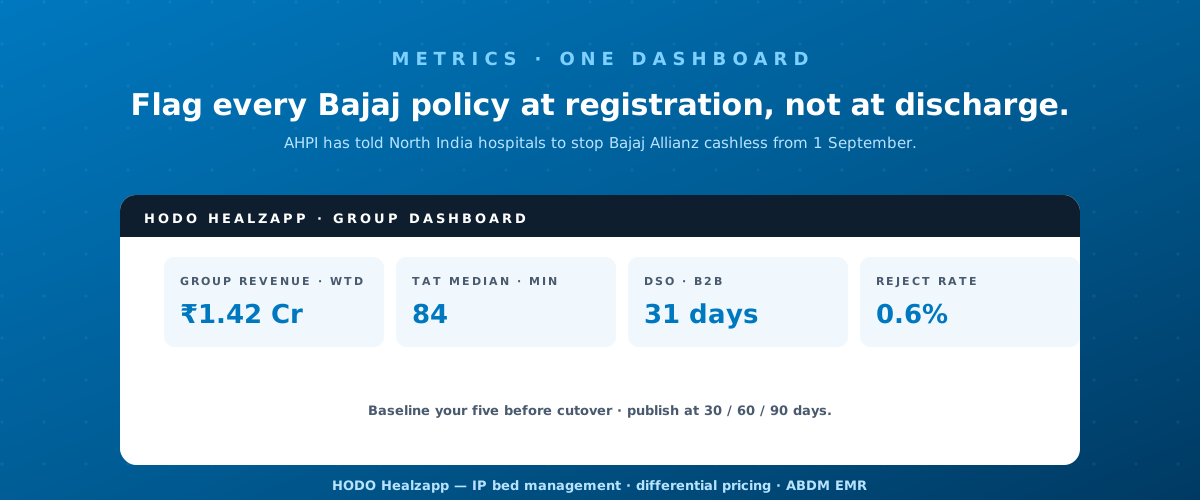
Any negotiation from September onwards is going to hinge on numbers the hospital can produce and the insurer cannot dispute. Case mix by insurer is table stakes — knowing that Bajaj accounts for 11% of admissions but 18% of orthopaedic cases changes the conversation. Costed procedure data matters more: if the hospital cannot show what a knee replacement actually costs it end-to-end, it cannot argue that the tariff is below cost. Denial rate by insurer, and the reason codes behind the denials, tell the insurer that the hospital is watching. Days-sales-outstanding by payer, tracked monthly, is what turns a settlement-delay complaint from an anecdote into a leverage point. Most hospitals have this data scattered across billing exports, TPA-cell spreadsheets and the finance team's memory. Consolidating it into a single monthly dashboard is a two-week project. It is also the difference between arriving at the negotiation table with a story and arriving with evidence.
The Bajaj Allianz situation is a workflow change, not a clinical one, and it lives inside three parts of the HIS. The Billing module in Healzapp is where the settlement-mode switch has to be enforced — Bajaj policyholders auto-routed to self-pay estimates, revised consent packs generated at registration, and claim-support documents bundled at discharge without receptionist intervention. Corporate-partner logins give each TPA and corporate a direct portal for pre-authorisations, approvals and settlement tracking, which replaces the email trail that most delayed-settlement disputes eventually turn into. And Differential pricing is what lets a hospital carry parallel rate cards — one cashless, one self-pay, one corporate — without a manual override at the counter every time an insurer changes its mind. The AHPI notice makes these three features operationally urgent for August, not aspirational for FY26.
See how Healzapp handles this — book a 30-min demo.
Source of the news hook: Read the source article →
See how Healzapp, Labzapp and EReazy fit your speciality in a free 30-minute demo.
Book a Free Demo