Fortune India reports that the government intends to cap trade margins on cancer drugs at 30%, alongside a parallel push to make hospitals publish their treatment rates. For a 100-bed hospital, these are not two separate headlines. They land on the same invoice, printed at the same counter, by the same billing staff. The pharmacy line stops being a quiet contributor to the bottom line and becomes a regulated, published number.
Two policy moves that meet on one invoice
Trade margin rationalisation is not a new instrument. The NPPA used it on cardiac stents and knee implants, and in 2019 applied a 30% ceiling to a set of 42 non-scheduled anti-cancer drugs. What is reported now is a wider application of the same logic across oncology, which is the single highest-value pharmacy category in most multi-speciality hospitals. Alongside it sits the rate transparency push, which has been gathering force since the Supreme Court pressed the Centre on standardised treatment rates under the Clinical Establishments Act.
Read together, the direction is clear. The margin a hospital earns between its purchase price and the printed MRP is being compressed from above, and the price a patient pays is being made visible from the side. A hospital that has been funding part of its operations from pharmacy spread, and most Indian hospitals in the 60 to 150 bed range have been, whether or not it appears that way in the management accounts, needs to know the size of that dependency before the notification arrives, not after.
The operational question is narrower than the policy debate. Does the hospital know, by drug category, what margin it actually realises after discounts, expiry write-offs, and schemes? Most do not, because the pharmacy is run on a separate billing stack from the HIS, and reconciliation happens monthly at a summary level.
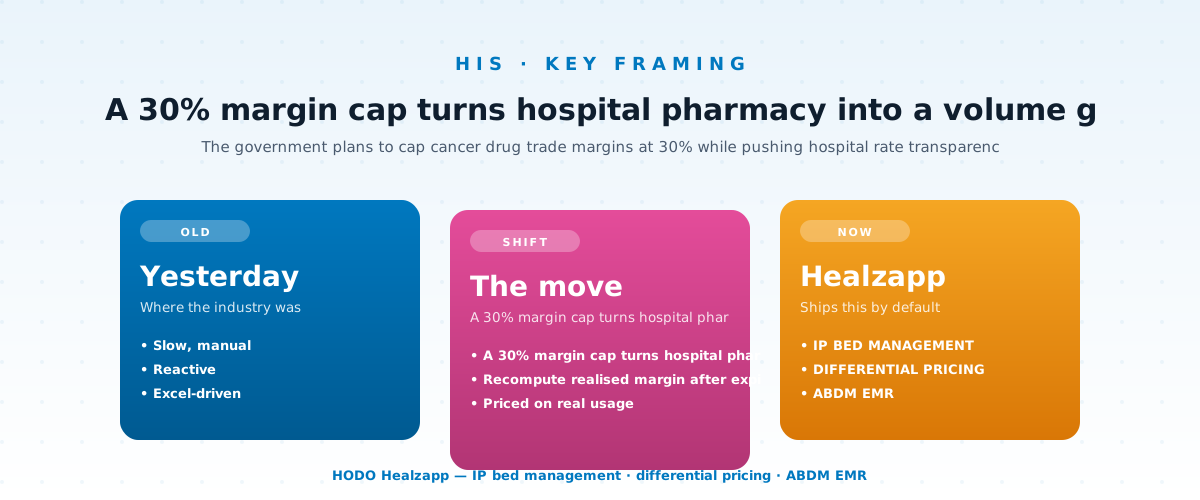
A 30% margin cap turns hospital pharmacy into a volume game.
Pharmacy margin is rarely where the management thinks it is
Three leaks consistently eat the headline margin on high-value oncology stock. The first is expiry. Oncology drugs are expensive, slow-moving in smaller towns, and often indent-driven for a named patient. A single expired vial can wipe out the margin on a dozen dispensed units. The second is the scheme and bonus structure from distributors, which inflates the apparent purchase discount but does not survive a batch-level audit. The third is write-off on returns and part-use, where a vial is opened, partially administered, and billed inconsistently across shifts.
A 30% ceiling leaves little room to absorb these. If realised margin on oncology today sits at 22% after leakage, the cap is not the binding constraint, the leakage is. That reframes the work. The priority is not lobbying on the ceiling; it is tightening batch-level inventory control so that the margin the hospital is permitted to earn is the margin it actually keeps.
This means a pharmacy module that holds batch, expiry, and purchase rate at the unit level and feeds the same record into billing, so that a dispensed item carries its own cost. It also means reorder logic keyed to actual consumption per oncology protocol rather than to a flat minimum stock level. For hospitals running day-care chemotherapy alongside inpatient cycles, consumption is predictable two weeks out if the appointment and protocol data is in the same system as the stock.
The batch and MRP revision problem
Margin caps create a specific, unglamorous operational mess: stock bought at the old MRP sitting on the shelf when the new one takes effect. Manufacturers reprint, distributors issue credit notes, and the hospital holds inventory in two price worlds at once. Staff at the counter are then asked to decide which rate applies, usually from a WhatsApp forward or a printed circular taped to the terminal.
This is where most compliance failures originate, and they are expensive twice over, once as a patient grievance, once as an audit finding. The fix is to make the price revision a system event, not a human memory event. New MRP attaches to new batches; old batches retain their own rate and are flagged for exhaustion or return; the billing screen reads the batch, not the drug name. No counter staff should be doing price arithmetic during a queue.
The same discipline applies to the purchase side. Credit notes against revised stock need to flow into the accounting ledger without a parallel spreadsheet, or the reconciliation lag becomes a cashflow problem in a month where TPA and PMJAY receivables are already stretched.
Transparency changes who reads the price list
Published rates alter the audience for a hospital's price master. Today it is read by the billing team and occasionally by a TPA desk. Once rates are published, it is read by patients before admission, by competitors in the same district, and by anyone filing a grievance. Three consequences follow for a 100-bed hospital.
First, internal consistency becomes non-negotiable. If the published rate for a chemotherapy day-care cycle is one number and the printed bill is another because a consumable was billed at a different tier, the gap is now documentable. Differential pricing across cash, corporate, TPA, and scheme patients remains legitimate, PMJAY and CGHS rates will not match cash rates, but each tier needs to be a defined, auditable rate set rather than a discount applied at the counter's discretion.
Second, the estimate given at admission carries more weight. Patients comparing published rates will treat the pre-admission estimate as a commitment. Hospitals that generate estimates from the same price master that produces the final bill will have far fewer disputes than those producing estimates on a separate template.
Third, pharmacy stops being invisible. When drug margins are capped and rates are public, the pharmacy becomes a throughput and accuracy function: dispense faster, waste less, bill correctly. Its contribution comes from volume and control, not from spread.
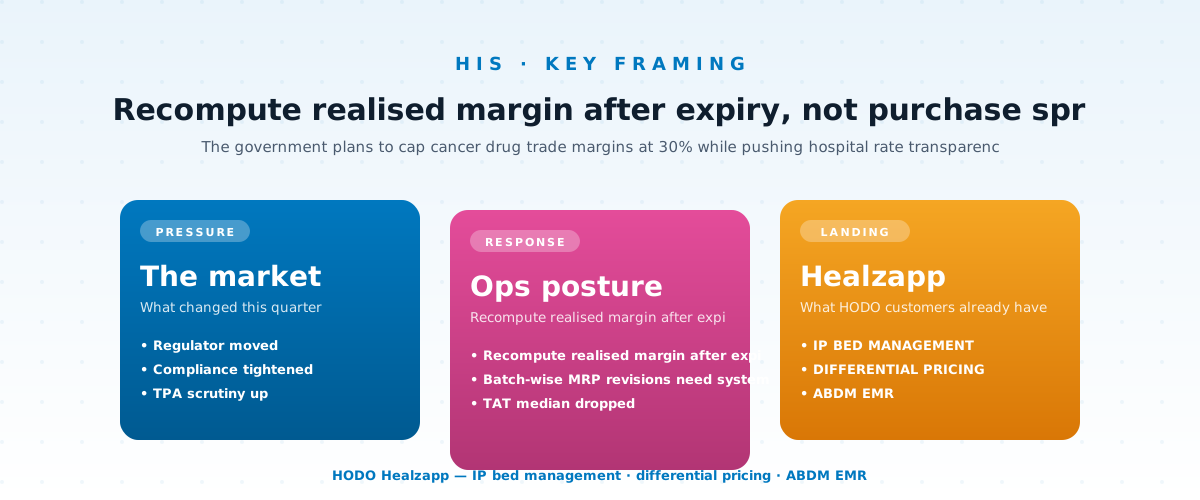
Recompute realised margin after expiry, not purchase spread.
What to measure this quarter
Four numbers are worth pulling before any notification takes effect. Realised margin by drug category, computed after expiry and write-off rather than on purchase-to-MRP spread. Expiry as a percentage of oncology purchase value, tracked monthly, not annually. Pharmacy contribution as a share of total hospital revenue, so the exposure to a cap is a known figure rather than a surprise. And billing exception rate, the count of bills amended after printing, which is the cleanest proxy for how much price confusion exists at the counter.
A hospital that can produce these four numbers in an afternoon is in a position to plan. One that needs a week of spreadsheet work to produce them will be reacting to the notification rather than preparing for it, and will likely absorb the cap as a straight hit to contribution.
What this means for HODO customers
The margin cap and the transparency push both reward hospitals whose stock, price, and bill live in one system. In Healzapp, Pharmacy and Inventory hold batch, expiry, and purchase rate at the unit level, so realised margin and expiry exposure on oncology stock are reportable rather than reconstructed. Differential pricing keeps cash, corporate, TPA, and scheme rate sets defined and auditable instead of applied by hand at the counter, which is what a published rate card requires. Tally integration moves purchase, credit note, and sales entries into the accounting ledger without a parallel spreadsheet, so MRP revisions do not create a month-end reconciliation backlog.