
Zee News reports that from September 1, roughly 15,000 hospitals across India may stop offering cashless treatment to policyholders of two large insurers, following an escalating dispute between hospital associations and insurers over tariff revisions and claim settlement. For hospital MDs, administrators and finance heads, this is not a distant headline — it is a live cashflow, front-desk and patient-experience problem that will land inside the next 60 days.
The trigger is a communication from the Association of Healthcare Providers India (AHPI) advising member hospitals to withdraw cashless facilities for two named insurers unless commercial terms — tariff revisions in line with medical inflation, faster claim clearance, and predictable denial rules — are resolved. The General Insurance Council has pushed back, arguing that continuity of cashless service is a policyholder right and that unilateral withdrawal will hurt patients more than insurers.
For hospitals, the operational reality is simpler than the politics. Any patient walking in on September 2 with a policy from either insurer will need to be treated on a reimbursement basis instead of cashless. That single change flips the pre-authorisation flow, the discharge desk conversation, the deposit collection policy and the receivables ageing bucket. Even hospitals that are not AHPI members will feel spillover — patients call every hospital in town before admission, and confusion at one competitor spreads to all.
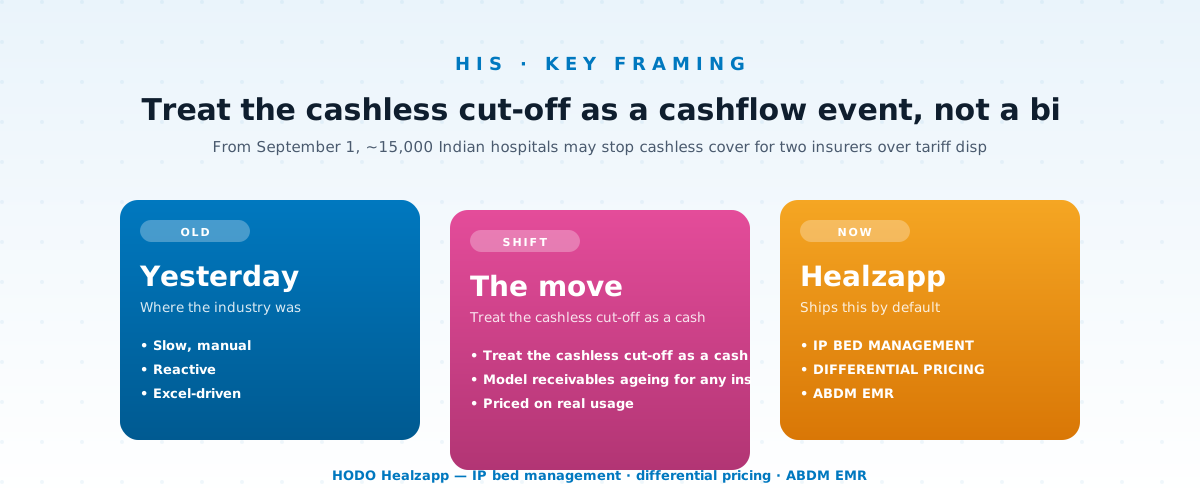
The reimbursement pathway shifts 100% of the bill onto the patient at discharge. In a 200-bed hospital where two named insurers account for even 12-18% of IP revenue, that translates into a working-capital hit of several crores in the first quarter alone. The money will eventually come back — but only after patients file, insurers process and reimbursement lands, which routinely takes 45-90 days.
Owner-operators should ask their finance team three specific numbers before the month ends. One: what share of IP and OP revenue in the last 90 days came from the two named insurers, split by cashless versus reimbursement. Two: what is the current DSO on non-cashless bills, and what happens to it if reimbursement volume triples. Three: what deposit policy is in force for reimbursement patients, and is the front desk enforcing it consistently across every outlet. Without those three numbers, any strategy meeting is guesswork.
The single largest failure mode in a cashless-to-reimbursement switch is not billing — it is the conversation at admission. Patients who assumed zero out-of-pocket suddenly face a full deposit demand, and the reaction ranges from anger at the counter to social media escalation. Every hospital should freeze its admission script, deposit table and refund policy in writing this week, then drill front-desk staff on it before September 1.
Proactive outreach to already-scheduled patients matters just as much. Patients with elective admissions in September who hold policies with the two insurers deserve a call, a WhatsApp message and an updated financial estimate before they arrive. The cost of one phone call is trivial compared to a cancelled surgery slot or a disputed discharge bill. Diagnostic and scan-centre chains carry the same exposure at a smaller ticket size — a Rs 8,000 MRI that was cashless yesterday is a Rs 8,000 upfront demand tomorrow, and the walk-away rate at the reception counter will spike unless it is handled with a proper scripted conversation.
Hospitals that have built their billing stack around one specific TPA portal integration will feel this cycle the hardest, because the workflow assumes one path (cashless) and treats reimbursement as an exception. The lesson from this dispute is that the billing engine has to be TPA-agnostic by design: the same estimate generation, the same discharge summary, the same tax invoice, the same GST posting and the same reconciliation ledger — regardless of whether the payer is an insurer, a corporate account, a government scheme or the patient directly.
Multi-outlet chains have an extra layer to handle. If outlet A honours cashless for a given insurer while outlet B has withdrawn, patients will arbitrage across the chain, and the head office will lose visibility on which outlet booked what. Central visibility over payer mix, receivables ageing and deposit collection — updated daily and not monthly — is the only way to see the shock as it lands rather than after month-end close.
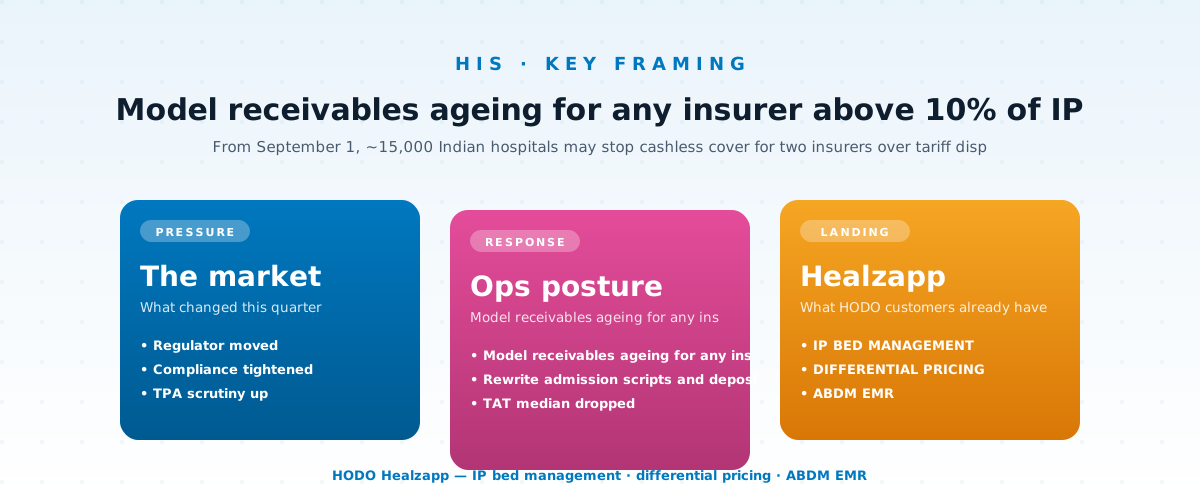
The current dispute is fundamentally about tariff. Hospitals argue that insurer rate cards have not tracked medical inflation, and insurers argue that hospital pricing lacks transparency. Whichever side an operator sympathises with, the practical takeaway is that empanelment contracts need to move from annual boilerplate to structured commercials: indexed tariff clauses, defined turnaround times for pre-auth and claim settlement, penalty clauses for delayed payment, and clear escalation matrices for disputed denials.
Corporate empanelments and TPA contracts should also be re-examined for concentration risk. If two insurers together drive more than a quarter of a hospital's receivables, the hospital is one policy dispute away from a cashflow crisis. Diversifying the payer mix — more corporate direct tie-ups, more Ayushman Bharat volume where the outlet qualifies, more transparent self-pay packages published on the hospital's own channels — is the medium-term hedge.
Hospitals running on HODO Healzapp have three specific levers that shorten the reaction time to a news event like this. Billing in Healzapp is designed to handle cashless, reimbursement, corporate and self-pay bills through the same estimate-to-invoice flow, so switching a patient from cashless to reimbursement is a payer-code change rather than a workflow rebuild. Corporate-partner logins let empanelled corporates and TPAs view live claim status, upload pre-auth documents and settle balances without the manual back-and-forth over email that inflates DSO on the receivables that stay in-network. And Tally integration keeps GST posting and the payer-mix ledger in sync with the finance team's books daily, so the CFO sees the cashflow shock in real time instead of at month-end close.
See how Healzapp handles this — book a 30-min demo.
See how Healzapp, Labzapp and EReazy fit your speciality in a free 30-minute demo.
Book a Free Demo