India's Central Drugs Standard Control Organisation has moved AI-based diagnostic software into the medical device regulatory perimeter, meaning any tool that reads a slide, flags a scan, or scores a pathology image will need a device licence to be legally deployed, according to reporting by the420.in. The rule catches lab operators between two problems at once: the vendors they already run and the vendors they are about to sign.
What CDSCO actually changed
The shift is not that AI in diagnostics is suddenly regulated, clinical decision support in India has been drifting toward the medical device framework for two years. What is new is scope. Standalone AI software that produces a diagnostic output, whether a probability score, a heatmap, or a triage recommendation, now falls under the same licensing regime as the imaging machine or analyser it sits on top of. That includes tools that read Pap smears, chest X-rays, ECGs, retinal scans, and increasingly, biochemistry pattern flags.
For lab operators, the practical read is simple. If a vendor sold an AI-assisted reporting module, or bundled a diagnostic AI as part of a machine interface, that module now needs its own licence. Absence of a licence doesn't just make the vendor non-compliant, it makes the report the lab issues legally exposed. The signature at the bottom is still the consultant's; the algorithm's regulatory status is now the lab's operational risk.
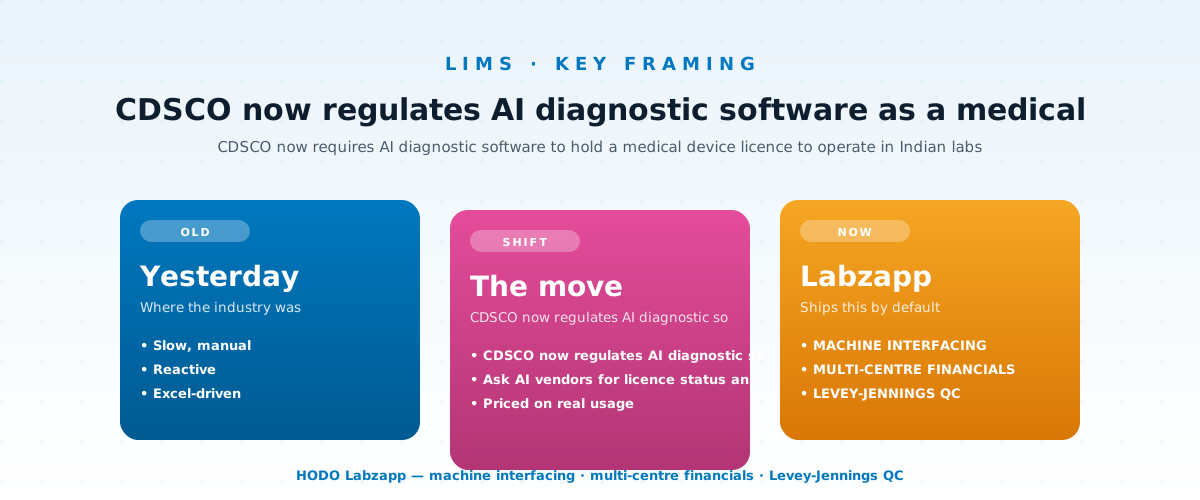
CDSCO now regulates AI diagnostic software as a medical device.
Why this hits lab operators before it hits software vendors
Enforcement realities in India mean vendors will move slowly. Small AI startups will apply, take 12 to 18 months, and quietly keep selling in the meantime. Larger foreign OEMs will apply through their Indian subsidiaries. In the middle, lab operators sit exposed: they are the ones running the software on live patient samples, generating billable reports, and answering to NABL auditors.
The immediate risk is not a raid. It is an audit trail question. When a NABL surveillance visit asks how a diagnostic call was made, "the AI helped" is no longer an answer that ends the conversation. Auditors will ask whether the AI is licensed, what version was running when that specific report was issued, and how the lab verified performance drift over the last quarter. Labs that cannot answer those three questions on a per-report basis are the ones who will see findings. Chains with 20 or 40 collection centres feeding into two or three processing hubs will find this hardest, the AI ran somewhere in the chain, but no one can point to which centre, which version, which sample.
The vendor conversation labs need to run this quarter
Every diagnostic AI vendor currently in a lab's stack needs three documents pulled before the next NABL cycle: current CDSCO application or licence status, version-lock policy (does the vendor push updates silently, or is each version separately validated), and a written statement of what the AI actually classifies versus what it merely highlights. That third point is where most vendor pitches quietly collapse, many AI modules are rule engines with a marketing skin, and clarifying that is often enough to sidestep the licensing question entirely.
For new procurement, the checklist gets longer. Ask for the intended-use statement in writing. Ask whether the AI runs on-device, on-premise, or in the vendor's cloud, because cloud inference means the medical device is technically off-shore, and CDSCO has been consistent that this does not dodge the rule. Ask for the training-data provenance summary, not to audit it, but because a vendor that cannot produce one has not done the paperwork required for a licence application either. If the lab is a franchisee network, head office needs a single approved vendor list that individual centres cannot override with local deals.
Costs, TAT and validation, what shifts on the shop floor
The operational cost is not the licence fee. It is the parallel-run period every lab will need when a licensed AI module replaces an unlicensed one. Expect two to four weeks of dual reporting, where the AI output is captured but not signed off, while consultants build a comparison baseline. Turnaround time will slip during that window. Cost per test will rise briefly. Both need to be planned for, not absorbed as a surprise.
Validation is the other quiet cost. Once an AI is licensed, the lab's own QC framework has to prove the AI is behaving as its licence specifies, which means daily or weekly control samples routed through the AI path, results tracked, drift flagged. This is close to what a good LIMS already does for analysers via Levey-Jennings charts; the same discipline now extends to any AI in the reporting chain. Labs that treated AI as a black-box add-on will find this cultural, not technical.
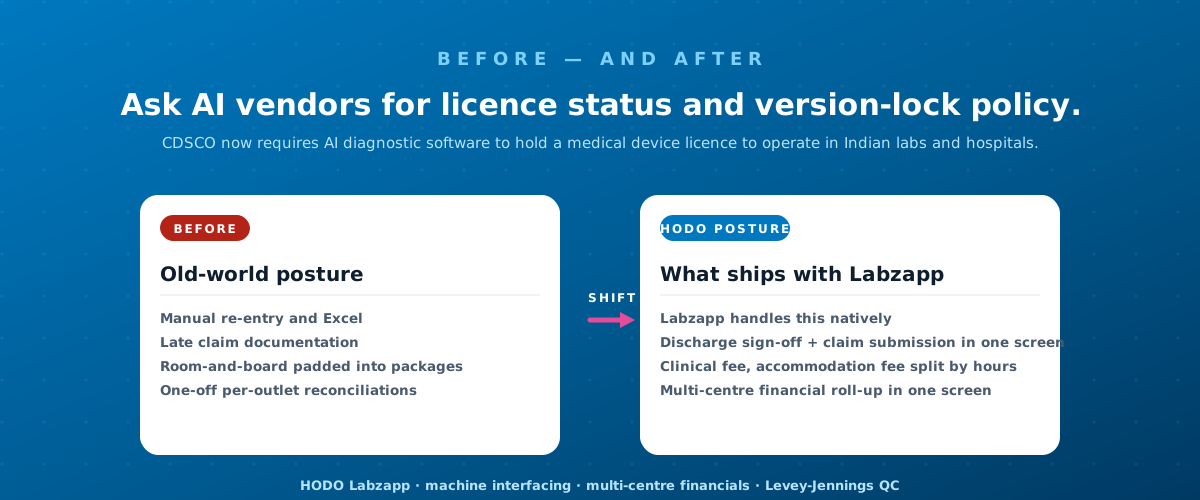
Ask AI vendors for licence status and version-lock policy.
Building a compliance-ready lab data spine
The labs that will absorb this rule change with the least disruption are the ones whose LIMS already knows which sample went through which instrument, which reagent lot, which operator, and now, which AI version. That is a data model question, not a compliance question. If a lab's software cannot answer "what version of X produced this report" for every report it issues, no amount of vendor paperwork will close the loop at audit time.
Similarly, chains with partner-lab arrangements, the anonymised sample tracking that lets a small centre send histopathology to a larger lab and get a report back, now need to know whether the receiving lab's AI is licensed, because the report bears both names. Franchisee networks face the same question in reverse: head office is responsible for the software stack running at every branded outlet, not just the flagship.
What this means for HODO customers
Labs already running Labzapp have the data spine this rule assumes. Machine interfacing captures the source instrument and version per sample, so extending the same discipline to a licensed AI module is a configuration change, not a rebuild. TAT reporting makes the parallel-run and post-licence performance windows visible instead of buried in ad-hoc spreadsheets. And partner-lab integration with anonymised sample tracking gives multi-centre and franchisee chains a single view of which AI module touched which report, across which outlet. The compliance work now becomes vendor management, which is where it should have been all along.