Medical Buyer reports that the Centre plans to deploy an AI-powered clinical decision support system across 70,000 public and private hospitals. The scale is unprecedented for Indian healthcare IT. For hospital administrators, the operational question is no longer whether CDSS is coming, it is whether the existing HIS can carry it.
Why the announcement matters for hospital operators
CDSS at this scale means every OP consultation, IP admission, and diagnostic order could route through an AI-suggested pathway. For a 200-bed hospital doing 800 OP visits a day, that is 800 additional structured data points the HIS must capture, timestamp, and hand off to the CDSS engine every single day. Hospitals still running paper case sheets or spreadsheet-based EMRs will not plug into a national deployment of this size without a systemic rebuild.
Capital allocation discussions for the next 12-18 months should now include the HIS replacement question, not defer it. Vendors currently offering EMRs without ABDM compliance, without structured discrete data capture, or without ABHA linkage will not survive the tender process once state health departments start attaching CDSS-readiness clauses. The announcement also creates a downstream effect on private insurance, TPAs and insurers will start asking why a claim's supporting EMR does not carry the CDSS interaction log. Hospitals that treat this as a compliance formality and defer the software decision to next fiscal year will find themselves paying premium for rush deployments in 2027.
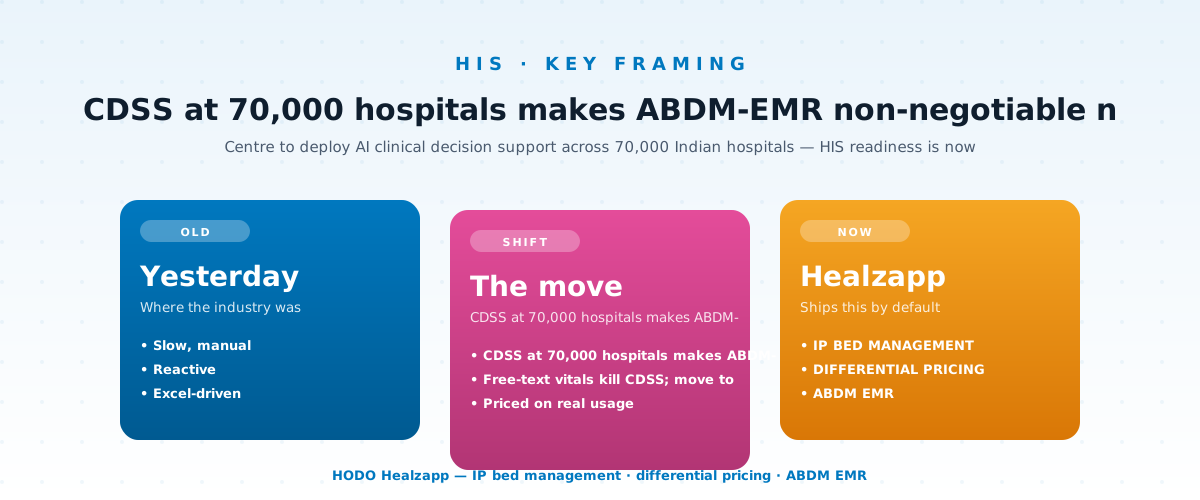
CDSS at 70,000 hospitals makes ABDM-EMR non-negotiable now.
The data-hygiene prerequisite most hospitals underestimate
CDSS output is only as good as the structured EMR input. If chief complaint is a free-text blob and vitals are typed into a narrative field, no decision engine can act on them meaningfully. Hospitals need discrete, coded fields for allergies, active medications, comorbidities, vitals, and lab values, all bound to the patient's ABHA identifier for cross-encounter continuity.
This is why the Centre's rollout implicitly forces adoption of ABDM-compliant EMRs, not just any EMR. A CDSS cannot pull in a patient's prior admission if that admission sits in a locally-hosted database with no interoperability layer. Administrators should run a diagnostic on their current EMR this quarter: how many patient records have structured allergy entries, how many have coded diagnoses using SNOMED or ICD, and how many are linked to an ABHA number? A figure below 60% on any of these dimensions means the hospital is not CDSS-ready today.
Fixing data hygiene retroactively across 200,000 legacy records is expensive and slow. Fixing it going forward, from the day a new EMR goes live, is the only viable path for most mid-sized hospitals.
Clinical workflow friction is the real deployment risk
Consultants earning volume-linked incentives will not tolerate a CDSS that adds three clicks per encounter. Nurses at triage will not read a 15-line AI recommendation while queues build behind them. The CDSS rollouts internationally that succeeded folded the AI recommendation into the existing OP note or ER triage form, not a separate screen.
Administrators should audit their HIS today with a specific question: does the EMR support inline decision prompts within the workflow, or will CDSS live in a parallel tab that clinicians learn to ignore within a week? The answer determines whether the Centre's investment translates into changed clinical behaviour at the hospital, or just another dashboard for the medical superintendent to review monthly.
The other friction point is override handling. Every CDSS will be overridden, that is normal and expected. What matters is whether the override is captured with a reason, tied to the encounter, and available for audit. HIS platforms that treat overrides as first-class events, not workarounds, will produce the compliance trail insurers and NABH auditors will start asking for within 18 months.
Multi-outlet chains face a governance question
For clinic chains and diagnostic networks running 5-50 outlets, CDSS deployment is not one project, it is one project per outlet, with a central override policy. Which alerts are hard-stop versus advisory? Who signs off on suppressing a CDSS recommendation for a specific patient profile? How does the group audit override rates across outlets to detect a rogue clinician or a broken workflow at one branch?
Chains that already run centralised HIS with standardised templates and one-click new-centre setup will complete the CDSS rollout in weeks. Chains stitched together from three legacy systems will spend twelve to eighteen months on integration alone, before a single CDSS alert fires in production.
The governance question also extends to differential pricing and partner logins. If a diagnostic chain runs different pricing for corporate partners and referral doctors, the CDSS layer must respect those partner boundaries, for example, not recommending investigations outside a corporate panel's approved list. This is not a clinical concern; it is a commercial one, and it needs to be designed into the CDSS deployment from day one, not patched later.
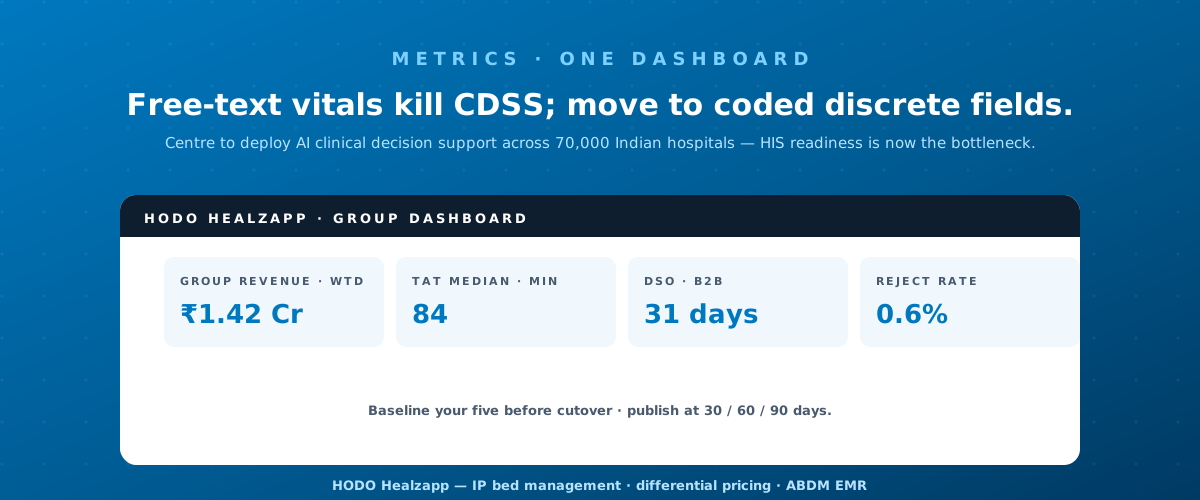
Free-text vitals kill CDSS; move to coded discrete fields.
Cashflow implications from TPAs and insurance
Insurers and TPAs are watching the CDSS rollout closely. Once the Centre's system is live, denials for clinically unnecessary investigations or admissions will start citing CDSS non-adherence as evidence. Hospitals that document the CDSS interaction, whether the clinician accepted the suggestion or overrode it with a documented reason, will have a cleaner audit trail for claim disputes.
Those that cannot produce that trail from their HIS will see rising claim rejections and slower reimbursement cycles. For a 200-bed hospital with monthly TPA billing of Rs 3-4 crore, even a 5% rise in denial rate is a Rs 15-20 lakh monthly cashflow hit. The finance office should be as interested in this rollout as the CMO. HIS selection criteria that focus only on clinical workflow miss the point, the vendor question is now equally about how the platform surfaces CDSS interactions to the billing module, and whether the audit log is exportable in the format TPAs will demand.
What this means for HODO customers
Hospitals on HODO Healzapp are already positioned for the CDSS integration curve. The ABDM-compliant EMR captures structured, coded data at source, which is the input any decision engine needs to function. The EMR (AI-condensed history) module gives clinicians a pre-read of the patient's cross-encounter history before the national CDSS layer is even queried, cutting the cognitive load a consultant faces when both an internal summary and an external recommendation land in the same encounter. And Multi-outlet scale-up with one-click new-centre setup means administrators of clinic chains and hospital groups can roll standardised CDSS templates across outlets without a separate deployment cycle per site.