
The Union Ministry of Health is preparing to roll out a cloud-based hospital management system for small clinics under the Ayushman Bharat Digital Mission (ABDM), Business Standard reported this week. The move is aimed at pulling single-doctor practices and sub-50-bed nursing homes into a common digital fabric — but the ripple effects will land squarely on 50-500 bed hospitals and multi-outlet chains that already run paid HIS deployments. If the smallest end of the market goes digital on a subsidised stack, the vendor and workflow assumptions at the mid-tier will need a fresh look.
The reported plan is a cloud-hosted, government-backed HMS distributed to small clinics either free or at a nominal price, with ABDM identifiers (ABHA, HPR, HFR) baked in from day one. It is not intended to compete with commercial HIS or LIMS platforms used by mid-size hospitals — the specification set covers appointments, basic OP billing, prescription capture, and health record push to the ABDM personal health records locker. The interesting piece for operators sits one layer up: every small clinic that a 200-bed hospital receives referrals from, or shares diagnostic work with, will soon be emitting structured, ABDM-tagged data. That raises the floor for what connected means in a referral network. A hospital that still exchanges patient histories over WhatsApp or scanned PDFs with feeder clinics will look outdated inside two quarters.
The other operational point: the Centre's system is being pitched as a way to bring roughly 1.5-2 lakh un-digitised clinics into the ABDM count. That number matters because ABDM linkages are increasingly a soft prerequisite for empanelment expansions, insurance pre-auth speed, and CGHS-style panel renewals.
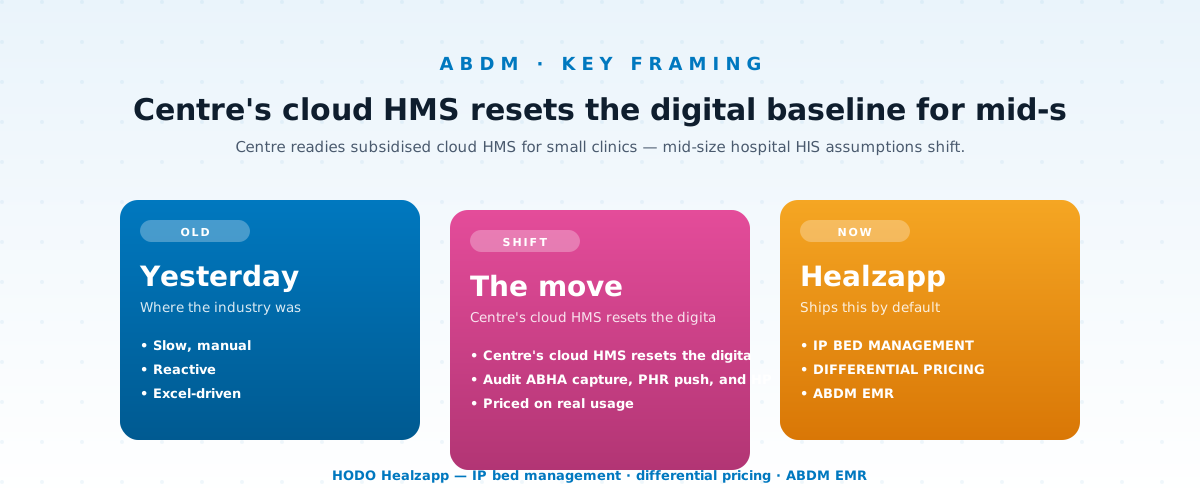
Most mid-size Indian hospitals already run a HIS. The question the Centre's move forces is not should we digitise but is our current HIS actually ABDM-native, or is it a legacy stack with an ABDM sticker on top. Three signals separate the two: whether ABHA linking happens at registration without a manual toggle, whether discharge summaries push to PHR automatically, and whether the HIS can share consented records with a small clinic on the government stack without an integration project. Vendors who tick these boxes have been building for two years; those who have not will scramble.
The second calculus shift is around referral capture. Small clinics on a subsidised HMS become discoverable inside the ABDM registry. Hospitals with a working referring-doctor portal — one that shows a GP their patient's IP progress, lab results, and discharge plan — will consolidate that referral base. Hospitals without one will keep losing referrals to whoever picks up the phone first.
NRCeS certification, HPR-linked provider directories, and consent-based record exchange are no longer talking points at digital health conferences — they are inspection checklist items. When the small-clinic tier goes ABDM-native under the Centre's subsidised HMS, the compliance conversation for larger hospitals stops being about intent and starts being about audit trail. State health authorities will find it easier to ask a 250-bed hospital for ABDM linkage rates, PHR push counts, and consent artefact logs when the 5-bed clinic down the road can produce the same reports from a free system.
Operators should treat the next 60-90 days as the window to confirm their HIS vendor is on the NRCeS list, enable ABHA capture at every registration desk with a hard rule rather than a soft prompt, and get a monthly ABDM push report on the CIO's dashboseard. The cost of not doing this is not a fine — it is slower TPA cashflow, patchy insurance pre-auth, and awkward conversations at empanelment renewal.
A subsidised HMS at the small-clinic end will pull down the reference price of basic digital health infrastructure in the market. Mid-size hospital operators renewing HIS contracts in FY26 will have new negotiation leverage, but they will also face harder questions from boards about what the paid HIS actually delivers over the free one. The honest answer is: IP management, OT scheduling, pharmacy inventory, machine interfacing, insurance workflows, TPA billing, multi-outlet consolidation, and role-based clinical modules. The free system will not do any of this. But operators need to be able to say so in one slide, with numbers.
The right internal exercise is a per-patient cost breakdown: HIS licence cost divided by registered patient visits, benchmarked against staff hours saved on billing, TAT improvements on discharge, and reduction in claim rejections. Hospitals that have never run this number will find it uncomfortable — and useful.
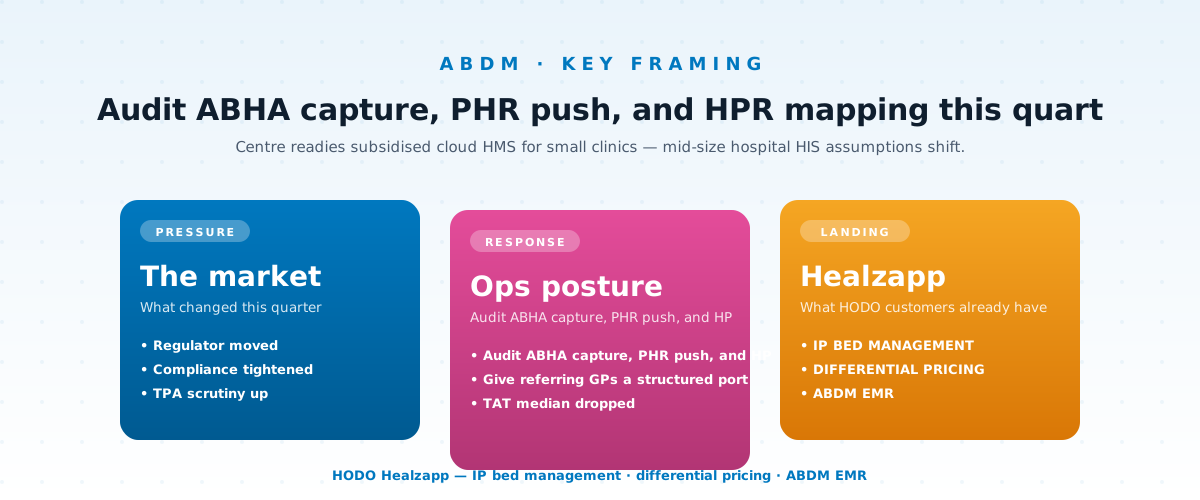
Five checks worth running before the Centre's system goes live. One, ABDM readiness — ABHA capture rate at OP registration, PHR push success rate on discharge, HPR mapping for every consulting doctor. Two, referral pipeline health — does the HIS have a working referring-doctor login with visibility into the referred patient's journey. Three, multi-outlet posture — if the hospital plans to add a satellite clinic or diagnostic outpost, can a new centre be set up on the existing HIS without a fresh implementation project. Four, financial integration — is the HIS pushing to Tally or a comparable accounting stack without CSV gymnastics. Five, communication rails — are lab reports and discharge summaries reaching patients on WhatsApp and SMS without a manual send step.
Anything scoring below 80% on these five is a candidate for either a vendor upgrade path conversation or a quiet market scan.
Hospitals already on HODO Healzapp are covered on the ABDM axis — the HIS is one of the first 20 ABDM-integrated HealthTechs in India and is NRCeS listed, so the compliance layer does not need a retrofit. Three specific features carry disproportionate weight against the Centre's announcement. First, ABDM-compliant EMR handles ABHA linkage, HPR mapping, and PHR push as default behaviour rather than optional configuration, which is what the audit conversation will centre on over the next two quarters. Second, B2B Referral / Outsource Lab / Corporate-partner logins gives feeder clinics and referring GPs a structured portal — the exact rail needed when small clinics move onto the ABDM grid and start emitting structured referrals. Third, Multi-outlet scale-up with one-click new-centre setup matters because the operators who react fastest to a shifting digital baseline are the ones expanding footprint — and setup friction is what kills that timeline.
See how HODO Healzapp handles this — book a 30-min demo.
Source of the news hook: Read the source article →
See how Healzapp, Labzapp and EReazy fit your speciality in a free 30-minute demo.
Book a Free Demo