The Economic Times has published a comparison of health insurers on a metric most hospital finance teams track informally and almost never formally — how quickly an insurer actually pays a claim it has already approved. Approval and payment are two different events, separated by anything from a fortnight to a full quarter, and the gap is where a 100-bed hospital's working capital quietly goes to sleep. For revenue cycle teams, the useful reading of that story is not which insurer tops the table; it is that settlement speed is now a published, comparable number, and payer mix has become a cashflow decision rather than a marketing one.
Approval rate and settlement speed are not the same metric
Most Indian hospitals review their insurance performance through two figures: the proportion of claims approved, and the deduction percentage on approved amounts. Both matter, but neither tells the finance team when money will arrive. A TPA that approves 94% of claims and pays in 68 days is harder on cashflow than one that approves 88% and pays in 22 days, because the second one lets the hospital fund salaries, pharmacy restocking and consumable purchases out of collections rather than out of an overdraft.
The distinction becomes sharper at scale. A 100-bed hospital running 65% occupancy with roughly half its inpatient revenue coming through cashless arrangements carries a receivable book that behaves like a loan nobody formally underwrote. Every additional week of average settlement time adds to that book. The published settlement-speed comparisons are useful precisely because they give negotiating teams an external reference point — a hospital can now walk into an empanelment discussion with a number the insurer's own regulator-reported data supports, instead of an anecdote about a batch that took three months.
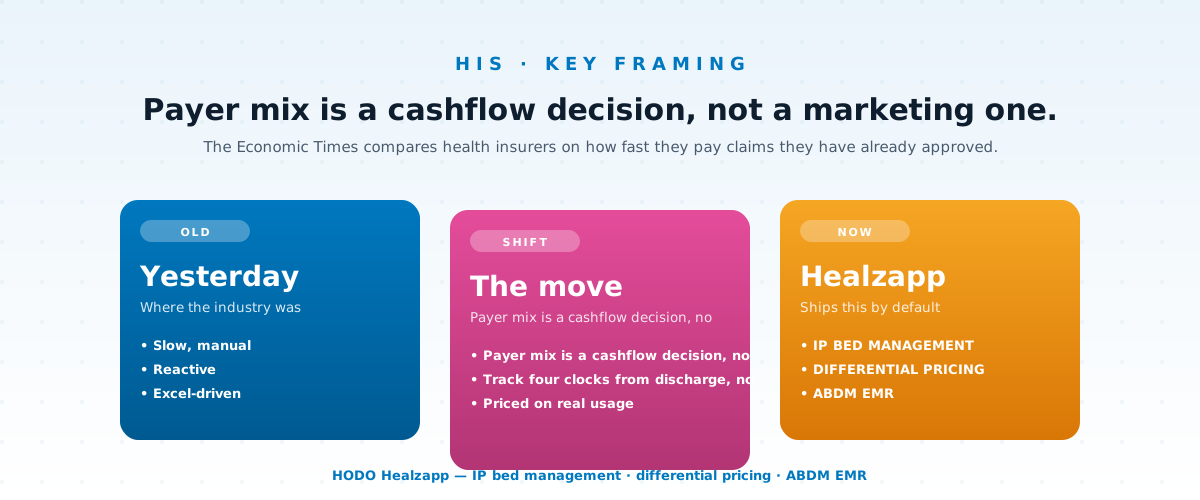
Payer mix is a cashflow decision, not a marketing one.
Measure days-to-cash per payer, not per claim
The practical first step is to stop measuring claim age from the date of query resolution and start measuring it from discharge. Four clocks are worth separating in the billing system: discharge to claim dispatch, dispatch to approval, approval to payment advice, and payment advice to bank credit. Hospitals that only track the middle segment blame insurers for delays that are in fact sitting in their own medical records department, waiting for a discharge summary to be signed.
Once the four clocks are visible per payer, patterns appear that no monthly MIS surfaces. One TPA may be fast on surgical packages but slow on medical management claims where implant and consumable justification is required. A government scheme may pay reliably but in fortnightly batches, which means a claim filed a day after the cut-off waits an extra cycle for reasons that have nothing to do with documentation quality. A corporate panel may settle quickly but deduct consistently on room-rent differentials, making its effective realisation lower than a slower payer. None of this is visible when all non-cash revenue is reported as a single "insurance" line.
The documentation discipline that decides the first clock
Settlement speed is partly the insurer's behaviour and partly the hospital's file quality. Queries are the single largest controllable cause of delay, and most queries repeat: missing initial assessment notes, investigation reports not attached to the claim, pharmacy indents that do not map to the prescribed line items, implant invoices without lot numbers, and discharge summaries that state a diagnosis the pre-authorisation did not mention.
A hospital that logs query reasons by category for one quarter usually finds that six or seven recurring causes account for the bulk of its rework. Fixing them is a process change, not a technology project: a pre-dispatch checklist owned by the billing supervisor, a rule that the treating consultant signs the discharge summary before the patient physically leaves, and a standing instruction that diagnostic reports move into the patient file automatically rather than being chased by the insurance desk. The gain is immediate — claims dispatched clean on the first attempt skip an entire query-and-resubmission loop that typically costs two to four weeks.
Payer mix as a balance-sheet decision
Indian hospitals rarely model payer mix against cost of capital, and it shows. If a hospital borrows working capital at 11–12% annually, every rupee of revenue parked in a 90-day receivable costs roughly 3% of its value in financing alone before any deduction is applied. Set that against the discount a fast-settling insurer may demand on tariff, and the arithmetic sometimes favours the insurer that pays less but pays sooner.
This does not argue for dropping panels. Volume commitments, catchment demographics and PMJAY or state-scheme obligations constrain most hospitals' choices heavily. What it argues for is pricing the delay honestly in every tariff negotiation, and for sequencing collection effort by value at risk rather than by claim age. Follow-up capacity is finite; a single ₹4 lakh orthopaedic claim pending 60 days deserves more attention than forty small OP claims pending 70 days. Hospitals that sort their follow-up queue by rupees rather than by days consistently recover faster with the same two-person insurance desk.
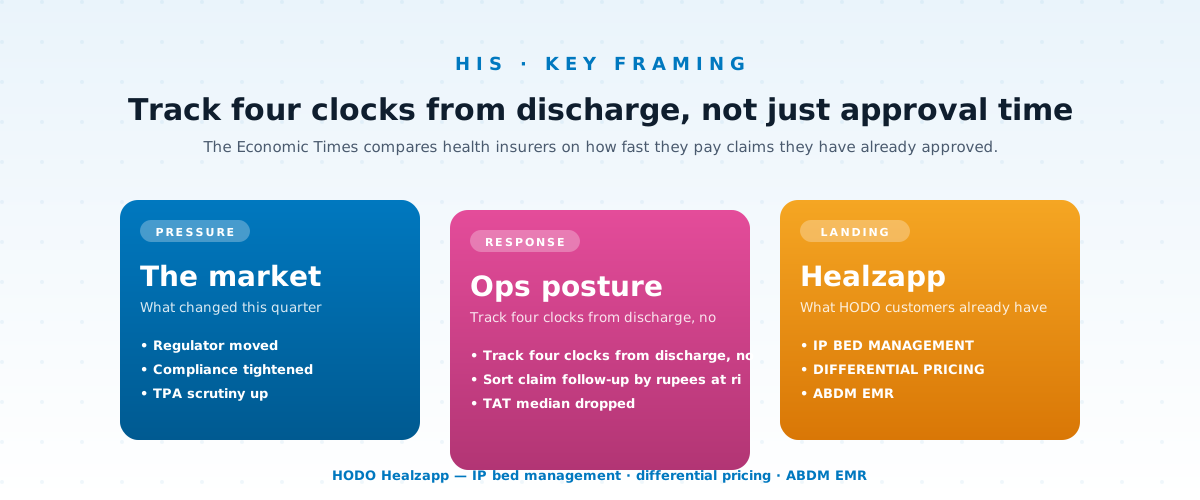
Track four clocks from discharge, not just approval time.
Building the review habit around it
A payer scorecard is only useful if someone reads it on a schedule. The pattern that works at 100-bed scale is a fortnightly thirty-minute review attended by the billing head, the medical records in-charge and one clinician, looking at four things: ageing by payer, query reasons by category since the last review, deduction value by reason code, and claims dispatched beyond 48 hours from discharge with the reason recorded. Decisions get taken in the room — a consultant reminded about implant documentation, a checklist item added, a TPA relationship manager escalated to.
The reason this habit matters more than any dashboard is accountability. Ageing reports circulated by email are read by nobody and change nothing. A review where the medical records in-charge has to explain why fourteen discharge summaries sat unsigned for three days changes behaviour within a cycle. Accreditation reviews under NABH increasingly look for exactly this kind of closed-loop evidence, so the documentation produced has a second use beyond finance.
What this means for HODO customers
Settlement speed is a reporting problem before it is a negotiation problem, and it needs the billing system to hold payer identity cleanly from registration onwards. In HODO Healzapp, Billing carries the claim through pre-authorisation, approval, deduction and payment stages so ageing can be read per payer rather than as one aggregate receivable, while Differential pricing keeps scheme, corporate and cash tariffs separate instead of forcing manual adjustments that later show up as deductions. Tally integration closes the loop into the accounts books, so what the insurance desk calls outstanding and what the finance team reports as receivables are the same number. For hospitals working with corporate panels and referring partners, B2B Referral / Outsource Lab / Corporate-partner logins reduce the email chasing that pads the first clock. Fast settlement is mostly discipline — the system's job is to make the discipline measurable.