EIN News reports that King Faisal Specialist Hospital and Research Centre has put formal governance around its clinical AI, with named safeguards against bias, hallucination and performance drift. The detail worth reading is not the ethics language, it is that a major Gulf provider has written down the conditions under which an algorithm is allowed to influence care. For founders building lab-at-home, doctor-at-home, clinic or diagnostics products across the GCC and India, that document is a preview of the questions procurement will ask, and it arrives long before any feature demo.
A governance framework is a buying checklist in disguise
When a reference institution publishes safeguards, those safeguards propagate downward through the market. Smaller buyers do not write their own frameworks; they borrow the vocabulary of the biggest hospital in the region and put it in a tender. A 14-doctor polyclinic group in Dubai, a three-branch lab in Riyadh or a home-collection operator in Doha will not run a bias audit. They will ask whether one exists, who signed it, and what happens when the model is wrong.
That changes the shape of an early-stage product. A founder pitching AI triage, AI report summarisation or AI-assisted coding into a Gulf facility used to be assessed on accuracy claims and demo quality. Increasingly the assessment includes model provenance, versioning, the human sign-off step, and the log that proves both. These are engineering commitments, not slide content, and they are expensive to retrofit once a product has live customers.
The practical implication is ordering. Governance scaffolding is usually treated as a compliance task to be handled after product-market fit. In healthcare it is closer to the opposite: the audit trail is part of the thing being sold, because it is what lets a medical director accept liability for using the output at all.
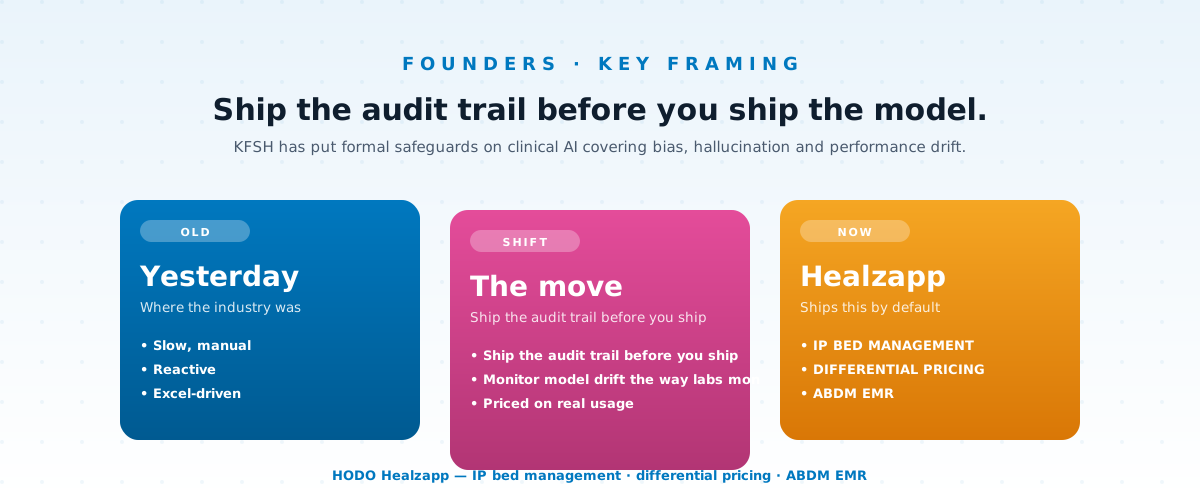
Ship the audit trail before you ship the model.
Name the three failure modes in your own product
Bias, hallucination and drift are not interchangeable risks, and each lands differently depending on what is being built.
Bias shows up wherever training or tuning data under-represents the population actually being served. A home-collection operator in the UAE serves a patient mix dominated by expatriate working-age adults; a lab chain in Kerala does not. A risk score tuned on one population and sold into the other will be confidently wrong in a direction nobody notices, because the errors cluster in a group that generates fewer complaints.
Hallucination is the acute risk for anything generating text a clinician or patient will read, discharge summaries, history condensation, report narratives, WhatsApp messages explaining a result. A fabricated value in a free-text summary is more dangerous than a wrong number in a structured field, because free text carries no validation and no provenance. The design answer is to constrain generation to content that can be traced back to a stored record, and to make that trace visible rather than implied.
Drift is the quiet one. A model that performed well at launch degrades as the input distribution moves: a new analyser is installed, a test panel is renamed, a referral partner changes its request format, patient mix shifts after a new branch opens. Nothing errors. Accuracy simply decays, and nobody is measuring it because the launch validation was a one-time exercise.
Treat drift monitoring the way labs treat quality control
Diagnostics has a solved pattern for exactly this problem, and founders building adjacent to labs should copy it. An analyser is not validated once and trusted forever. It is run against controls on a schedule, the results are plotted over time, and a trend away from the mean triggers action before any patient result is affected.
The same discipline applies to a model in production. That means a fixed reference set re-scored at a defined interval, a recorded metric per model version, a threshold that triggers review, and a named owner for that review. It also means knowing which upstream changes invalidate the baseline, an instrument swap, a new partner lab, a reference-range revision, a new outlet with a different case mix.
For a founder, this is a build decision with a real cost. Storing inputs and outputs per inference, keyed to model version, is cheap to design at the start and awkward to add later. Without it, drift can only be inferred from customer complaints, which is the slowest and most expensive detection method available. With it, degradation becomes a chart someone reviews on a Monday, and the product gains something genuinely saleable: evidence that performance is being watched.
The record layer carries the governance, not the model
Most AI governance obligations in healthcare resolve into record-keeping problems. Who ordered this. What data the model saw. Which version produced the output. Who reviewed it. What was sent to the patient, when, and to which number. None of that lives in the model. It lives in the operational system around it, registration, orders, results, billing, delivery.
This is where products built AI-first tend to run into trouble in the GCC and in India alike. A summarisation layer assumes a structured history exists. A triage model assumes appointments and visit types are consistently coded. A result-interpretation feature assumes analyser output arrives as data rather than as a printout someone photographs. Where the record layer is thin, the AI feature cannot be governed even if the founder wants to govern it, because there is nothing authoritative to trace back to.
The sequencing that works is unglamorous: get deterministic capture working first, identity, orders, instrument data, dispatch logs, then add inference on top of a substrate that can answer audit questions. Buyers in Saudi Arabia, the UAE, Qatar and Bahrain are converging on this view faster than most roadmaps assume, and licensing conversations with DHA or MOHAP-style regulators reward it.
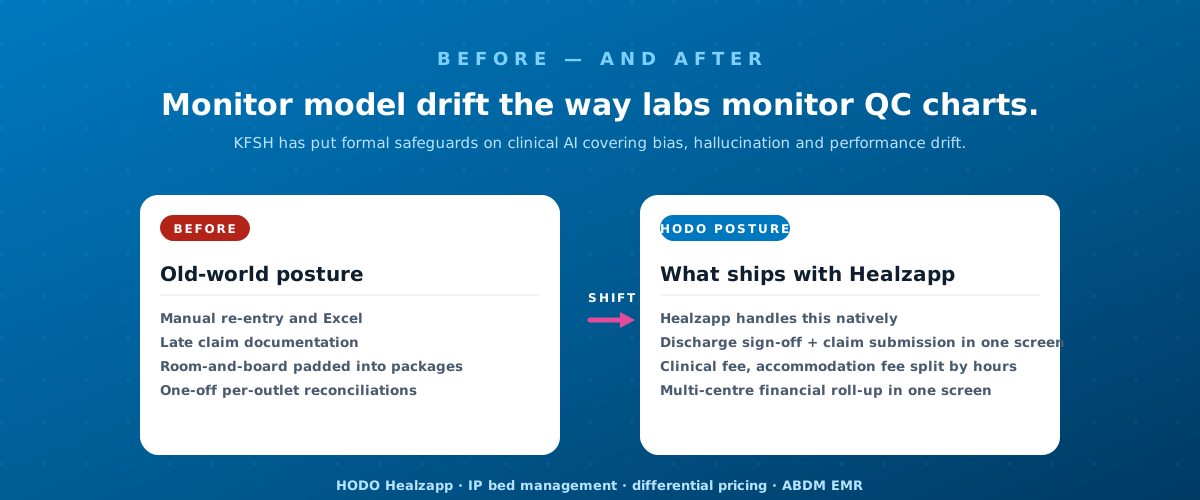
Monitor model drift the way labs monitor QC charts.
Governance belongs in the unit economics, not the ethics slide
There is a commercial reason to take this seriously beyond risk. Governance work has a measurable cost per inference and per visit: storage, review time, periodic revalidation, and the staff minute spent confirming an AI-generated summary before it goes out. Founders who have not costed that line will mis-price the product and discover the margin gap after scaling to a few hundred visits a day.
Costing it also sharpens scope. A model whose output requires a two-minute clinician review on every case may be worse than no model at all for a high-volume, low-ticket workflow such as routine home collection. The same model may be clearly worth it where a single avoided error prevents a repeat visit or a rejected claim. Pricing governance honestly is how a founder decides which AI features belong in version one and which belong in a premium tier for buyers who will pay for the audit trail.
What this means for builders
A governance framework at a flagship Gulf hospital sets the language the rest of the market will use within a year or two. The products that clear those questions are the ones where the operational record is strong enough to answer them, which is why reference architecture matters more than model choice at this stage. In Healzapp, EMR (AI-condensed history) is built so condensation sits on top of a stored clinical record rather than replacing it, keeping the source traceable. Machine Interfacing removes the transcription step that makes instrument data unauditable, and WhatsApp/SMS report delivery logs what was sent, to whom and when, the evidence a medical director asks for when an output is questioned. Built in that order, governance stops being a cost centre and becomes part of the reason a buyer signs.