The General Insurance Council has told The Times of India that close to 5,000 hospitals are being brought onto a common cashless platform usable by every insurer, pushing the Cashless Everywhere idea towards shared infrastructure instead of insurer-by-insurer plumbing. For a 100-bed hospital in India, this is not an insurance headline. It is a front-office, tariff and cashflow change, and most of it lands on whatever HIS the billing counter runs.
The submission layer collapses; the hospital's own work does not
Billing executives at a mid-sized hospital today juggle a dozen TPA portals, each with its own pre-auth template, document checklist, upload limit and escalation contact. A common platform standardises that layer: one place to raise pre-auth, one place to track status, one format for the discharge claim. What it does not do is produce the inputs. Diagnosis coding, package selection, tariff mapping, the itemised bill, the discharge summary, investigation reports, implant invoices and consent forms are all generated inside the hospital.
Standardising the pipe actually raises the penalty for weak inputs. When the format is uniform, deficiencies become visible and comparable across insurers, and a hospital with inconsistent documentation will see its query and rejection ratio stand out rather than get absorbed in one TPA's backlog. Claim handling stops being a relationship exercise with individual TPA desks and becomes a process metric that management can review weekly. Hospitals that still assemble a claim by printing from three disconnected systems and stapling the output together will carry the same lag they carry now, only measured against peers on a shared dashboard. The work to do is upstream and unglamorous: one patient record, one bill, one clinical file, assembled once and reused for every payer.
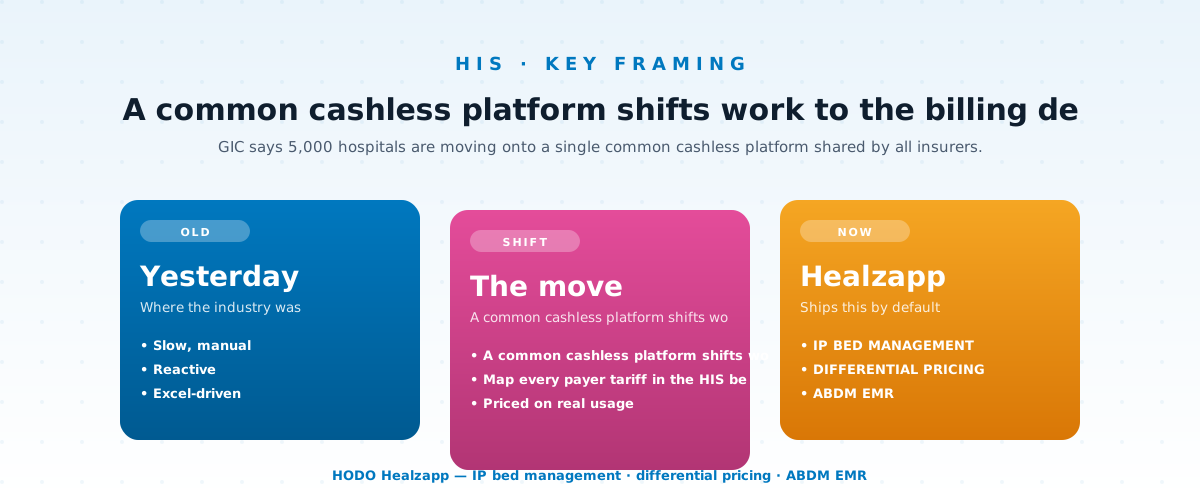
A common cashless platform shifts work to the billing desk.
Cashless growth is a working-capital decision, not a marketing one
When cashless is available at non-network hospitals as well, the share of patients walking in with a policy rather than cash rises. That helps bed occupancy and OP-to-IP conversion. It also hits working capital directly. A hospital collecting 60 per cent of its IP bill at discharge today may find itself collecting 25 per cent, with the balance sitting in a receivable that settles anywhere between 21 and 60 days depending on the payer and the number of deficiency cycles. Occupancy up, bank balance down is a combination that has strained more mid-sized Indian hospitals than any clinical problem.
The control is measurement at payer level. A single debtors figure in the trial balance is useless here. Payer-wise receivable ageing shows which insurer, which TPA, which corporate account and which government scheme is funding the hospital, and which is quietly borrowing from it. That only works when the billing module and the accounts ledger agree, which in practice means the HIS should post to Tally continuously rather than be reconciled against it by hand at month end. Hospitals planning for a higher cashless share should also model the pharmacy and consumables float separately, since those are paid to vendors upfront and recovered inside a claim that may be partly disallowed.
Tariff mapping is the prerequisite nobody budgets for
A typical 100-bed hospital runs cash rates, PMJAY package rates, CGHS or state scheme rates, two or three corporate contracts, a handful of TPA tariffs and camp pricing. Every one of those has a revision history and an owner, and in most hospitals they live in spreadsheets kept by one person. When submission moves to a common platform, rate mismatches surface faster because comparison across claims becomes trivial.
The fix is a single service master with payer-specific rates attached, so the rate applied at the counter is the contracted rate and not a billing clerk's judgment. The same discipline applies to non-payables. Gloves, syringes, administrative charges and certain consumables are routinely disallowed, and if they are not categorised at item-master level, the patient-payable portion gets computed manually at discharge and then argued about at the counter. Tagging them once means the discharge bill splits into payer-payable and patient-payable automatically, which shortens discharge time and removes a common source of refund disputes. Hospitals should also keep an audit trail on tariff changes: who revised which rate, effective from when. On a common platform, a rate applied three weeks after a contract revision is no longer an internal matter.
Documentation speed is now settlement speed
Under a shared platform, the differentiator between two hospitals with identical case mix is how fast a complete, defensible claim file leaves the building. The metric worth tracking is hours from discharge to claim dispatch, and after that, queries per hundred claims. Both are documentation problems rather than finance problems.
Most of the delay sits in clinical records. Discharge summaries waiting on a consultant, nursing notes that do not match the medication chart, investigation reports attached as photographs, and prior history that has to be reconstructed from paper files. An HIS where nursing charting, orders, reports and billing sit in the same record removes that assembly step. AI-condensed history helps reviewers at the insurer end as much as it helps the treating consultant, because a readable chronology reduces the back-and-forth that drives deficiency cycles. ABDM-compliant records matter here too, not as a compliance badge but because a patient arriving with prior records linked saves the hospital from re-justifying investigations it has repeated. Hospitals should pick two or three high-volume procedures, document the exact file a clean claim needs, and make that the template rather than leaving it to individual executives.
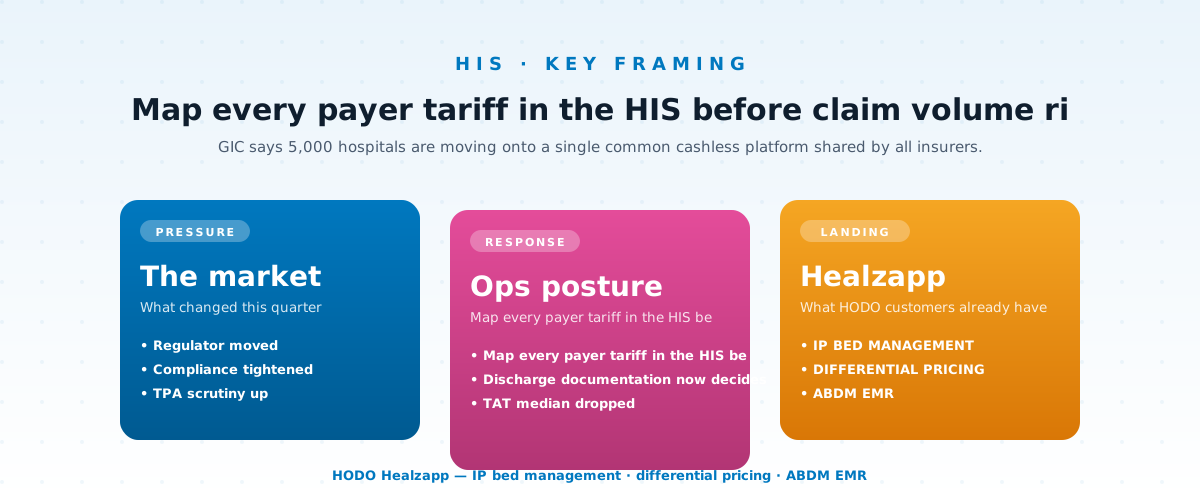
Map every payer tariff in the HIS before claim volume rises.
Diagnostics and pharmacy ride inside the same claim
Lab, radiology and pharmacy typically account for a large share of a disputed bill, and they are where transcription errors creep in. Results typed manually from analyser printouts, outsourced tests tracked over WhatsApp, and scan reports that reach the file after the claim has gone out all extend the cycle. Direct analyser integration removes the retyping step and timestamps the result, which is what a reviewer looks for when questioning whether an investigation preceded a treatment decision.
Outsourced panels deserve specific attention. Where a hospital sends specialised tests to a reference lab, the report has to return into the same patient record with the right rate attached, or it becomes either a disallowance or an unbilled cost. Lab chains supplying these hospitals sit on the other side of the same cycle: their payment follows the hospital's claim, so TAT and report formatting directly affect their own collection period. For hospitals running satellite collection centres or a second unit, the tariff and claim template should be set once and inherited, not rebuilt per location.
What this means for HODO customers
A common cashless platform rewards hospitals whose internal data is already clean and penalises those relying on manual assembly. Three things in Healzapp map to this directly. Differential pricing holds payer-specific rates against a single service master, so TPA, corporate, scheme and cash rates are applied at billing instead of being corrected after rejection. Tally integration keeps the billing ledger and the accounts ledger in step, which is what makes payer-wise receivable ageing trustworthy enough to act on. ABDM-compliant EMR with AI-condensed history shortens the gap between discharge and a complete claim file, and gives reviewers a chronology they can read without raising a query. For hospitals running more than one unit, Multi-outlet scale-up with one-click new-centre setup means the tariff masters and claim templates travel to the next centre rather than being rebuilt.
The hospitals that gain from this change will be the ones that spend the next two quarters on tariff masters, item-level non-payable tagging and discharge documentation discipline, rather than waiting for the platform to go live and then reacting.