
Outlook Business has reported that private hospital associations are formally opposing the insurance industry's proposal for a common empanelment framework — a scheme under which a hospital, once cleared by one insurer, would be treated as empanelled across all general and health insurers on a single set of tariffs and cashless terms. Insurers pitch it as a fix for the paperwork ordeal that policyholders face at admission. Hospital owners are reading it differently: as a rate-compression move dressed up as a consumer-convenience reform.
The standoff will not be resolved by press releases. Whichever way the regulator eventually leans, hospital owners have roughly twelve to eighteen months to fix the operational reality inside their billing and TPA desks — because the moment a common empanelment framework kicks in, even in a soft form, the negotiation leverage shifts to whoever holds cleaner data on cost, throughput, and outcomes.
The proposal — as reported and as discussed in industry consultations — is a bundle of four things. One, a shared credentialing and empanelment process so a hospital does not have to file the same infrastructure, staffing, and NABH paperwork with each insurer separately. Two, a common tariff structure for cashless procedures, likely package-based, with corridor limits by city tier and hospital grade. Three, a uniform pre-authorisation and discharge workflow with agreed turn-around times on both sides. Four, a shared master of hospitals, doctors, and packages that TPAs and insurers can pull from without individually mapping.
On paper, three of these four items help hospitals as much as they help policyholders. It is item two — the common tariff — that has triggered the pushback, because a tariff decided at industry level cannot easily reflect the vast cost differences between a 60-bed nursing home in a tier-3 city and a 300-bed multi-speciality in a metro.
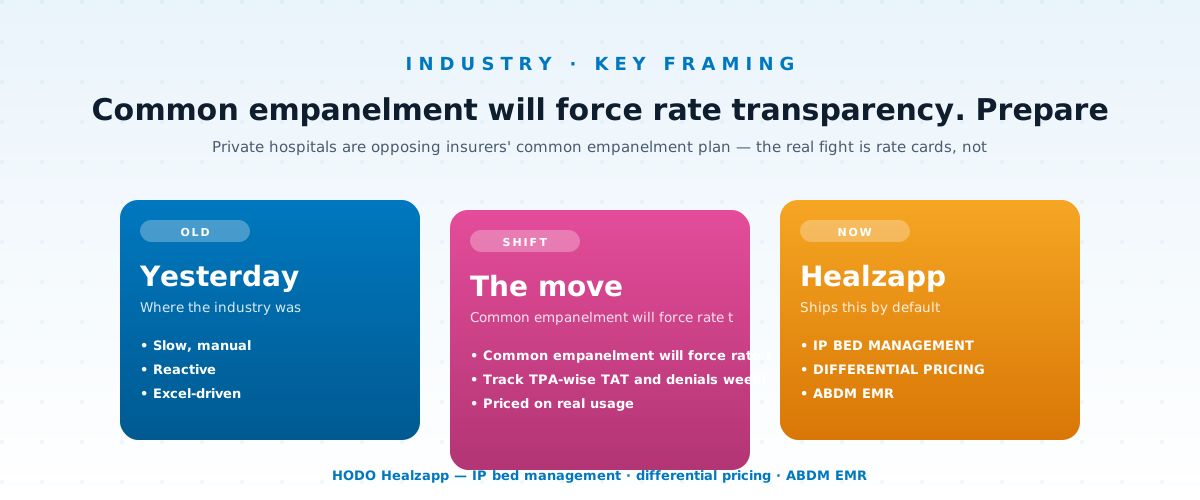
Three concerns keep coming up in the resistance. First, tertiary hospitals cross-subsidise unprofitable specialities — paediatric ICU, burns, complex neonatology — using margins on packages that are routinely under-priced in insurer schedules. A single tariff freezes that cross-subsidy in place and does not leave room for the tertiary hospital to keep those loss-making units open.
Second, capital cost is unequal. A hospital that recently invested in a cath lab, a robotic surgery system, or a linear accelerator carries EMI load that a hospital using ten-year-old equipment does not. A common package rate treats both identically and quietly punishes the reinvesting operator.
Third, and less discussed publicly, is the fear of losing negotiating access altogether. Today an administrator can escalate a stuck claim, a wrong denial, or a coding dispute to a named account manager at each insurer. In a common empanelment world, that channel could collapse into a shared grievance portal — which is fair in theory and often slow in practice.
The pushback is not unreasonable. But it is also not a defence that will hold up if hospitals cannot show clean data on their own cost per package, denial rate by payer, and discharge TAT.
Cashless business is now 50-70% of revenue for most 50-500 bed hospitals, and the operational cost of running that book is quietly rising. Days-sales-outstanding on TPA receivables has drifted from 45 days to 70-90 days in several networks over the last two years. Denial rates on first submission sit between 8% and 18% in the hospitals that measure it — and most do not measure it at that granularity. Discharge delays waiting for final pre-auth eat into bed turnover, and in an IP business, bed turnover is the actual margin lever.
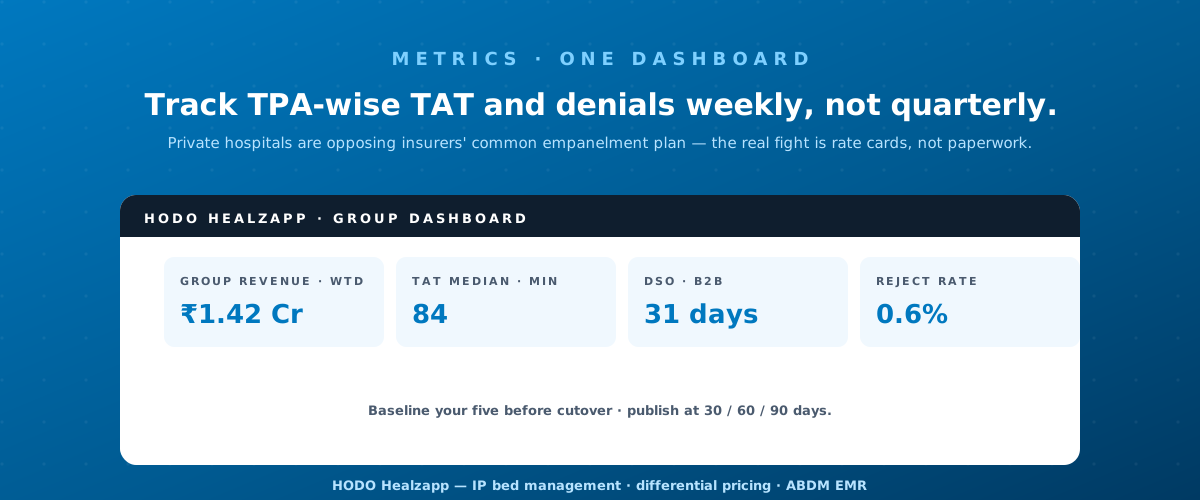
Owners who track cashless as one blended KPI ("we are at X% cashless") are flying blind. The number that matters is payer-wise TAT and denial trend, tracked weekly, plotted against the contracted SLA. Without that, any renegotiation — under the current bilateral regime or under a future common empanelment regime — starts from a weaker position.
Five items belong on the operations agenda for the next two quarters, independent of what the regulator decides. One, get every payer contract loaded into the billing master with the exact package rates, exclusions, and co-pay logic — not stored in a folder on the finance team's laptop. Two, tag every denial with a structured reason code and review the top five reasons monthly with the treating consultants. Three, move pre-authorisation drafting to a template-driven flow so junior TPA staff can produce a first draft the doctor only needs to correct. Four, build a discharge readiness checklist that includes final bill preparation and insurer approval in parallel, not sequentially. Five, publish an internal weekly payer scorecard covering TAT in, TAT out, denial rate, and DSO, and put it in front of the CFO and the medical director together.
None of this requires the common empanelment fight to be resolved. All of it strengthens the hospital's position when it is.
Whatever the eventual regulatory shape, hospitals that can price and bill differently by payer, package, outlet, and referral partner will handle both worlds — the current bilateral one and a future common one. That flexibility is not a spreadsheet exercise. It belongs in the billing engine, enforced at bill generation, auditable at month-end.
Rate flexibility also matters for corporate contracts, referring-doctor packages, camp pricing, and international patient billing. The same hospital that is fighting a common tariff at 8% below cost may be quietly running a 30% discount for a preferred corporate client. A billing system that treats every payer as a first-class contract, with its own rate card and its own approval workflow, is the operational answer to a policy environment that is going to get more, not less, complex.
The core of this problem lives in the billing stack and the corporate-payer relationship layer, both of which sit inside HODO Healzapp. Differential pricing lets a hospital hold multiple rate cards — one per insurer, TPA, corporate, or referral partner — inside the same billing engine, so package rates, exclusions, and co-pay logic are enforced at bill generation rather than reconciled later. Corporate-partner logins give TPAs and corporate clients a controlled view into the patient's admission, procedure, and bill status, which shortens the pre-authorisation and discharge cycle where most TAT is lost today. Tally integration then closes the loop into finance, so DSO on each payer is visible without a month-end reconciliation ritual.
See how Healzapp handles this — book a 30-min demo.
Source of the news hook: Read the source article →
See how Healzapp, Labzapp and EReazy fit your speciality in a free 30-minute demo.
Book a Free Demo