
Common hospital empanelment has crossed the 5,000-hospital mark, with insurers moving towards a shared network and standardised treatment rates, as reported by bfsi.economictimes.indiatimes.com. The headline reads like network expansion news. For a 100-bed hospital in a tier-2 Indian city, it is actually a costing and cashflow event, and the preparation window is short.
A common empanelment list means a hospital stops negotiating with every insurer and TPA as a separate relationship. One credentialing file, one broad set of documentation norms, and increasingly one rate grid for a defined set of procedures. For hospitals that have spent a decade managing a dozen payer relationships with a dozen different pre-authorisation habits, the administrative relief is genuine.
That relief is also where margin pressure starts. Standardisation shifts negotiating leverage towards the payer. Once a package rate for a cataract, a normal delivery or a three-day pneumonia admission is published across a 5,000-hospital network, a mid-sized hospital cannot argue that its cost base is special. It can only demonstrate — or fail to demonstrate — that it can deliver that package at that price and still fund salaries and equipment AMC.
Most mid-sized Indian hospitals cannot answer that question with numbers today. Bed-day cost, consumable burn per procedure, OT minute cost and nursing hours per case are typically estimated at quarter-end from an accounting export, not tracked per case as it happens. Under a standard rate regime, that lag is the core risk. The rate is fixed on day one of admission; the true cost surfaces ninety days later, when nothing can be corrected.
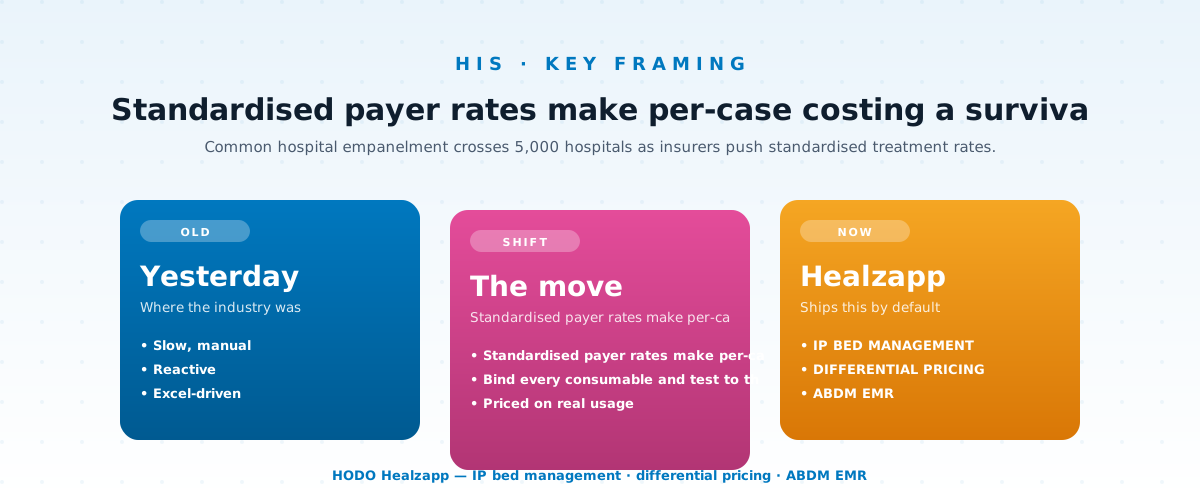
Package pricing punishes untracked leakage. In an itemised cash bill, a stent, an extra day of oxygen or four additional vials of antibiotic simply get added to the patient's bill. In a package, each of those is a direct deduction from contribution. The hospital that knows its per-case consumable consumption can redesign the pathway. The hospital that does not know will discover the loss only in the P&L.
Three leakage points recur across 100-bed hospitals. First, pharmacy and consumable indents issued to the ward without being attributed to a specific IP case, so the cost lands in a general stores figure rather than against the admission. Second, in-house lab and radiology work done inside a package where results are typed in manually from the analyser, which creates both a transcription risk and no reliable count of tests consumed per package. Third, implant and high-value item traceability, where the batch billed and the batch used do not reconcile at audit time.
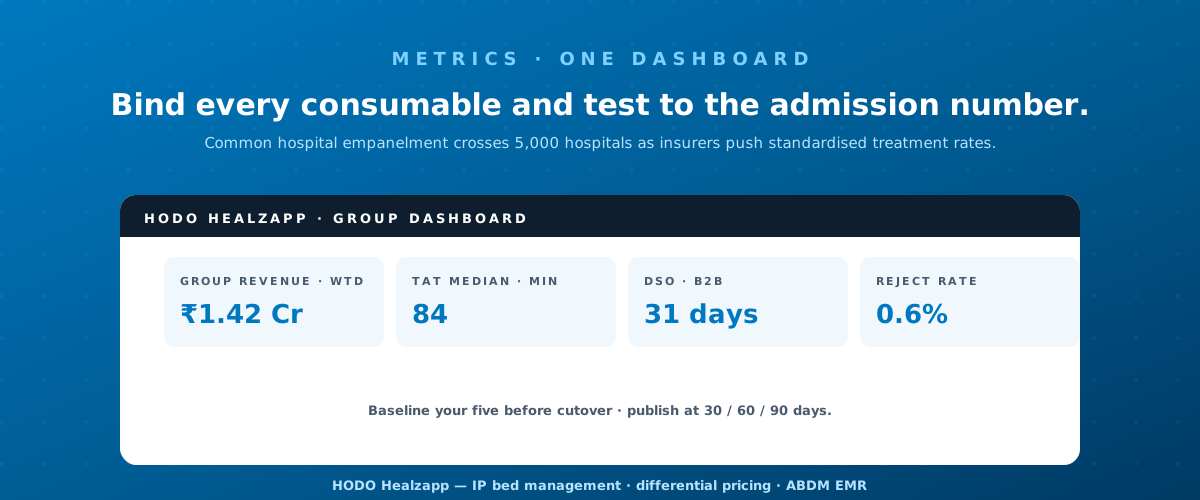
Fixing these is not a finance project; it is a workflow question. Every consumable movement, every ward indent and every analyser result needs to be bound to an admission number at the moment it happens. Machine interfacing in the lab removes the typing step and gives an accurate per-package test count. Inventory tied to IP episodes converts a stores figure into a per-case cost. Only then does a standardised rate become something a hospital can price against rather than accept blindly.
Standardisation of rates is always accompanied by standardisation of documentation. Shared empanelment networks work on common claim formats, common discharge summary expectations and common evidence requirements for implants, ICU days and higher-grade antibiotics. Payers rejecting or short-paying on documentation grounds is already the single biggest controllable revenue loss at this hospital size.
The pattern in most hospitals is retrospective assembly. The patient is discharged, the TPA desk then chases the consultant for a signed summary, the nursing station for vitals charts, the OT register for notes, and the pharmacy for the implant invoice. Each handoff adds days, and each missing artefact invites a query. A query cycle of even seven days, repeated across a third of claims, is enough to push average collection days past sixty.
The alternative is to treat the claim file as a by-product of clinical work already recorded. If nursing observations, drug administration, OT notes and investigation results are captured in the EMR as they occur, the discharge summary becomes a generated document rather than a drafting exercise. Pre-authorisation and enhancement requests can then be raised with evidence attached on the same day the clinical decision is taken, which is also when the clinical justification is clearest. ABDM-aligned record structure helps here for a second reason: records that are already standardised for health-record exchange are far easier to map onto a payer's common claim format.
Empanelment expands volume before it expands cash. A hospital that adds three new payer networks this quarter is adding receivables, not revenue, until the money is credited. With PMJAY, state schemes and private TPAs in the same mix, settlement cycles can range from three weeks to five months in the same month's billing.
Two practices separate hospitals that survive this from hospitals that get squeezed. The first is AR ageing maintained payer-wise rather than as a single receivables pile. A consolidated sixty-eight-day average hides the fact that two payers are at thirty days and one is at a hundred and forty. Only the payer-wise view tells management which network to push volume into and which to cap. The second is a denial and short-payment reason log that is actually coded — missing document, non-payable item, rate mismatch, pre-authorisation gap — and reviewed monthly. Denial reasons at this hospital size concentrate in five or six repeat categories, and most are process defects rather than genuine disputes.
Both practices require billing and receivables to live in the same system as clinical records, with the accounting side reconciled rather than re-keyed. When billing data is exported to accounts manually, payer-wise AR ageing becomes a monthly spreadsheet project, which means it stops being done by March.
The operational tax of multi-payer empanelment is pricing. The same knee replacement now carries a cash rate, a common-network standard rate, a legacy TPA rate still in force until renewal, a scheme rate, a corporate-contract rate and a camp or referral rate. Front-office staff cannot be expected to remember which applies, and billing errors in either direction are costly — undercharging erodes margin silently, overcharging triggers a query and a delay.
This has to be a system rule, not a desk memory. Payer-wise rate cards, versioned with effective dates, applied automatically the moment the payer is selected at registration. The same logic extends to corporate clients and referring partners who send volume on negotiated terms, and to multi-outlet groups where a new centre must inherit the group's rate structure on day one instead of rebuilding it locally. For hospitals running attached labs and collection points, partner-wise pricing and referral portals matter for the same reason: the price has to follow the relationship, automatically.
Standardised empanelment rewards hospitals that can measure a case while it is still open. Three parts of Healzapp carry most of this load. Differential pricing holds payer-wise, partner-wise and corporate rate cards so the correct rate applies at registration rather than being remembered at the billing counter. Billing keeps claims, receivables and payer mix in the same system as the clinical record, with Tally integration removing the re-keying step that makes payer-wise AR ageing collapse into a quarterly spreadsheet. And ABDM-compliant EMR with AI-condensed history means the discharge summary and claim evidence are generated from work already recorded at the nursing station, OT and lab, not reconstructed a week after the patient has gone home.
See how Healzapp handles this — book a 30-min demo.
See how Healzapp, Labzapp and EReazy fit your speciality in a free 30-minute demo.
Book a Free Demo