
NDTV reports that the Delhi government will roll out a Unified Health Information System (UHIS) across all hospitals in the capital, linking patient records, billing data and clinical workflows into a single state-run backbone. For owners of private hospitals, clinic chains and diagnostic groups operating in or around Delhi, this is not a distant policy signal — it is a procurement deadline in disguise. Every private facility that expects to receive referrals, process CGHS or state-scheme claims and serve empanelled patients will need to be able to talk to the state stack.
The UHIS is described as a single platform that unifies OPD registration, IP admissions, laboratory results, pharmacy dispensation and discharge summaries across government hospitals — with hooks for private participation. Under the hood it will almost certainly ride on the Ayushman Bharat Digital Mission (ABDM) rails: ABHA IDs, the Health Facility Registry, the Healthcare Professional Registry, and FHIR-based record exchange. Delhi is not inventing a parallel standard; it is operationalising the national one at state scale.
For a private hospital MD, the practical read is this: if your HIS cannot mint or verify an ABHA, cannot push a FHIR-formatted discharge summary, and cannot pull a patient's longitudinal record on consent, you will be locked out of the referral graph the state is building. Delhi has 40-plus government hospitals and hundreds of empanelled private ones. Once the state hospitals are live on UHIS, the private facilities will be pulled in within two to three quarters.
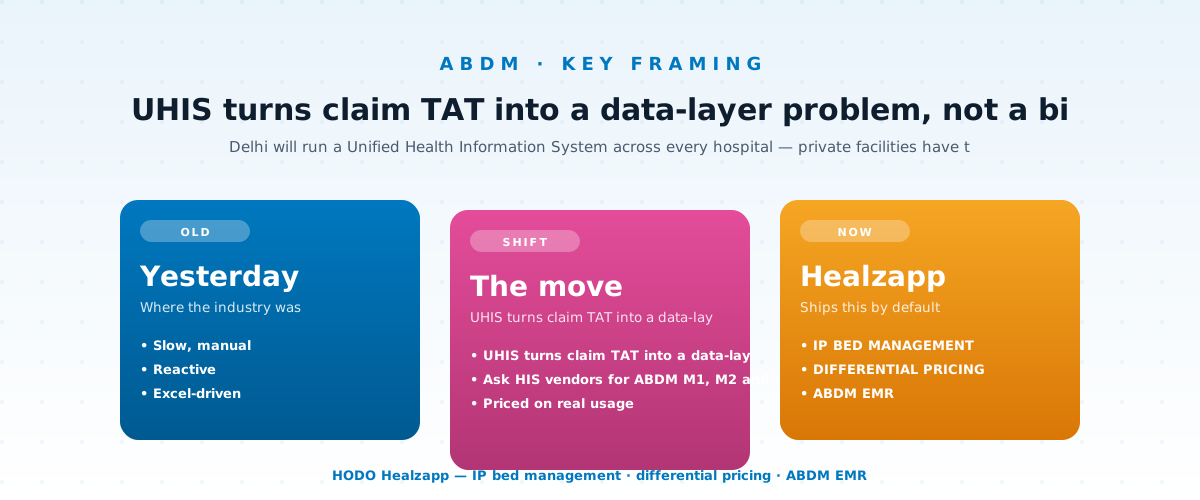
Most 50-500 bed hospitals in India still run a HIS that was procured five to ten years ago — often on-premise, often customised, often unable to export a machine-readable clinical record. That was fine when the only regulatory pressure was NABH documentation. UHIS changes the equation because the state now becomes a data consumer. Insurance TPAs, CGHS, ESIC and state health schemes will begin pulling claim-adjacent data directly from the interoperability layer instead of asking hospitals to email PDFs.
The operational implication: TAT for claim settlement will start to correlate directly with the maturity of your data layer. Hospitals with clean, structured, FHIR-exportable records will see faster reimbursements. Hospitals still relying on scanned handwritten discharge summaries will see delays widen. That gap will show up in cashflow within two quarters of the mandate going live, and it will show up first in the schemes with the tightest audit trails.
Before signing a renewal or a new HIS contract in the next two quarters, three questions matter more than price.
First: is the HIS ABDM-certified end to end, or only for ABHA creation? Many vendors advertise ABDM compliance but stop at ABHA generation. UseHIS integration will need the full stack — HFR, HPR, PHR, consent manager, health information exchange. Ask for the M1, M2 and M3 milestone certificates by name.
Second: what is the incremental cost per new outlet? Chain operators — especially clinic and diagnostic chains — will need to onboard new centres onto the state system on the same day the centre opens. A HIS that requires a six-week implementation per new location is now a growth cap, not just a nuisance.
Third: how does the HIS handle differential pricing across CGHS, TPA, corporate and cash patients? UHIS will make pricing visible in ways it was not before. Facilities without a clean price-list-per-scheme configuration will face audit exposure.
The UHIS mandate will not stop at hospitals. Diagnostic and pathology chains that receive referrals from Delhi government hospitals will need to accept ABHA-linked orders, return FHIR-formatted reports, and support consent-based record sharing. For a mid-sized lab chain running 20 to 40 collection centres, the operational lift is real: barcoded sample tracking has to be tied to ABHA, machine interfacing has to feed structured results into the exchange, and report delivery has to be logged for audit.
The chains that will capture the referral flow from state hospitals are the ones that can turn around a report in under 24 hours with a machine-readable payload. The rest will lose to whoever has invested in the LIMS layer. Franchisee-heavy chains have an additional problem — every franchise outlet has to hit the same interoperability standard, or the whole chain gets flagged.
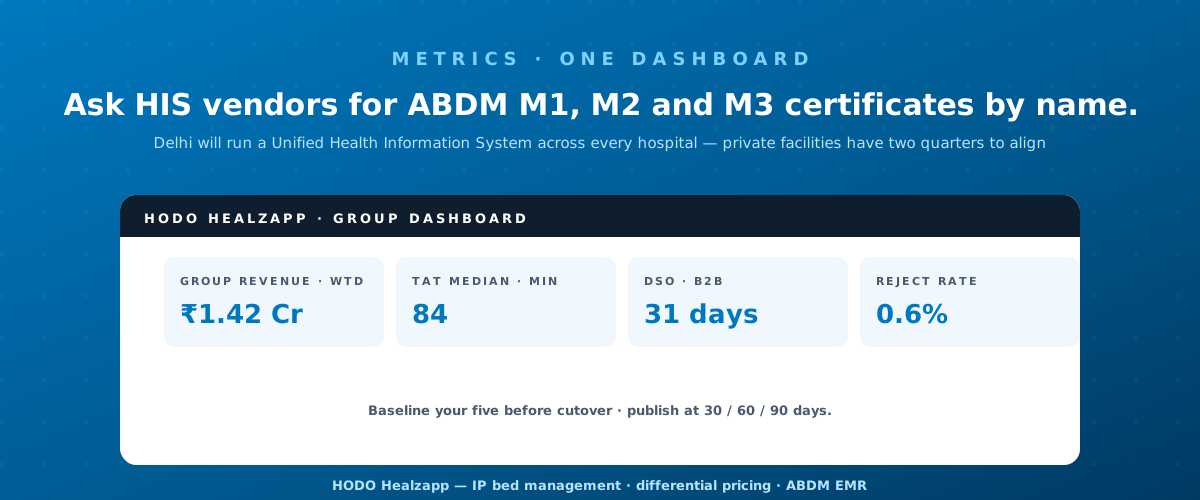
A short internal audit before the mandate hardens will save procurement pain later. Five items to run through with the CIO and the front-office head.
One, list every module in your current HIS that touches patient data and mark whether it emits FHIR. Two, count the number of ABHAs your OPD desk has created in the last 30 days — if it is under 20 per cent of new registrations, the front office needs retraining. Three, check whether your discharge summary template is structured or free-text; UHIS will not consume free-text summaries reliably. Four, map your TPA and corporate contracts against your HIS pricing configuration — every mismatch is a future claim rejection. Five, ask your vendor for the ABDM sandbox test results, not a marketing deck.
Hospitals and chains running HODO Healzapp are already positioned for the UHIS transition because the platform was built on ABDM rails from the start — HODO was among the first 20 ABDM-integrated HealthTechs in India and is NRCeS listed. Three features do the heavy lifting here.
ABDM-compliant EMR handles ABHA creation, verification and consent-based record sharing directly from the OPD and IP workflows, so a Delhi hospital going live on UHIS does not need a parallel data-entry process. Patient Management ties the ABHA to every downstream module — appointments, billing, EMR, pharmacy — so the longitudinal record the state expects is generated as a by-product of normal operations, not as a separate compliance task. Multi-outlet scale-up with one-click new-centre setup matters for clinic and diagnostic chains: when a new outlet opens, its facility registration, HIS configuration and ABDM linkage go live together, not over six weeks.
See how Healzapp handles this — book a 30-min demo.
See how Healzapp, Labzapp and EReazy fit your speciality in a free 30-minute demo.
Book a Free Demo