M42, the Abu Dhabi-based health group, has partnered with Siemens Healthineers to advance diagnostic and imaging capability across markets described as the Global South, according to a report carried by Menafn. The announcement is written in the language of equipment, AI-assisted reporting and capability transfer. For founders building lab-at-home, scan-booking, homecare or diagnostics-adjacent products in the GCC and India, the more useful reading is narrower: the hardware layer of diagnostics is becoming something a company rents rather than something it must own.
Read the deal as a capacity signal, not a technology story
Partnerships between a large regional operator and a global equipment manufacturer tend to move three things at once: installed base, financing structure and service coverage. More modalities land in more cities, often under managed-service or pay-per-study contracts rather than outright purchase. Local engineers get trained, so uptime stops being a reason to avoid a second site. Reporting capacity is pooled, so a scan acquired in one city can be read somewhere else.
The founder consequence is direct. Five years ago, a diagnostics-adjacent startup in Dubai, Doha or Kochi faced a capital wall: no scanner, no analyser, no business. That wall is lower now. Capacity can be contracted from hospital groups, partner labs and imaging chains that have spare slots and a fixed cost base to defend. What a founder brings is demand, scheduling discipline and a clean record of what happened to each patient and each sample. That is software and operations work, not capex work, and it is where most early-stage diagnostics products are still thin.
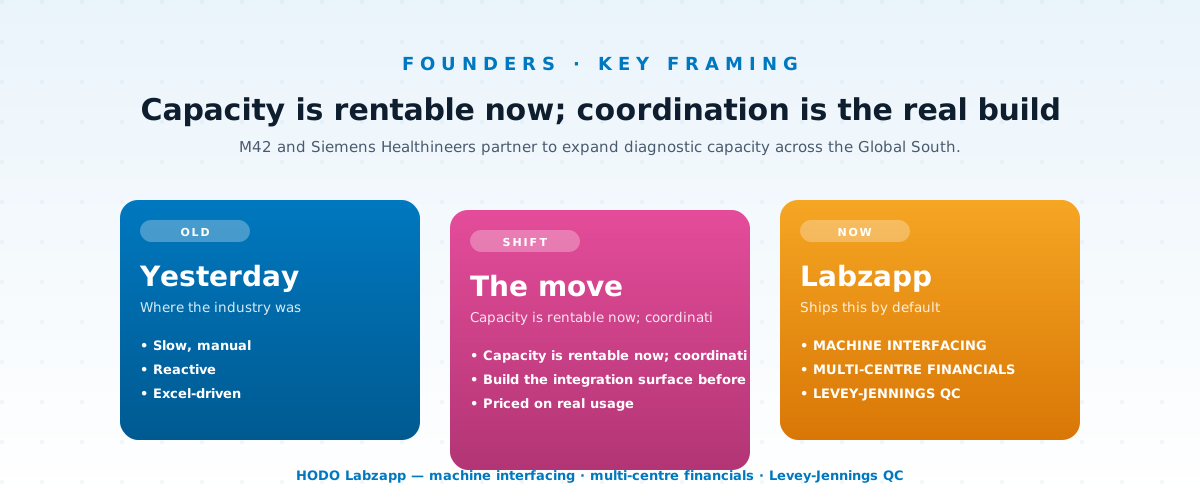
Capacity is rentable now; coordination is the real build.
Capacity gets rented; coordination stays unowned
When capacity is purchasable, the scarce resource shifts to coordination between organisations. Four questions decide whether a rented-capacity model holds up past the pilot stage, and none of them are answered by the partner's equipment.
First, who confirms the slot? A booking taken in an app but not held in the partner's system becomes a patient standing at a counter that has no record of them. Second, who chases the unread result? A sample collected at home and processed at a partner lab has two owners and often no single escalation path when it stalls. Third, who reconciles the rate card? Partner pricing is rarely one number, it varies by test, volume band, outlet and payer, and a spreadsheet maintained by one person becomes a reconciliation problem by the second contract. Fourth, who proves sample identity? Two organisations touching one specimen need identifiers that travel without exposing the patient's details to a partner who has no reason to hold them.
Founders who treat these as back-office details usually discover them as churn. The operator on the other side of the contract notices the same thing: the startup that sends clean orders, settles on time and raises exceptions early gets the better slot allocation next quarter.
Build order: the integration surface comes before the consumer app
The common sequencing mistake is to build a polished booking experience first and treat integrations as a later phase. In diagnostics, that order causes a rebuild. Analysers, modalities and partner systems each emit results in their own formats, and the cost of normalising them does not fall over time, it grows with every outlet and every partner added.
A more durable build order starts with the data spine. Barcoded samples from the point of collection, so a specimen has one identity for its whole life. Machine interfacing to pull results directly from analysers instead of re-keying them from a console printout, which is both a staffing cost and a reporting error source. Partner-lab integration with anonymised sample tracking, so outsourced work stays visible without handing over a patient list. Then turnaround reporting, so delays are visible as numbers rather than as complaints.
Only after that spine exists does the consumer surface earn its investment. The reason is simple: the app sells a promise about time and reliability, and nothing on the front end can keep that promise if the back end cannot see where a sample is. Reference architecture is worth studying rather than re-deriving, HODO's Labzapp was built around exactly this spine for lab chains and home-collection networks, and the module list is a reasonable checklist for a founder deciding what to build, what to buy and what to defer.
Unit economics when the scanner is not yours
Rented capacity changes the cost structure in ways that need to be modelled before the first marketing spend. Owned capacity has high fixed cost and near-zero marginal cost, which rewards volume at almost any price. Contracted capacity is the reverse: marginal cost per test or per study is real and visible, so discounting straight into a partner rate destroys the unit.
Three numbers deserve a weekly review. Cost per test or per study, loaded with collection, transport and the partner fee, not just the partner fee. Realised price by payer and by channel, because self-pay, corporate and insurance-funded work behave differently in both price and collection cycle. And repeat rate per household or per referring doctor, since acquisition cost only amortises if the second order arrives. Differential pricing per partner belongs in the system rather than in a negotiation memory, because a founder who cannot price a corporate contract accurately at the point of order will find out the margin was wrong at the point of settlement.
Turnaround time deserves separate treatment because it is usually the actual product. A partner's scanner is available to competitors too. A reliable three-hour report, delivered without the patient calling to ask, is not.
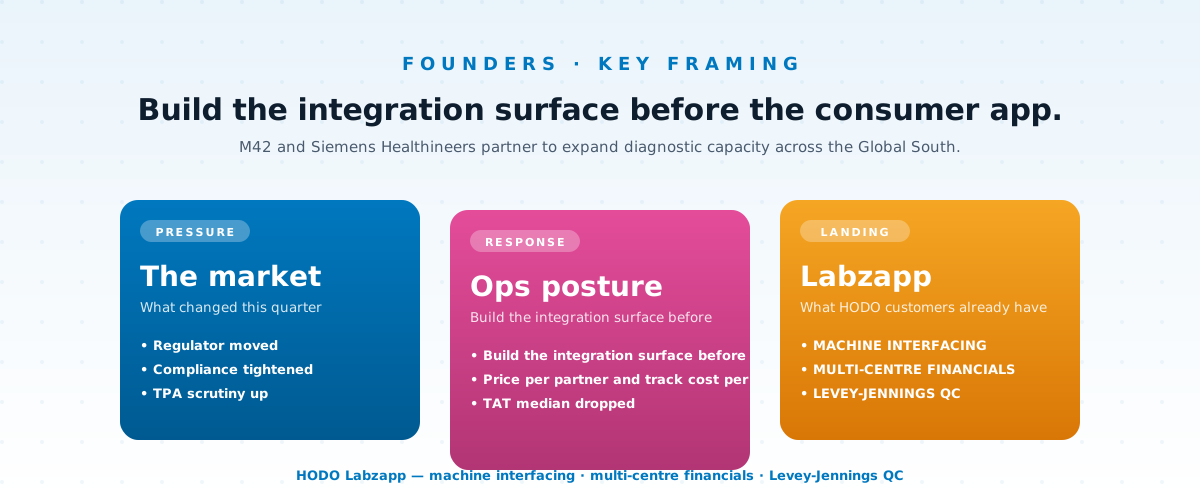
Build the integration surface before the consumer app.
Licensing, reports and the audit trail
Regulatory path varies by market and should be designed in early rather than retrofitted. In the UAE and wider GCC, facility and practitioner licensing under DHA, MOHAP or DoH-style regimes attaches to where a service is performed and by whom, which matters when a collection happens at home and processing happens at a partner site. In India, outlet-level accreditation and referral-partner documentation carry similar weight. In both cases, the operational requirement is the same: every order, sample movement and report release needs a timestamped record naming who did it.
Report delivery is part of this. Automated SMS, WhatsApp and email delivery reduces the call volume that otherwise consumes a small team's day, but it also needs consent capture and a delivery log, proof of what was sent, to which number, and when. Franchisee and partner-run outlets raise the bar again, since a founder expanding through partners is accountable for work performed by staff who are not on the payroll.
What this means for builders
The M42–Siemens Healthineers partnership is a reminder that diagnostic capacity in these markets is getting easier to access and harder to differentiate on. The defensible build for a founder is the coordination layer: identity for every sample, direct capture from instruments, partner economics that hold at scale, and a turnaround promise that survives audit. Machine interfacing removes the re-keying step between analyser and report. Partner-lab integration with anonymised sample tracking keeps outsourced work visible without exposing patient lists. Differential pricing per partner prices corporate and franchise contracts correctly at the point of order instead of at settlement. Together they are the unglamorous half of a diagnostics product, and the half that decides whether the second hundred outlets behave like the first ten.