Sahyadri Startups reports that Crysta IVF has been acquired by Moon Care, with Redcliffe Labs stepping back from the fertility business to concentrate on diagnostics expansion. Stripped of the deal-value talk, this is an operating decision rather than a financial one: a large pathology network deciding that its next hundred crores of growth come from more samples per day, not from a second clinical vertical. For every standalone lab and regional chain in India watching from a few hundred crores lower down the table, that decision is worth reading closely.
What the Crysta IVF deal actually signals
Redcliffe built the fertility arm at a time when diagnostic players across India were adding adjacent verticals, teleconsultation, pharmacy, wellness subscriptions, speciality clinics, on the argument that a patient already in the funnel is cheaper to convert than a new one. That argument is arithmetically true and operationally expensive. A fertility clinic is a clinician-led, appointment-heavy, long-cycle business with its own licensing, its own consumables, its own counselling load and its own revenue recognition. A pathology chain is a logistics and instrumentation business measured in samples per phlebotomist per day and turnaround time per department.
Running both means running two operating models under one management layer, and the second one always gets the leftover attention. The exit says the leadership would rather put that attention into collection-centre density, home-collection routes, machine capacity and partner-lab arrangements. For smaller chains the lesson is not "never diversify". It is that a vertical you cannot measure weekly, at the level of each centre, will quietly consume the margin your core business earns.
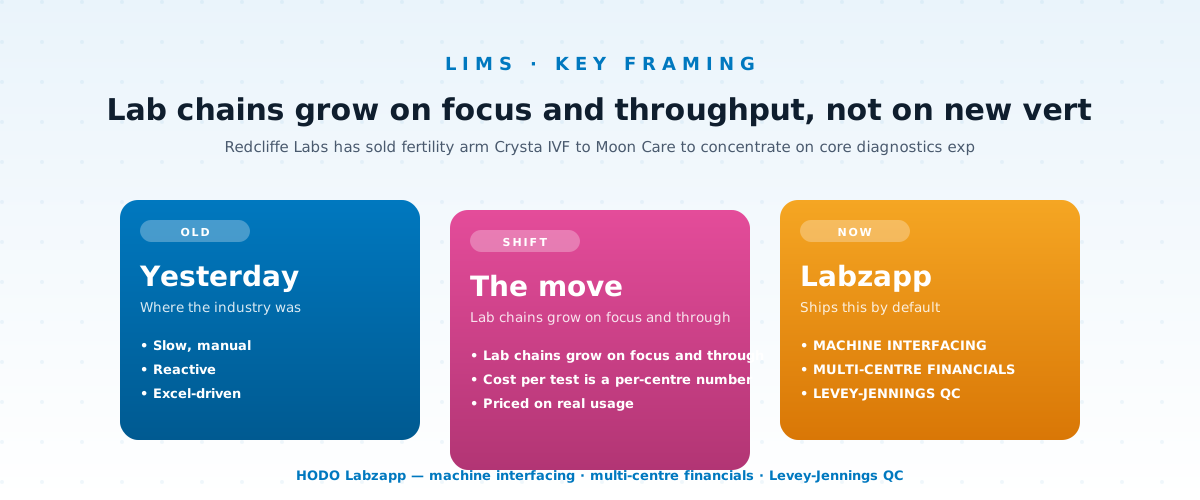
Lab chains grow on focus and throughput, not on new verticals.
Diagnostics scales on throughput, not on headcount
The economics of a lab chain are unusual in Indian healthcare because the marginal cost of one more test on an already-running analyser is small, while the fixed cost of the analyser, the reagent contract, the AMC and the pathologist is large. That means growth is mostly a question of feeding capacity, more collection points, more home visits, more B2B samples from smaller labs and clinics that cannot afford their own instruments.
Chains that grow this way hit a predictable wall. Sample volume rises faster than the back office, and the chain loses visibility: which centre is running at 40% analyser utilisation, which route is collecting eleven samples when it costs the same to collect twenty-two, which department is missing its promised turnaround on weekends. At that point the chain starts hiring coordinators to recreate, over phone and WhatsApp, information the LIMS should already be producing. Machine interfacing that pulls results directly from analysers, and barcoded samples that make every tube traceable from collection to report, are not conveniences at this scale, they are the only way throughput growth does not turn into a proportional growth in staff.
Cost per test is a per-centre number, not a chain average
Most lab chains quote cost per test as a single figure derived from monthly P&L. That number is almost useless for decisions. The real distribution is wide: a mature urban centre with high biochemistry volume may be running at a third of the cost of a six-month-old satellite centre in a tier-3 town where the same profile is being outsourced to a partner lab and back.
A chain that only sees the average will keep opening centres that look accretive and are not, and will keep pricing partner work off a blended figure that hides a loss-making segment. Multi-centre financials reported per outlet, revenue, test mix, outsourced share, reagent consumption, rejection and repeat rates, turn that average into something actionable. The follow-on decision is pricing: corporate accounts, referring doctors, franchisee partners and B2B labs should not all be billed off one rate card. Differential pricing per partner exists precisely because a corporate contract with predictable daily volume and 45-day credit is a different commercial animal from a walk-in patient or a franchisee sending twelve samples a week.
Focus gets tested at the franchisee and partner edge
When a chain decides to concentrate on diagnostics, the growth almost always arrives through partners rather than owned centres, franchisee collection points, referral doctors, corporate tie-ups and outsource arrangements with labs that send out their specialised work. Each of these relationships has a failure mode. Franchisees dispute settlements. Referring doctors stop referring when reports reach them late or reach the patient first. Partner labs worry that their patient data is visible to a competitor who also runs retail collection in the same town.
These are governance problems before they are software problems, but they are solved with software. Franchisee management with transparent settlement and per-centre accounting removes the monthly argument. Referral-doctor and corporate-partner portals let the people sending samples check status themselves instead of calling the lab. Partner-lab integration with anonymised sample tracking lets a B2B relationship work without either side exposing its patient list. A chain that builds this layer early can absorb partner volume quickly; one that does not will find its expansion capped by how many settlement disputes its finance team can handle in a month.
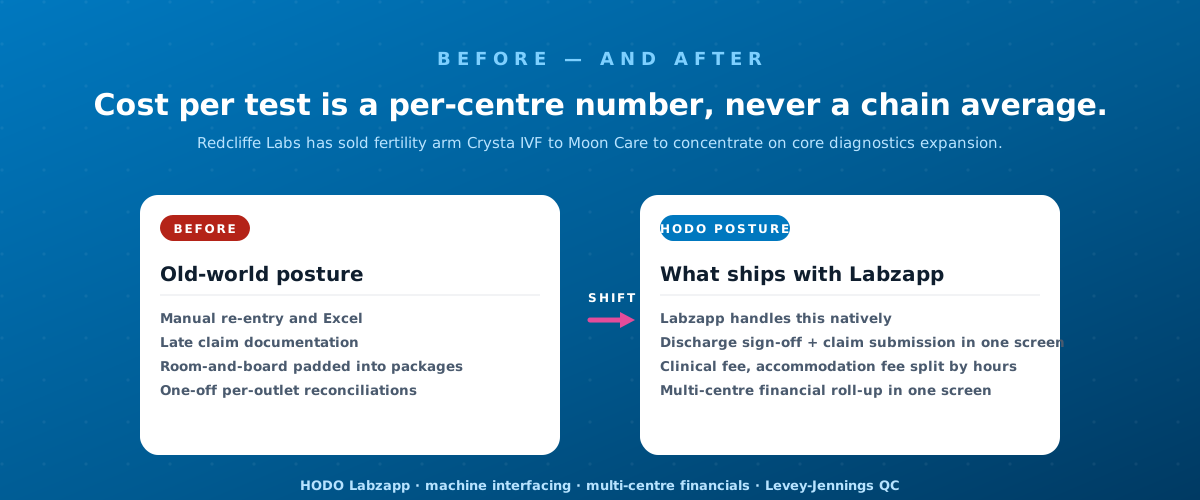
Cost per test is a per-centre number, never a chain average.
Before adding a vertical, audit the one you run
The practical test before any Indian lab chain considers a second business line is unglamorous. Pull the last ninety days of turnaround time by department and by centre, not as an average but as a distribution, what percentage of routine biochemistry reports went out within the promised window, and what the tail looks like on Sundays and public holidays. Pull sample rejection and recollection rates by phlebotomist and by route. Pull quality control drift by analyser.
If those three numbers are not available on demand, the chain does not have spare management capacity for a new vertical; it has a measurement gap in its existing one. TAT reporting and Levey-Jennings QC exist to close exactly that gap, the first tells the chain whether it is keeping its commercial promise, the second tells it whether the results behind that promise are stable before a patient or a NABL assessor points it out. Redcliffe's decision to consolidate around diagnostics is the large-cap version of the same discipline: fix and scale what is measurable, and let someone else run what is not.
What this means for HODO customers
A lab chain choosing focus over breadth needs its core operating numbers to be visible without anyone assembling them by hand. TAT reporting makes the delivery promise auditable centre by centre and department by department. Multi-centre financials with differential pricing per partner keep cost per test and partner margin honest instead of blended. Franchisee management and machine interfacing let sample volume grow without a matching rise in coordination headcount. Together they answer the question every expanding chain eventually faces: is this new centre, route or partner adding margin, or only adding samples?