Medical Buyer reports that India's diagnostic chains are posting growth on the back of test volumes rather than price increases, with realisation per test broadly flat even as footfall and test mix improve. For a regional lab chain running eight collection points or eighty, that headline is a margin instruction rather than a market update. Growth that arrives as volume on a steady rate card converts to profit only if cost per test falls as throughput rises.
What a volume-led quarter is actually saying
The national chains have chosen to defend the rate card against aggregator and online discounting, and to grow instead through more patients, wider test menus and deeper geography. That decision is easier to take when scale is already in place. A mid-sized chain faces the same market pressure with a thinner buffer, the same competitive discounting, the same reagent and consumable inflation, the same wage pressure on phlebotomists and technicians, but far less room to absorb a bad month at one centre.
The practical consequence is that the growth has to be earned inside operations. If a centre processes 30 per cent more samples on the same rate card, the P&L improves only if that extra volume does not bring proportionally more reruns, more courier trips, more manual data entry hours and more report-chasing calls. Most labs discover the hard way that variable cost per test is not actually flat. It steps up at the point where the existing process breaks.
Knowing where that step sits, centre by centre, is the first piece of work. It needs per-centre reporting on samples processed, tests per sample, rerun rate, TAT breach rate and contribution after direct cost. A chain that sees only a consolidated monthly P&L cannot tell which branch is carrying the growth and which is quietly consuming it.
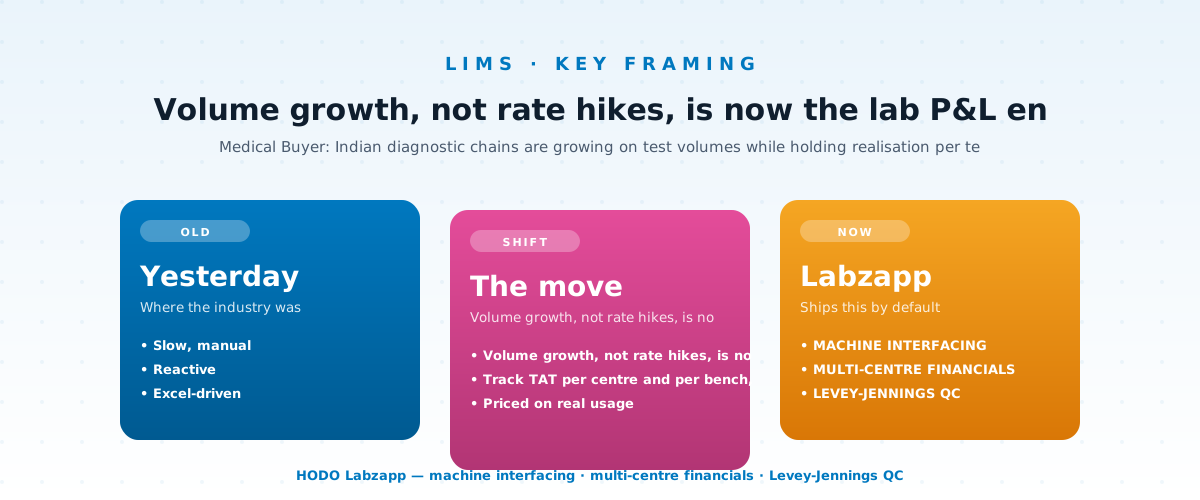
Volume growth, not rate hikes, is now the lab P&L engine.
Volume shows up as a TAT problem first
Before margin moves, turnaround time moves. Registration queues lengthen, samples pile up at the accession bench, analyser worklists run behind, and reports go out at 8 pm instead of 2 pm. Referring doctors notice before the finance team does, and the first signal is usually a drop in repeat referrals rather than a complaint.
The controllable part of TAT is rarely the analyser run itself. It sits in the handoffs: registration to collection, collection to accession, accession to analyser, result to authorisation, authorisation to delivery. Every one of those handoffs is a place where a manual step creates a queue. Barcoded samples at the point of collection remove the re-labelling and transcription work that generates both delay and mismatch. Machine interfacing takes the technician's keyboard out of the result path, which cuts accession-to-report time and eliminates an entire category of transcription error.
TAT reporting then has to be read by centre, by department and by test, not as a single chain-level average. A chain-level 94 per cent on-time figure can conceal one histopathology bench running three days late, or one franchisee centre where samples sit until the evening pickup. Volume growth compounds these local failures rather than averaging them out. The lab that measures TAT at the level it is actually breached can fix the specific bench instead of asking everyone to work faster.
Holding price is a cost-per-test discipline
Holding the rate card works only if the lab can say what each test costs to deliver at each centre. That number is not reagent cost. It is reagent plus controls and calibrators, plus the rerun rate, plus consumables, plus the allocated cost of the phlebotomist, the courier route, the reporting pathologist's time, and the centre's fixed overhead spread over actual volume.
Two items on that list move with quality rather than with purchasing. Reruns burn reagent twice and TAT once, and a bench with drifting QC quietly raises the cost per reportable result across every test on that analyser. Levey-Jennings QC charting makes the drift visible before it becomes a batch of repeats and a NABL non-conformance at the next assessment. Chains that treat QC as a documentation exercise for audit day are paying for it in consumables every week.
The second is volume allocation. Fixed cost per test falls as a centre's throughput rises, which means the marginal economics of a new collection point look nothing like those of a mature one. Multi-centre financials that show contribution per centre, rather than revenue per centre, tell the operator which new location is on track and which needs either more volume or a harder conversation. Discounting to buy volume at a centre that is already below contribution only moves the loss faster.
Where the pricing line usually leaks
Most labs that believe they are holding price are holding it only on walk-in retail. The leak is in B2B, referring doctors on special rates, corporate and insurance panels negotiated by a sales manager, franchisee centres on a share model, and partner labs sending outsourced work. Each of these gets a bespoke rate, and in many chains those rates live in a spreadsheet or in one person's memory.
The outcome is predictable. A corporate contract signed two years ago is still billing at the old rate after both the test menu and the cost base have changed. A referral doctor's discount is applied at one centre and not at another. A franchisee books a package at retail and claims partner pricing at settlement. None of this is fraud; it is the normal consequence of rate logic sitting outside the system that produces the bill.
Differential pricing per partner belongs inside the LIMS, applied automatically at billing based on the source of the sample. Referral-doctor and corporate-partner portals shift the other half of the load, letting partners pull their own reports and statements instead of calling the centre, which removes a support cost and leaves a clean record of what was billed at what rate. Partner-lab integration with anonymised sample tracking does the same for outsourced work, so referred-out tests stay visible without exposing patient identity to the processing lab.
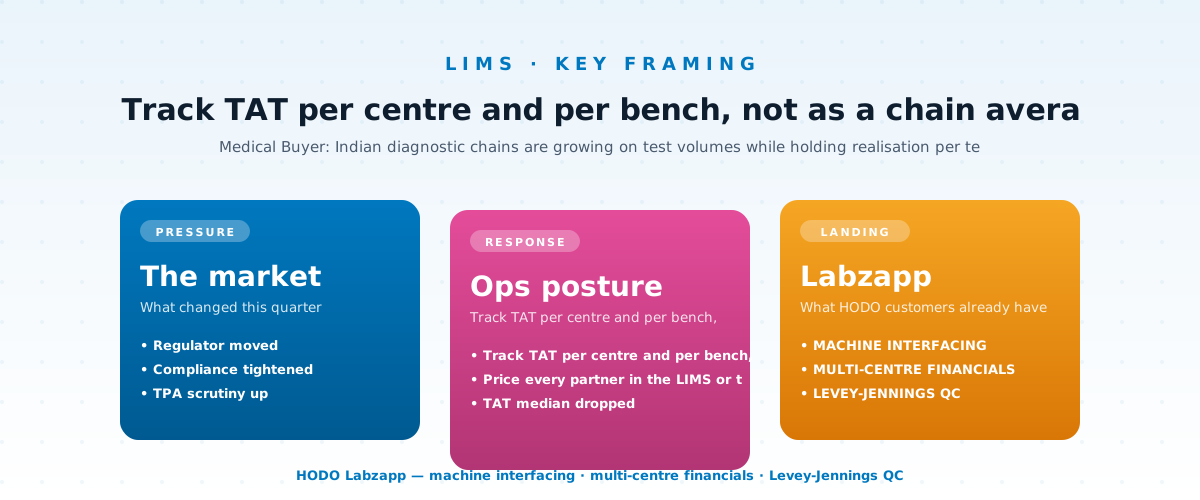
Track TAT per centre and per bench, not as a chain average.
Home collection is the cheapest volume and the most fragile
A large share of the incremental volume is coming from home collection, and it is the channel most likely to break pricing discipline. A home visit adds phlebotomist time, travel and a cold-chain step to a test priced as though it were collected at the counter. If the convenience fee does not cover the route cost, every additional home booking improves the volume number and worsens the margin number.
The levers are route density and sample integrity. Cost per home visit falls when bookings cluster geographically and the phlebotomist's day is planned rather than dispatched ad hoc. Phlebotomy and home-collection workflows that put barcoding at the doorstep, sample labelled and logged at the point of draw, not on arrival at the lab, protect chain of custody and remove the accession bottleneck that home samples otherwise create when they all land together in the afternoon. Automated report delivery closes the last cost, ending the follow-up calls that trail every home collection.
What this means for HODO customers
A volume-led market rewards labs that can measure themselves at centre level and price every channel deliberately. Three capabilities carry most of that load. TAT reporting broken down by centre, department and test shows where added volume is actually breaking, instead of hiding it inside a chain-wide average. Differential pricing per partner moves referral, corporate and franchisee rate cards out of spreadsheets and into the billing engine, so the price line holds in B2B and not just at the retail counter. Levey-Jennings QC keeps rerun cost and NABL exposure under control at the bench, where cost per reportable result is really set. Add Multi-centre financials and the operator can see contribution per centre before deciding where to add the next collection point.