
Asia Healthcare Holdings has agreed to acquire a majority stake in Dr Dangs Labs, a marquee Delhi-based diagnostic chain, in a deal reported by Medical Buyer. It is the latest in a run of platform-level bets on Indian diagnostics — and the clearest signal yet that regional lab operators outside the top five brands will be measured against a very different bar in 2026.
Dr Dangs is a specialist reference lab with strong brand equity in NCR — the sort of business PE-backed platforms buy because it is already tidy. What the deal signals is not the valuation. It is the appetite. Asia Healthcare Holdings, backed by TPG's Rise fund, has been assembling single-specialty platforms across women's health, oncology and now diagnostics. When platforms of that scale start writing majority cheques for regional labs, the pricing of comparable assets moves — and so does the operating standard. Every two-to-fifteen-centre lab in India is now, whether the promoter likes it or not, on someone's target list or someone's competitor list. That changes the discussion in the promoter's office. The question stops being 'how do we grow ten per cent?' and starts being 'are our SOPs, TAT, financials and IT stack in a state where a strategic buyer or franchisee partner can plug in without a six-month clean-up?' The labs that answer yes will get better multiples. The labs that don't will be told to fix the LIMS first.
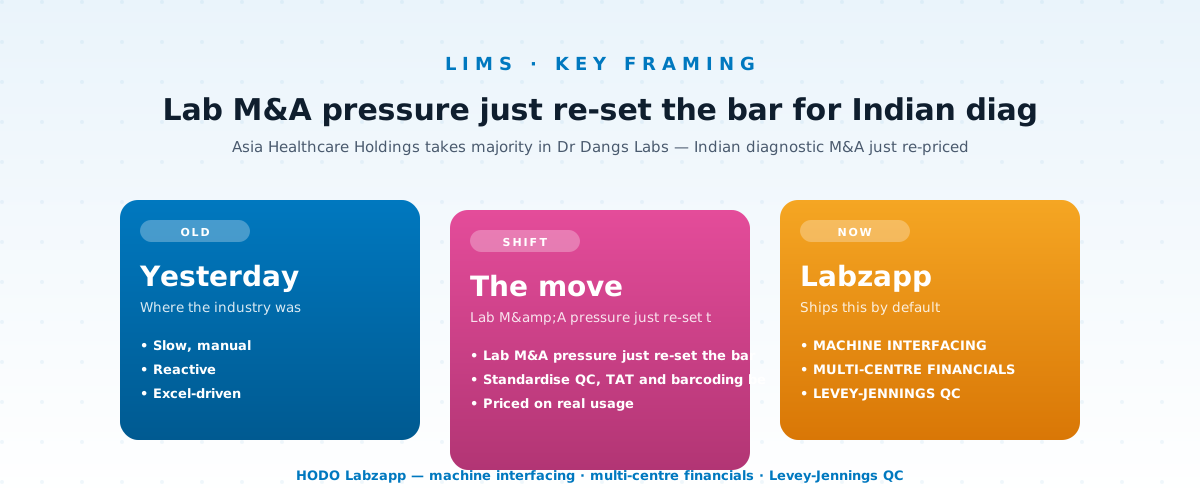
The single most common finding when a PE diligence team walks into a regional lab chain is that the P&L is centre-wise trustworthy but network-wise a mess. Revenue per test, cost per test, credit ageing by corporate partner, referral commission owed to individual doctors — these numbers exist in seven spreadsheets and three billing systems, not one report. That is a solvable problem, but only if the LIMS was set up for it from day one. A consolidated multi-centre view of financials — with the ability to see revenue by centre, by test panel, by referring doctor and by corporate account without exporting anything — is now table stakes for any lab that wants to be acquired or that wants to acquire. It is also table stakes for Tally-integrated GST filing at the group level. Regional labs that still reconcile centre P&Ls manually at month-end are effectively locking themselves out of the M&A conversation.
Consolidators are not paying premium multiples for revenue. They are paying for a repeatable operating model. That means Levey-Jennings QC charts running the same way at every centre, machine interfacing configured so that no result is manually keyed in from an analyser to a reporting system, and TAT tracked at collection, at accessioning, at analyser, at validation and at report despatch — as five distinct data points, not one blended number. Regional labs that can produce a monthly TAT breach report per test, per centre, per shift are running at a different tier of operational maturity. It also affects retention: pathologists and technologists prefer working in a lab where the process is codified rather than negotiated daily. Standardisation of barcoding at sample collection is the least glamorous but probably highest-ROI item in that list — mislabelling remains the single largest source of preventable rework, and the only fix that scales across centres is barcode-first, exception-second.
The Dr Dangs of India are not walk-in businesses. Referral doctors, corporate contracts, insurance panels and outsourced sample flows from other labs make up the bulk of volume. Each partner comes with its own rate card, its own credit terms and its own reporting expectation. A LIMS that cannot hold differential pricing per partner, and cannot open a login for a corporate HR head or a referring GP to pull their own reports, will bleed operations time on manual work and bleed sales time on trust. Anonymised sample tracking for outsourced work — where lab A sends a sample to lab B and neither wants the other seeing patient identifiers — has moved from a nice-to-have to a compliance-adjacent requirement, particularly for oncology and molecular panels. Regional labs that want to sit inside a larger network, or become the anchor of one, need this plumbing before the conversation, not after.
Almost every mid-sized Indian lab chain hits a wall at 15-25 centres. The wall is usually franchisee management. Collection franchisees need transparent commission tracking, real-time TAT visibility, and a portal where they can print reports for their walk-ins without ringing the central lab. Without that, franchisees churn and the growth curve flattens. This is a solved problem in the LIMS category, but it requires the LIMS to have been chosen for it — retrofitting franchisee logins onto a legacy on-premise LIMS is a project in itself. Cloud-hosted LIMS deployments on Google Cloud Platform or equivalent are now standard for chains planning to open centres in tier-two cities, because the alternative is a rack of servers at every branch office and a sysadmin visit every time an analyser needs re-linking. Consolidators will pay a premium for a business where opening centre number 26 costs the same as centre number 11.
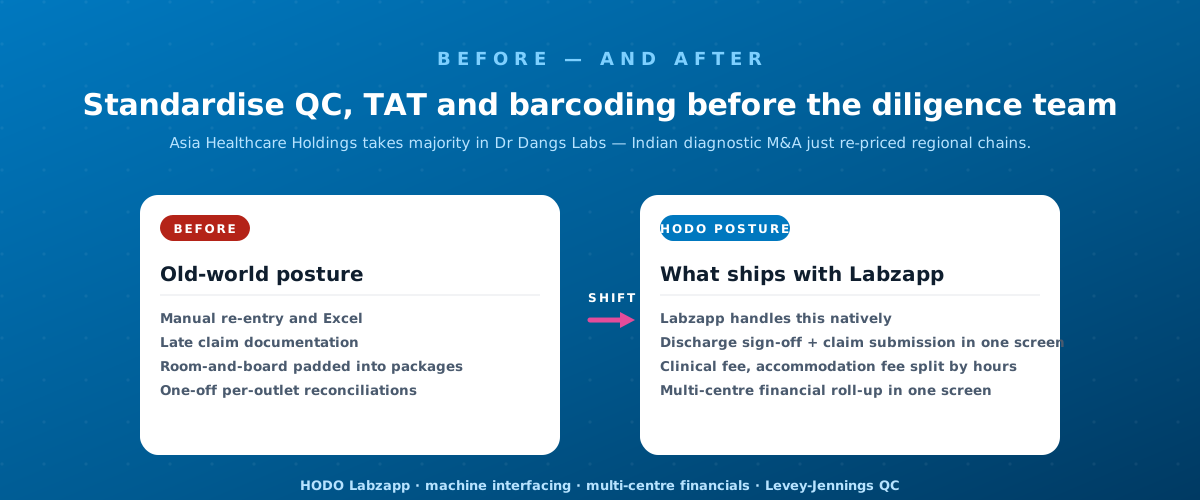
For diagnostic and pathology chains running on HODO Labzapp, the operational picture the Dr Dangs deal implies is largely already covered — the point is to make sure it is switched on and being used. Multi-centre financials should be the default management review, not exported to Excel — the group P&L, revenue-per-test and outstanding-per-corporate views are already in the module. Barcoded samples with machine interfacing should be the standard operating procedure at every centre, including franchisee-collection points, because the moment a buyer or partner audits TAT, the barcode timestamps are the audit trail. Differential pricing per partner, combined with the referral-doctor and corporate-partner portals, is where lab chains earn back the sales cycle they lose to manual quotation — and where they demonstrate to a strategic buyer that partner revenue is defensible, not personal.
See how Labzapp handles this — book a 30-min demo.
See how Healzapp, Labzapp and EReazy fit your speciality in a free 30-minute demo.
Book a Free Demo