Neuberg Diagnostics is reported to be exploring a ₹400-500 crore pre-IPO round, with acquisitions named as the main use of funds, according to Medical Buyer. That is buyout capital, not equipment capital, money raised to absorb regional labs into a larger network ahead of a listing. For every standalone pathology lab and every three-to-thirty-centre chain in India, the signal in that line matters more than the sum.
Buyout capital is chasing the unorganised half of pathology
Indian diagnostics remains a fragmented market. A large share of test volume still sits with single-city labs, doctor-owned collection networks and small chains that grew on referral relationships rather than brand. Listed and listing-bound players cannot grow into that volume organically at the speed public markets expect, so they buy it. A pre-IPO round earmarked for acquisitions is, in effect, a shopping list being funded before the listing narrative is fixed.
The practical consequence for a lab owner is that acquisition conversations are no longer hypothetical. Over the next few years, the mid-sized lab in Coimbatore, Nagpur or Kochi will get a call, from a national chain, a regional consolidator, or a PE-backed roll-up platform. What determines whether that call becomes a term sheet is rarely the quality of the reporting pathologist. It is whether the lab's operations can be read, priced and merged by an outsider within a diligence window of six to ten weeks.
Labs that cannot produce a clean centre-wise P&L, a test-code master that matches their price list, or a defensible turnaround time record end up valued on revenue multiples with heavy discounts and long earn-outs. Labs that can produce those numbers negotiate on EBITDA. The gap between the two positions is systems, not science.
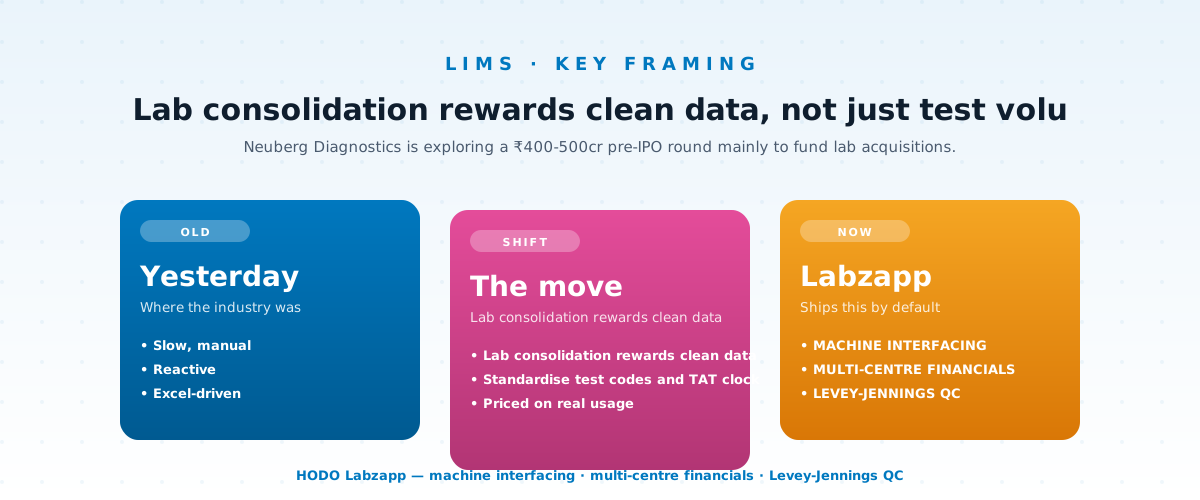
Lab consolidation rewards clean data, not just test volume.
The acquisition case is really a cost-per-test case
An acquirer buying a regional lab is not buying its revenue. It is buying the difference between what that lab currently spends per test and what it will spend per test once it sits inside a larger network, shared reagent contracts, consolidated reference testing, centralised reporting, and fewer duplicate analysers across overlapping catchments.
That means the acquirer needs a per-test cost line that is real. Most labs cannot produce one. Reagent consumption is tracked in a register, machine-wise throughput lives in the analyser software, repeat and reject rates live in the technician's head, and outsourced test spend sits in a payables ledger with no link back to the test that generated it. The result is a cost per test that is a divided average, total cost over total tests, which hides exactly the outlier tests where consolidation savings actually come from.
The labs that come out well in this cycle are the ones where sample flow is captured from barcoding at registration through to analyser result capture, so reagent draw, repeat runs and outsourced sends are all attributable to a test and a centre. That is not an accounting exercise done in diligence week. It is a year of clean operating data, or it does not exist. Owners who intend to sell in two years should be building that record now; owners who intend to buy need it even more, because they will have to merge someone else's numbers into their own.
What breaks in the first ninety days after a lab is acquired
Integration failures in diagnostics are predictable and repetitive. The first is the test master. Two labs almost never name, code or bundle the same panel identically, a lipid profile with eight parameters in one lab and eleven in the other cannot be reconciled by a spreadsheet mapping alone, because the reference ranges, the method and the price all differ. Until the masters are merged, consolidated MIS is fiction.
The second is machine interfacing. An acquired lab typically runs analysers that the parent has never connected. Every day those results are typed in manually is a day of transcription risk and lost TAT. Interfacing work that was scoped as a two-week task routinely runs to two months because the driver, the middleware and the LIS test codes were never aligned.
The third is report delivery. The acquired lab's patients were used to a report on WhatsApp within four hours; the parent's process sends an email at end of day. Patients and referring doctors notice the downgrade immediately, and referral volume, the actual asset being purchased, starts leaking within a quarter.
The fourth is the referring doctor relationship. Acquisitions transfer the lab; they do not transfer the referral. If the referring-doctor portal, commission structure and report-access habits change abruptly, the doctor simply sends the next case elsewhere. Retention here is an ops configuration problem, not a relationship-management problem.
Franchisees and partner labs are where valuation leaks
Most growing Indian chains carry three commercial layers at once: their own centres, franchisee collection points, and partner labs that either send work in or receive outsourced work. Each layer runs on different rates. A franchisee bills at a network rate, a corporate tie-up at a negotiated rate, a walk-in at list price, and an outsourced send-out at a B2B rate that may be below the lab's own list.
When those rates are maintained in parallel price lists, one in the LIMS, one in an Excel file with the franchise manager, one in an email thread, reconciliation becomes a monthly argument. Franchisee settlements slip, disputed credit notes accumulate, and an acquirer's diligence team reads all of it as receivables risk. Chains routinely discover during diligence that a meaningful share of franchise revenue was billed at rates nobody can now evidence.
The fix is unglamorous: one pricing engine that holds differential rates per partner, per franchisee and per corporate account, with every bill traceable to the rate card that produced it. Outsourced and partner-lab work needs the same discipline, anonymised sample tracking so a partner's samples can move through the network without exposing patient identity or the partner's client relationships, and a settlement statement that both sides can generate independently and get the same answer.
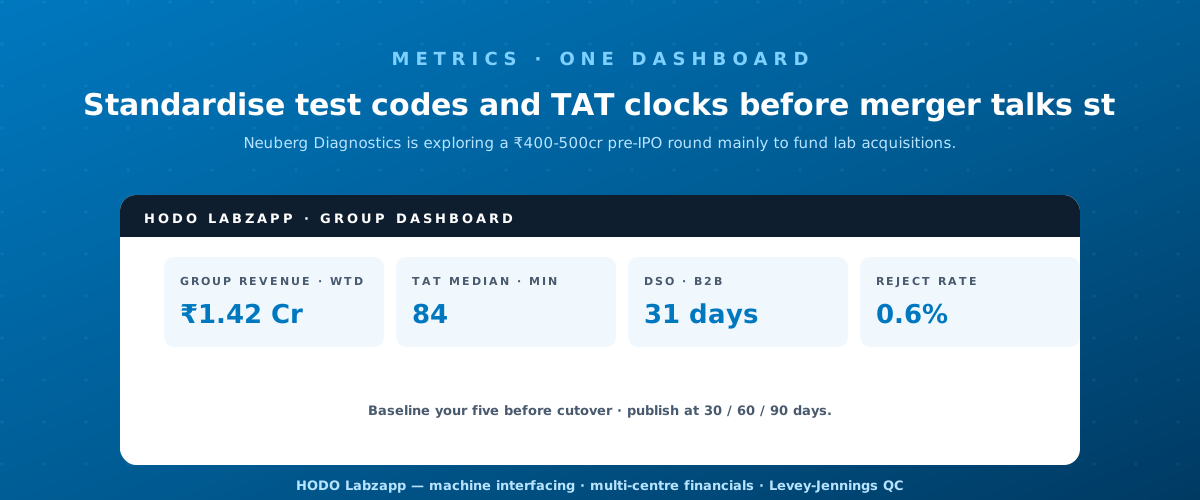
Standardise test codes and TAT clocks before merger talks start.
Diligence rewards the chain that can produce numbers on demand
Three numbers decide most diagnostics valuations: TAT performance by test and centre, repeat/reject rate as a proxy for quality discipline, and contribution margin by centre. All three are byproducts of a properly run LIMS and all three are nearly impossible to reconstruct retrospectively.
TAT in particular is where claims and reality diverge. A lab that markets a six-hour turnaround but measures it from sample receipt at the main lab, not from collection at the spoke, is reporting a number its patients do not experience. Acquirers now check this, and NABL surveillance increasingly checks it too. Measuring TAT from registration, with the phlebotomy and transport legs included, produces a worse number initially and a far more defensible business afterwards.
Quality control tells a similar story. A lab running Levey-Jennings charts with documented Westgard responses has an audit trail that survives a buyer's technical diligence. A lab that files QC as paper printouts in a cupboard has a compliance story it cannot prove. In a consolidation cycle, provable beats good.
What this means for HODO customers
Consolidation pressure does not reward the lab with the newest analyser. It rewards the lab whose operations can be read by a third party without a translator. Labzapp's Multi-centre financials give centre-wise and network-level revenue and margin from the same transaction data, so a chain can answer a valuation question without a month of spreadsheet archaeology. TAT reporting measures turnaround from registration through result release across own centres, home collections and outsourced sends, which is the version of the number that holds up in front of a buyer or an NABL assessor. Differential pricing per partner plus Franchisee management keep every rate card, settlement and credit note inside one system, so franchise revenue is evidenced rather than asserted. For labs on the buying side, one-click addition of a new centre and standard test masters make each acquisition an onboarding task instead of a migration project.