
Inc42 reports that Redcliffe Labs has signed a ₹40 crore deal to acquire Megavision Diagnostics, adding another regional network to the growing roll-up in Indian diagnostics. For lab owners watching from the sidelines, the deal is less a headline and more a warning: the operating standard for TAT, partner-lab economics, and multi-centre finance is being reset by acquirers who move fast, and the data room they demand sits inside the LIMS.
The Redcliffe-Megavision transaction is the latest in a run of regional-diagnostic acquisitions that have pushed the aggregate deal pipeline in Indian pathology past a decade high. Inc42's framing positions it as another addition to Redcliffe's footprint, but the sub-text for independent lab owners is sharper. Acquirers now underwrite on standardised operating metrics: turnaround time by test category, cost per accession, partner-lab share of revenue, and retention of referring doctors after the transition. If a target lab cannot produce those numbers cleanly on a call, the offer either walks or gets discounted.
The ₹40 crore ticket itself is unremarkable — regional networks of this size have traded in the ₹30-70 crore band for eighteen months. What matters is that a buyer with a national brand and a private-equity clock is choosing to absorb another regional lab rather than build organically. That decision assumes the target's IT can be migrated inside two quarters, its financials can be consolidated inside one, and its referring doctors can be retained through the switchover. Any lab owner who cannot check those three boxes has already surrendered pricing power in a future sale.
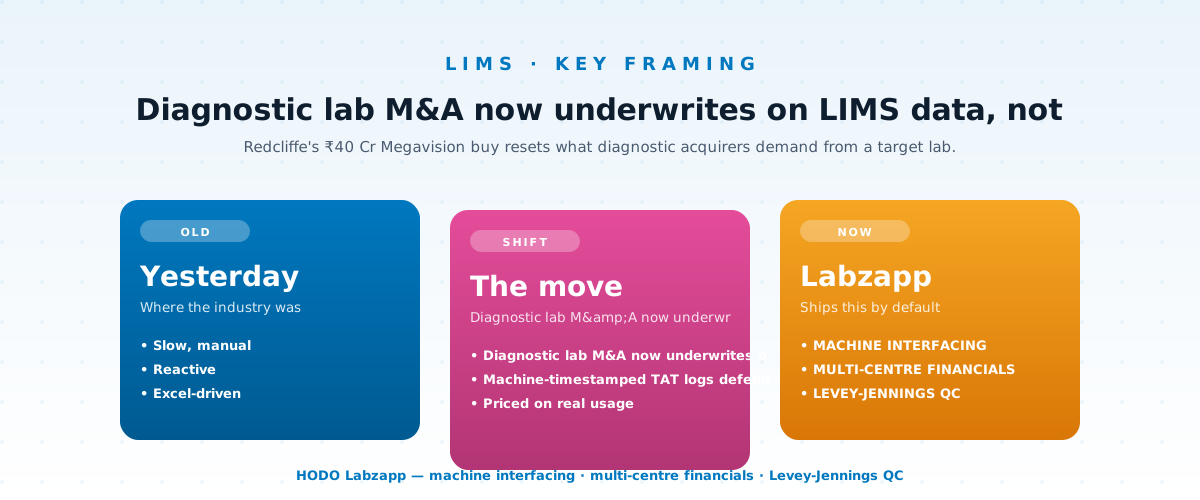
A ₹40 crore cheque in diagnostics is almost never a real-estate or equipment play. Analysers depreciate, leases renegotiate, and civil work is trivial to rebuild. The acquirer is buying, in order: the referring-doctor book, the corporate-hospital and TPA contracts, the franchisee agreements, and the process discipline that produces a reliable cost-per-test. Every one of those assets sits inside the LIMS — not in a spreadsheet, not in the founder's head, and not on a shared drive.
That is why LIMS due diligence has quietly moved to the top of the acquisition checklist. Buyers now ask for exports of TAT by test and centre for the trailing eighteen months, revenue split by referring doctor, and a reconciliation of partner-lab outsourcing volume against invoices raised. Labs that run on paper requisitions, Excel invoicing, or a first-generation LIMS bolted onto a billing package usually cannot produce these exports without a week of manual work. The valuation gap between a lab with clean LIMS data and one without is now larger than the gap between a lab with fifty crore turnover and one with forty.
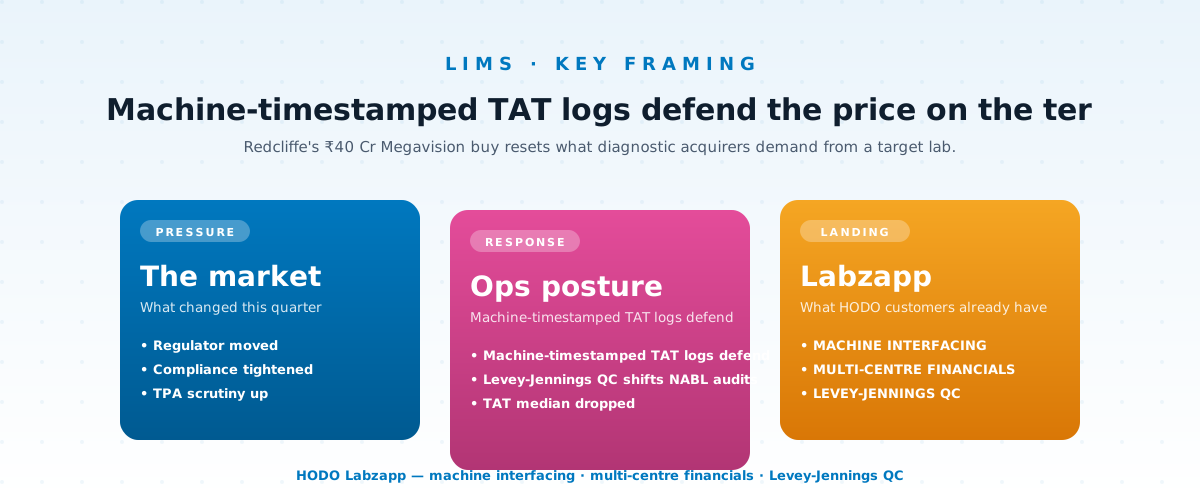
Turnaround time is the operating number every acquirer benchmarks first, because it maps directly to patient repeat-rate and to the willingness of referral doctors to keep sending samples. A lab quoting six-hour biochemistry TAT that cannot show a machine-timestamped log gets discounted. A lab with barcoded samples plus machine interfacing feeding a live TAT dashboard walks into the negotiation with a defensible number that survives buyer verification.
Quality control is the second lever. The National Accreditation Board for Testing and Calibration Laboratories audit process rewards labs that maintain Levey-Jennings QC charts test-by-test, instrument-by-instrument, and can produce shift-and-trend analysis on demand. Acquirers use the same charts to spot instruments that are drifting out of specification and will need replacement — capex that gets deducted from the offer. Labs still running QC on paper or in a general-purpose spreadsheet are handing the buyer a discount they never see coming, and losing an accreditation defence they will need again inside twelve months.
Independent labs almost always outsource the tail of their test menu — histopathology, molecular, specialised hormones — to partner labs. That partner-lab revenue is high-margin for the referrer but hard to defend in due diligence. Buyers ask for anonymised sample tracking to confirm what was actually sent out, what came back, and how the margin was split. Labs that log this natively produce the reconciliation as a single export. Labs that don't produce it as a fight.
Referral doctors and corporate partners sit in the same trap. A lab with a hundred active referring doctors but no doctor-level revenue report cannot promise the acquirer that the book will hold post-transition. A lab that runs a referral-doctor portal and corporate-partner portal with differential pricing per partner already has the doctor logged in, ordering, and receiving reports through a system that carries over to the new owner. The retention risk drops, and so does the discount attached to it in the term sheet.
Regional networks like Megavision typically have a mix of owned collection centres and franchised ones, plus a home-collection field team. Consolidating the P&L across those legal entities is where most acquisitions bleed time. If revenue recognition, franchisee payouts, and inter-centre sample transfers are logged in separate books, the finance integration alone can take a full quarter and generate audit qualifications that spook the new investor.
Labs that run multi-centre financials and franchisee management inside the LIMS avoid that quarter of pain. Every accession, every payout, every inter-centre transfer sits in a single ledger from day one. When the acquirer's CFO asks for a consolidated view, it is a report, not a project. That readiness is not a soft benefit — it is the difference between closing on the original letter of intent and closing on a revised, lower one written after four weeks of reconciliation calls.
Diagnostic-lab owners running HODO Labzapp are already sitting on the data room an acquirer wants. Barcoded samples + machine interfacing produce the TAT log that defends the valuation. Levey-Jennings QC produces the accreditation-grade quality record that keeps NABL audits routine and buyer capex questions off the table. Partner-lab integration with anonymised sample tracking and the referral-doctor + corporate-partner portals with differential pricing per partner produce the revenue-attribution report that keeps the doctor book intact after any change of control. Whether the exit is a Redcliffe-style acquisition or an organic push into new districts, the operating discipline is the same — and it lives inside the LIMS, not around it.
See how Labzapp handles this — book a 30-min demo.
See how Healzapp, Labzapp and EReazy fit your speciality in a free 30-minute demo.
Book a Free Demo