Thyrocare Technologies has launched a new diagnostic laboratory in Tamil Nadu, as reported by Indian Pharma Post. For a national chain, a state-level processing lab is a routine capacity decision. For every regional lab chain and standalone pathology lab working the same catchment, it quietly resets the competitive baseline — because what a nearby processing lab really buys is not a larger test menu, it is hours.
A regional lab is a turnaround decision before it is a capacity one
When a large chain opens a processing facility inside a state it earlier served from a metro hub, the press release talks about capacity, investment and test menu. The operating number that matters to competitors is transit time. Samples that previously travelled overnight to a distant hub now stay within a few hours' road distance of the accessioning bench. Reports that took a day and a half start landing the same evening.
That shift is felt first by referring doctors, not by patients. A consultant running an evening OP clinic decides where to send a thyroid profile or a culture based on whether the report will be back before the patient's next visit. Price enters the conversation later. So when a national lab shortens its regional turnaround, the labs it competes with lose referrals for reasons that never appear in a rate comparison.
The defensive move is not to match the chain's capital spend. It is to know, with evidence, where the existing turnaround actually goes. Most labs can quote an average turnaround for the whole lab. Very few can state the 90th percentile turnaround for a specific test, from a specific collection centre, in the last thirty days. That gap is where referral loss hides, and it is closable without buying a single new analyser.
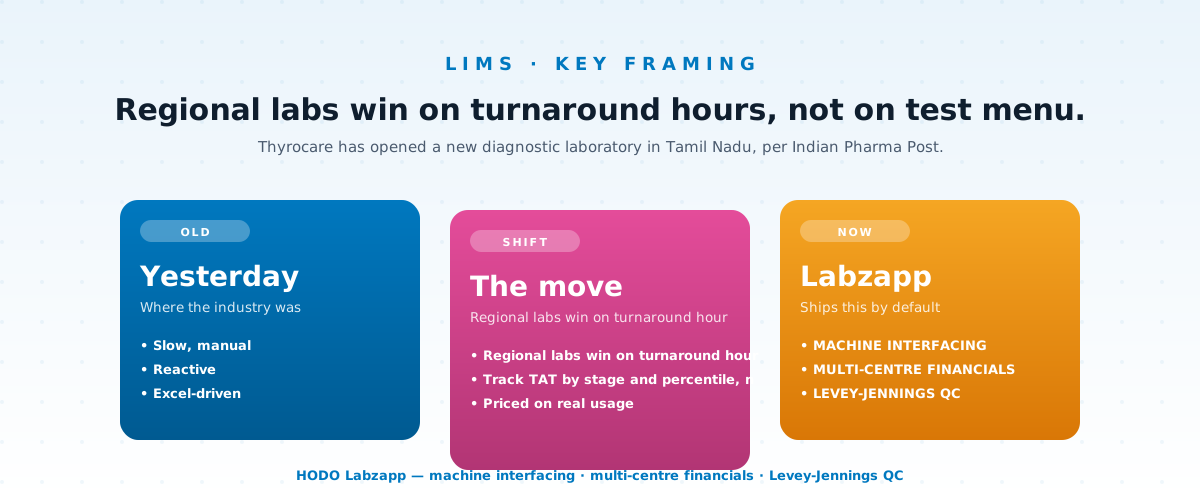
Regional labs win on turnaround hours, not on test menu.
Measure turnaround by stage, not sample-in to report-out
End-to-end turnaround is a reporting number. It is close to useless for fixing anything, because it bundles together stages owned by completely different teams. A usable breakdown has at least six timestamps: collection, pickup from the centre, accessioning at the lab, analyser result, pathologist validation, and delivery to the patient or referrer.
Once a lab starts reading those stages separately, the diagnosis usually surprises the management. The analytical phase is rarely the bottleneck. Delay concentrates in two places: waiting for the next courier run, and waiting for validation because the pathologist works in batches. Both are scheduling problems, not equipment problems. A second afternoon pickup from three high-volume centres often does more for turnaround than a faster analyser, and it costs a fraction as much.
Stage timestamps only exist if the sample is identified once and tracked thereafter. Barcoded samples at the point of collection, plus machine interfacing that pushes results in without manual transcription, remove both the data-entry lag and the transcription errors that force repeat testing. Manual result entry is an underrated turnaround tax: it adds minutes per sample, and the occasional wrong entry costs a full re-run plus a credibility hit with the referring doctor.
What a new hub does to cost per test
Expansion changes unit economics in a direction most lab owners underestimate. Splitting volume across two processing sites raises cost per test on every low-volume assay, because reagent kits, calibrators and controls get consumed on a per-run basis regardless of how many patient samples are in that run. A kit opened for four samples carries the same quality control burden as one opened for forty.
This is why the insource-versus-outsource line has to be redrawn after every expansion, and redrawn per test rather than per department. The honest calculation includes reagent cost, control and calibration consumption, the share of analyser maintenance, technologist time, repeat rate, and the cost of holding a sample until a run is viable. Against that, the outsourced rate from a reference lab is a known, variable number with no idle cost.
Plenty of growing labs discover that twenty to thirty per cent of their in-house menu would be cheaper outsourced, while a handful of tests they currently send out have crossed the volume threshold where insourcing pays. The only way to see this is per-centre, per-test financials that sit next to the volume data rather than in a separate accounting system reconciled at month end.
Outsourcing well also needs its own discipline. Partner-lab integration with anonymised sample tracking lets a lab route specialised work to a reference partner without exposing patient identity to a competitor, and without losing visibility of where the sample is when the referrer calls to ask.
The spokes decide the expansion, not the hub
A processing lab is a fixed asset. The network of collection centres, franchisees, referral doctors and corporate tie-ups around it is the actual business, and it is the harder half to run. National chains compete on exactly this layer, which is where regional labs have a structural advantage — local relationships, faster decisions, better coverage of smaller towns.
The advantage leaks through rate-card drift. Every franchisee negotiates, every corporate contract has its own discount, and over two or three years nobody can state the realised margin per partner with confidence. Credit notes, free repeats and informal concessions accumulate outside the price list. Differential pricing per partner, enforced by the system at billing time instead of remembered by a branch manager, is the difference between a managed network and a loose one.
Partners also need to serve themselves. A franchisee waiting on a phone call to know whether a report is ready generates work for the central lab and irritation for the patient. Referral-doctor and corporate-partner logins, plus automated WhatsApp, SMS and email report delivery, move that traffic off the counter. Home collection deserves the same treatment: phlebotomy routes, sample custody and collection-slot capacity are operational data, not a WhatsApp group.
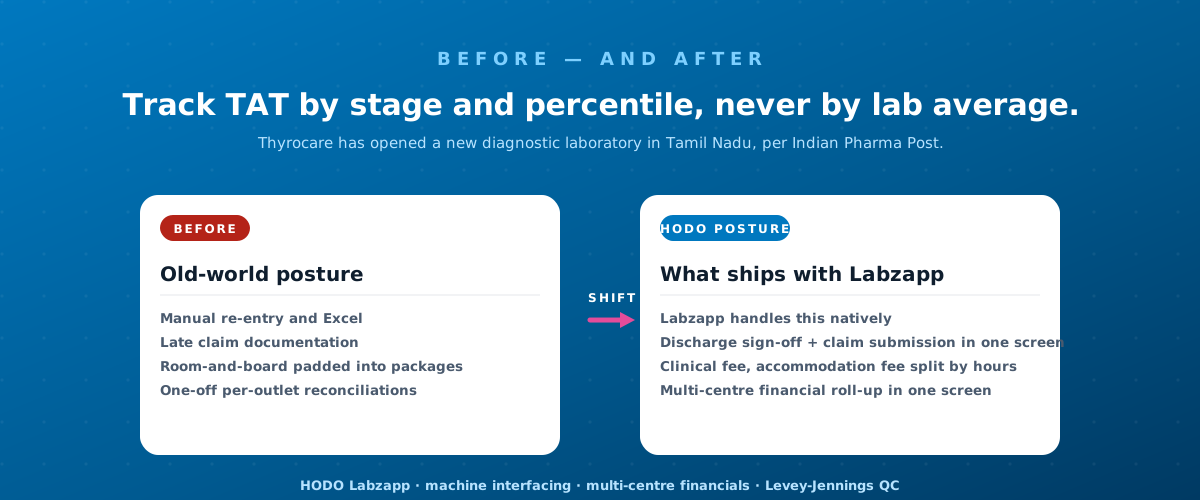
Track TAT by stage and percentile, never by lab average.
NABL scope travels with process, not with intent
Accreditation is where expansion often stalls. NABL scope attaches to a defined facility and a defined test list, so a new site does not inherit a parent lab's certificate. Assessors look for internal quality control records, calibration history, competency files and corrective action trails for that site, over a sustained period before assessment.
Labs that treat quality control as a monthly scramble through spreadsheets struggle, not because the analytics are weak but because the evidence is scattered. Levey-Jennings charts maintained continuously per analyte and per instrument, with Westgard violations recorded along with what was done about them, turn an audit from an archaeology exercise into a printout. The same records answer the harder operational question — whether a repeat spike is a reagent lot problem, an instrument drift, or a technologist training gap.
For multi-centre labs the discipline has to be identical at every site from day one. Retro-fitting documentation onto a centre that has been running for eight months without consistent control records is far more expensive than running it correctly from the first sample.
What this means for HODO customers
A national chain opening a lab in a neighbouring district is not a reason to buy equipment. It is a reason to tighten the three numbers that decide where referrals go: turnaround at the 90th percentile, cost per test per centre, and realised margin per partner. All three are data problems that a lab's own systems should already be answering.
Labzapp is built around that operating view. TAT reporting breaks turnaround down by stage, test and centre instead of leaving it as a single lab-wide average. Franchisee management with differential pricing per partner keeps network rate cards enforced at billing rather than negotiated at the counter. Levey-Jennings QC maintains the continuous quality control record that NABL scope expansion depends on, across every centre, from the first run.