Neuberg Diagnostics is preparing to raise about USD 200 million through a public issue, as reported by Medical Buyer and carried on Google News. For a group assembled from regional pathology brands across India and overseas, a filing of that size is as much a disclosure exercise as a fundraise. Everything a lab chain normally keeps in spreadsheets and WhatsApp groups — turnaround time by centre, cost per test, outsourced sample leakage, franchisee collections — becomes a number that outsiders are entitled to interrogate.
A lab IPO is an operations audit before it is a capital event
Indian diagnostics has seen a visible run of listings and attempted listings over the past few years, and the pattern in each is similar: clinical capability is rarely the question. Diligence concentrates on repeatability. How many centres report the same test at the same price? Which ones breach promised TAT, and by how much? What share of revenue comes from samples the lab did not actually process in-house? How much of the receivable on the balance sheet is corporate and TPA money that is ninety days old?
A chain of ten labs can answer these from memory. A chain of two hundred collection points, fifteen processing labs and a few hundred franchisee outlets cannot. The answers have to come out of the system that runs the lab, because any other source is a reconstruction — and a reconstruction a reader can question is worth less than a report drawn straight from the transaction trail.
That is the practical reason mid-sized lab chains should read the Neuberg filing even if a listing is nowhere on their own roadmap. The same questions arrive with any serious capital event: a private-equity round, a strategic sale, a bank's working-capital review, a corporate client's vendor audit. The evidence required is identical. Only the audience changes.
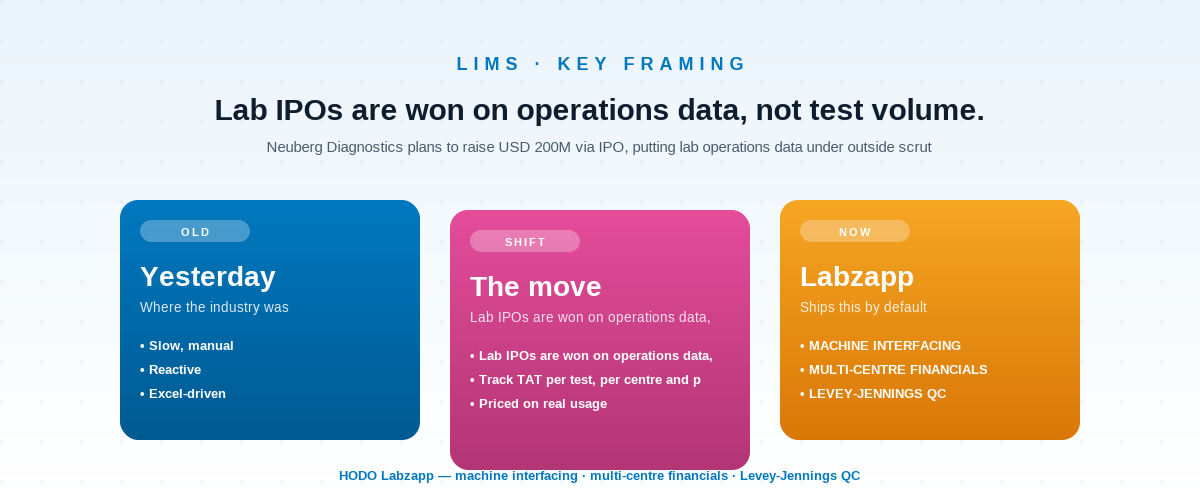
Lab IPOs are won on operations data, not test volume.
TAT stops being a service promise and becomes a financial metric
Turnaround time is usually quoted to clients as a single promise — routine biochemistry by evening, histopathology in three days. Internally it is nothing of the sort. TAT is a chain of timestamps: registration, collection, transport, accessioning, analysis, verification, release. A chain-level average hides the fact that one branch is losing four hours in transport while another holds reports because the pathologist signs off in a single evening batch.
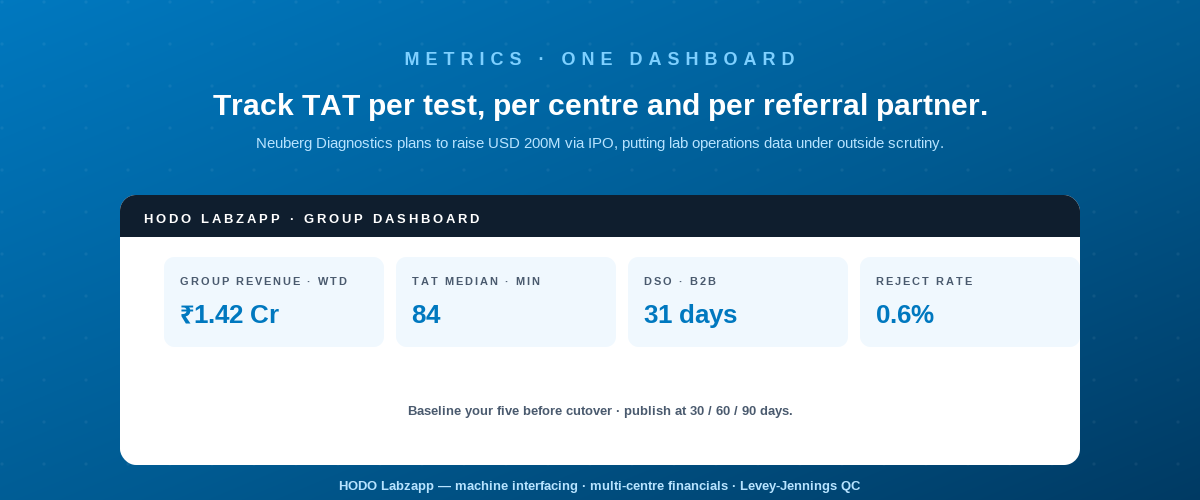
For a chain that wants to defend its service claims, TAT has to be measurable at three levels — per test, per centre, and per referral partner. Per test, because the outlier departments are where credit notes and repeat runs originate. Per centre, because one poorly run collection point will damage the brand across a city. Per referral partner, because the doctors and corporates who send volume judge the lab on their own samples, not on the aggregate.
The operational fix is boring and effective: barcode the sample at the point of collection, let the analyser write results back through machine interfacing rather than a typist, and timestamp every status change automatically. Once those three are in place, turnaround reporting stops being a monthly argument and becomes an exception list a quality manager can clear before clients notice.
Cost per test is the only unit that compares across a network
Revenue per centre is the number most lab chains track, and it is the number most likely to flatter a weak network. Two collection points billing ₹4 lakh a month can have entirely different economics once reagent consumption, rejected samples, repeat runs, courier cost, phlebotomist time and the discount given to the referring doctor are attributed properly.
Building a usable cost per test requires three things labs often keep separate: consumption tied to the test rather than to a monthly purchase register, sample rejection and repeat rates recorded as events rather than as a verbal estimate, and pricing visible at the actual rate given to each partner instead of the published tariff.
The last point deserves attention. Most Indian lab chains run several price lists at once — walk-in retail, referral doctor, corporate contract, camp rate, partner-lab rate, insurance panel. When those sit outside the system, realisation per test is unknowable and the discount structure drifts quietly. When differential pricing per partner is enforced inside the billing flow, a quarterly review shows exactly which partner relationships earn their discount and which are volume for its own sake. That review is also the fastest route to better margin without touching the price card.
The B2B book is where lab chains quietly lose margin
Almost every lab chain outsources something — specialised molecular panels, histopathology opinion, tests that do not justify a local analyser. Outsourcing is sound commercially and routinely untracked operationally. The sample leaves the building, the report comes back on the partner's letterhead or is retyped into the chain's format, and the margin on that test is estimated afterwards.
Two risks follow. The first is clinical and legal: if custody of a sample moving between the chain and the partner lab is not logged, a disputed or lost report has no defensible trail, and NABL assessors will ask for one. The second is commercial: when outsourced volume is not priced per partner inside the system, nobody can say whether a referred test earns anything after courier, handling and the partner's rate.
The inbound side is the counterpart. For a chain with processing capacity, acting as a reference lab for smaller labs is attractive revenue — provided each partner sees only their own samples and patient identity is not exposed across the network. That is why partner-lab integration with anonymised sample tracking matters more than it sounds: it makes a B2B book auditable, and auditable B2B revenue is the kind a buyer or an investor will pay a multiple for.
Track TAT per test, per centre and per referral partner.
Home collection changes both the unit economics and the audit trail
Home collection is now a default expectation in metros and a growing one in tier-2 cities, and it changes the cost structure in ways a centre-based P&L does not capture. A home visit carries travel time, a phlebotomist's half-day, consumables, a temperature-sensitive transport leg and a higher chance of a rejected sample. Unit economics per visit are only visible if the visit itself is a tracked object — booked, assigned, routed, collected, accessioned — rather than a phone call that ends in a barcode.
Report delivery deserves the same treatment. Automated SMS, WhatsApp and email report delivery is not a convenience feature at scale; it is the difference between a front desk that answers status queries and a front desk that takes bookings. For home-collection networks it also closes the loop with a patient the lab will never meet in person. Quality control runs in parallel: Levey-Jennings QC gives the lab a record when a result is challenged, and when an audit asks how drift is detected across instruments at different sites, the chart answers instead of an assurance.
What this means for HODO customers
The headline number in the Neuberg story will dominate coverage, but the operational standard behind it is the part a mid-sized chain can act on this quarter. The data a listing demands is the same data that fixes turnaround complaints, recovers margin from drifting discounts and settles disputes with partner labs.
HODO Labzapp is built around that transaction trail. TAT reporting works off barcoded samples and machine interfacing, so turnaround is measured per test and per centre instead of estimated. Multi-centre financials hold each outlet's contribution with differential pricing per partner applied at billing, which makes cost per test comparable across the network. Partner-lab integration with anonymised sample tracking keeps outsourced and inbound reference work logged and priced without exposing patient identity between partners. Franchisee management and referral-doctor portals extend the same record to outlets and doctors the chain does not directly operate.
A lab chain that can produce these numbers on demand negotiates from a stronger position with every counterparty it meets — investor, banker, corporate client or assessor.