eHealth Magazine reports that the Kalyan Singh Super Speciality Cancer Institute (KSSSCI) in Lucknow has commissioned a ₹2.16 crore digital pathology facility and brought the wait for a cancer biopsy report down to five days. The capital figure will get the headlines, but the five days is the number worth studying. For Indian diagnostic labs, pathology chains and 100-bed hospital labs, the useful question is not what a whole-slide scanner costs — it is what has to be true inside a lab before histopathology can report in five days instead of fifteen.
Five days is a workflow number, not a scanner number
The ₹2.16 crore at KSSSCI buys scanners, image storage and the network to move whole-slide images between viewers. It does not buy turnaround time. Turnaround comes out of the sequence every specimen passes through before a consultant signs it out: receipt and accessioning, grossing, fixation and processing, embedding, microtomy, staining, immunohistochemistry where indicated, scanning, reading and sign-out. Digital pathology removes two specific delays — the physical movement of slides between a collection centre and the reporting pathologist, and the week a second opinion used to take. Both are real savings. Everything else on that list remains a floor-level operations question: how many cassettes a histotechnician clears per shift, whether the IHC panel was raised on day one or day four, and whether a block sat on a bench between the processor and the microtome. Labs in India that have genuinely compressed histopathology TAT without buying a scanner usually did it by tightening accessioning discipline and IHC ordering rules. Labs that bought the scanner first and left the workflow untouched ended up with a faster way to look at slides that still arrive late. Capital equipment exposes a workflow; it does not repair one.
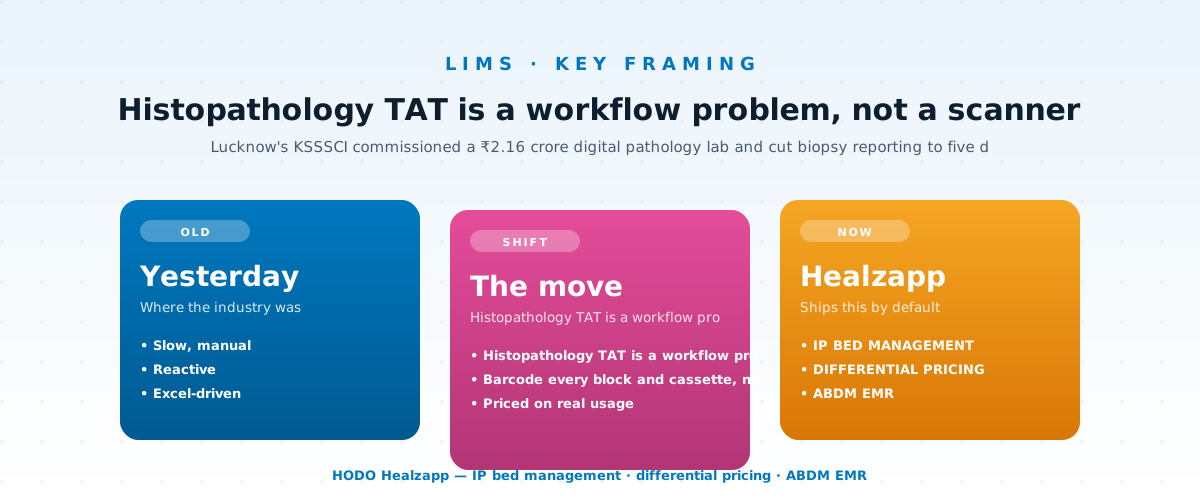
Histopathology TAT is a workflow problem, not a scanner problem.
Where histopathology TAT actually leaks
Most labs quote an average TAT, and most averages conceal the problem. Reported in stages, three leaks recur across Indian histopathology setups. The first is accessioning: specimens arriving from an operation theatre or an outside clinic without clinical history, site or laterality, which forces a call back to the surgeon before grossing can begin. A day disappears before any technical work starts. The second is re-work — inadequate fixation, a thin or folded section, a stain that has to be repeated — each of which adds a processing cycle rather than an hour. The third, and usually the biggest, is immunohistochemistry: the decision to order a panel is taken at first reading rather than at grossing, so the clock effectively restarts three or four days into the case. Add referral work, where the block is physically with a partner lab and nobody at the originating lab can state where it is or when it will return. Seen this way, a fifteen-day histopathology TAT is rarely fifteen days of work. It is four days of work and eleven days of waiting, and almost all of the waiting sits in handoffs between people, benches and organisations.
The cost per test maths of digital pathology
A whole-slide scanner changes a lab's fixed cost, not its variable cost. Capital of that order, depreciated over five to seven years and loaded with service contracts, storage and bandwidth, needs volume beneath it. A government cancer institute draws that volume from its catchment. A private lab chain or a hospital lab has to build it, which means the business case cannot rest on in-house histopathology alone. Slides read for other labs, reads by a pathologist who does not sit on site, sub-speciality opinions and teaching archives all have to be counted in. A scanner handling forty in-house blocks a day will be the most expensive instrument in the lab measured per reportable test, and that figure rarely appears in the purchase note. Cost per test is worth computing per discipline, with instrument depreciation, reagents, consumables, technician minutes and pathologist reading time separated out — because histopathology, cytology and routine biochemistry behave nothing alike. Multi-centre labs face a further decision: whether one scanner sits at a hub while spokes send cases digitally, and how inter-centre work is priced internally so that a branch manager's P&L still reflects reality. Without multi-centre financials, hub-and-spoke reporting quietly moves cost into whichever unit owns the machine.
Referral and partner labs are the real volume lever
Once slides are digital, geography stops deciding who can read them. A lab in Lucknow, Kochi or Pune can offer histopathology reporting to smaller labs and nursing homes that cannot retain a full-time pathologist, and that is the most reliable way to fill a scanner. The operational requirements are specific. Cases must be received from a partner in a defined format, not as WhatsApp images and a phone call. The partner's patient identity must stay anonymised on the reporting side, so the originating lab's data is not exposed to the reading lab's staff. Rates must differ by partner, because a franchisee, a corporate account and a walk-in referral will never sit on the same card. And the partner needs a login that answers the status question — received, under process, reporting, released — without a human having to look it up. Labs that scale referral histopathology without this spine spend their margin on coordination calls. Labs that build it find that referral volumes also sharpen in-house TAT, because an external partner complains about delays in a way an internal department does not. The discipline that partner work imposes is, in practice, part of the return on the scanner.
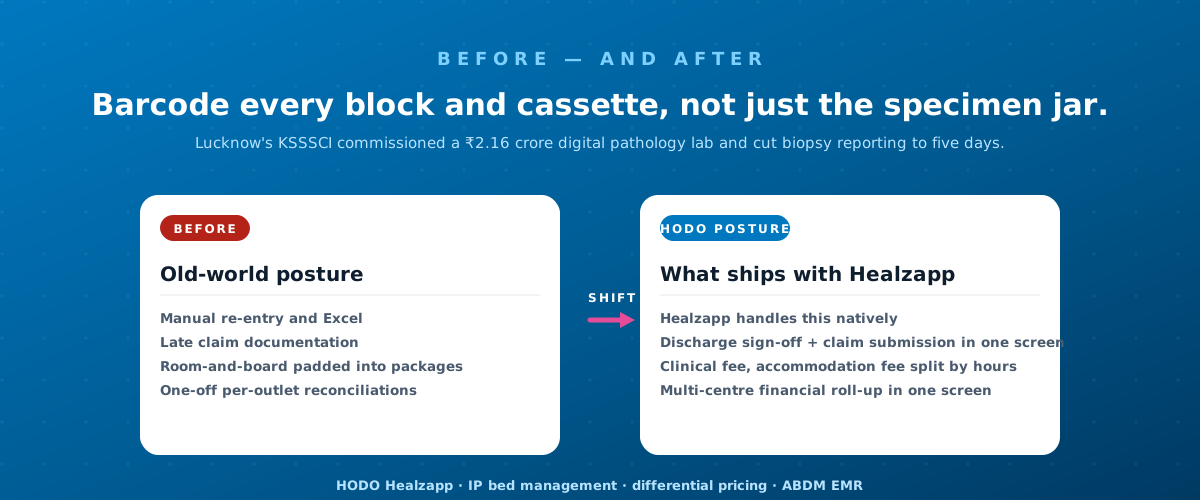
Barcode every block and cassette, not just the specimen jar.
Reporting TAT in a form an assessor accepts
NABL expects a defined turnaround time per test, monitoring against that definition, and documented action when it is breached. An assessor asks for the data, not the intent. That means timestamped records at accessioning, at each processing stage and at sign-out; an exception list showing which cases breached and why; and evidence that the breaches were reviewed. Labs that reconstruct this from registers before an assessment are doing the work twice and learning nothing from it. Labs that capture it continuously get something more useful than a certificate — a stage-wise view of where days are lost, which is precisely the view needed before approving any capital purchase. The same applies to analytical quality on the instrument side, where Levey-Jennings QC charts have to exist as running records rather than retrospective exhibits. Digital pathology adds a scanning stage and an image-storage dependency to the TAT chain; both need to appear in the monitored sequence from day one, not after the first breach.
What this means for HODO customers
Labzapp was built around the stages where TAT actually leaks. Barcoded samples combined with machine interfacing remove the manual transcription and bench-level ambiguity that create re-work, and give each specimen, block and slide a traceable identity from collection to sign-out. TAT reporting turns turnaround from a quoted average into stage-wise data an assessor and an operations head can both use. For labs building referral volume on the back of digital pathology, partner-lab integration with anonymised sample tracking and differential pricing per partner handle the case intake, identity separation and rate-card problems that otherwise sit in spreadsheets. Report release closes the loop through automated SMS/WhatsApp/Email report delivery, so a five-day report does not become a seven-day report while it waits for someone to send it.