At the ISB Healthcare 4.0 conclave last week, sector leaders argued that India's next healthcare gains will come not from tertiary metros but from the 50-300 bed hospitals and single-city clinic chains that see the bulk of patient volume, as reported by ANI News. The panel's core message to owners and administrators was blunt: digital transformation and value-based care are no longer optional add-ons, and the operators who delay will lose ground to peers who are already re-plumbing their HIS, billing and reporting stacks.
Why the ISB Panel Named Small Hospitals as the Pivot Point
The ISB Healthcare 4.0 discussion framed small and mid-sized hospitals as the pivot point for two reasons. First, they carry the load, the majority of outpatient footfall and secondary care in India runs through this segment, not through the marquee chains. Second, they are the most exposed to the twin squeeze of TPA payment cycles stretching past 60 days and rising input costs on consumables, diagnostics and manpower. Panelists pointed out that a 120-bed hospital running on paper case sheets, a standalone billing package and a WhatsApp group for lab reports simply cannot cost its own services accurately, let alone negotiate value-based contracts with insurers or corporate partners. The takeaway for owners is uncomfortable but useful: the digital gap is now a cash-flow gap. Hospitals that cannot produce clean encounter-level data, every consultation, every consumable, every minute of OT time, will be the ones that get squeezed hardest when payers move from fee-for-service to bundled and outcome-linked pricing over the next three to five years.
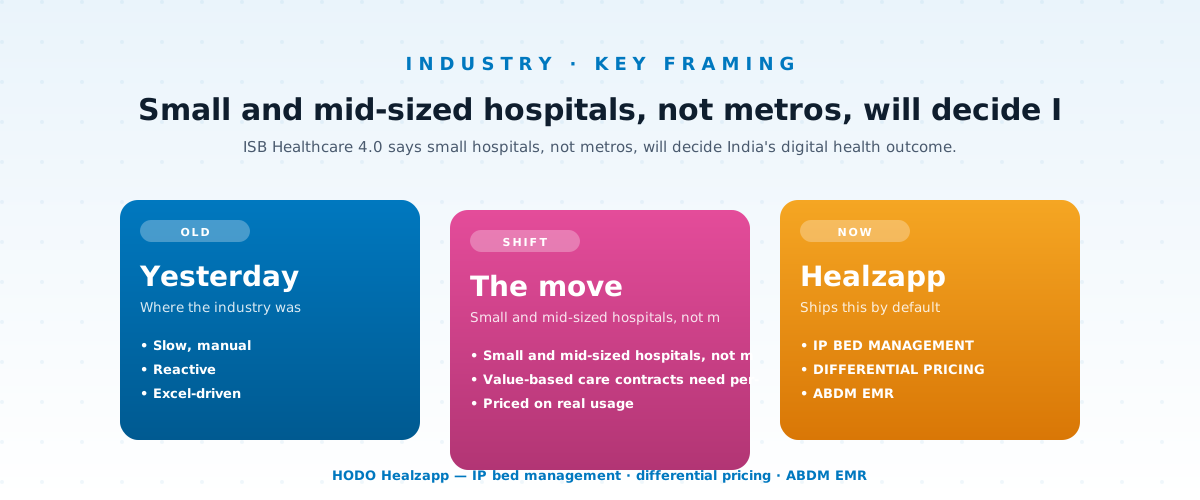
Small and mid-sized hospitals, not metros, will decide India's next healthcare gains.
Value-Based Care Needs a Data Spine, Not a Slogan
Value-based care sounds like a policy phrase until an administrator tries to price a knee replacement package that covers pre-op workup, surgery, implants, physiotherapy and 90-day readmission risk. Doing that honestly requires one continuous record per patient episode, linked billing, and the ability to pull cost and outcome data across departments without a week of Excel work. Most 50-500 bed hospitals in India today cannot do this, not because staff are unwilling, but because their HIS, pharmacy, lab and OT systems were bought in different years from different vendors and were never designed to talk to each other. The ISB panel's practical prescription was to consolidate onto an integrated HIS that owns the patient record end-to-end, and to insist on ABDM compliance from day one so that the hospital is not locked out of national health-ID-based referrals, claims and analytics. Owners who are still evaluating vendors should ask a direct question: can the system produce a per-patient P&L on demand? If the answer requires a data team, the platform is not ready for value-based care.
ABDM Compliance Has Quietly Become a Commercial Filter
Two years ago, ABDM readiness was a compliance checkbox that most administrators filed under "next quarter". That window has closed. Corporate empanelment tenders, government scheme integrations under PMJAY, and increasingly TPA network onboarding forms now ask for ABDM-linked health ID capture, consent artefact storage and FHIR-format record sharing. Hospitals that cannot demonstrate a live ABDM integration are being quietly dropped from shortlists. For a 200-bed hospital doing 40% of its revenue through cashless and scheme patients, that is a material commercial risk, not an IT problem. The operational fix is not complicated but it is non-negotiable: the HIS in use must be certified against ABDM's Health Information Provider and Health Information User specifications, must be listed on NRCeS for teleconsultation where relevant, and must be able to issue and consume consent artefacts without manual workarounds. Administrators should also verify that their vendor was among the earlier cohort of ABDM-integrated platforms, later entrants are still catching up on edge cases like consent revocation and multi-facility record stitching.
Multi-Outlet Growth Is Where Most Chains Break
A recurring theme at the ISB event was that Indian clinic and diagnostic chains hit a wall between the third and seventh outlet. The first two locations run on the founder's memory and a shared WhatsApp group. By the fifth, differential pricing gets confused, referral commissions leak, lab TAT varies wildly between centres, and consolidated financials arrive ten days after month-end. The digital fix here is unglamorous but decisive: a single-instance HIS or LIMS that supports one-click new-centre setup, centre-wise and partner-wise differential pricing, and consolidated multi-centre financial reporting out of the box. Chains that get this right can add a new outlet in a week without hiring a separate accountant or IT admin for it. Chains that get it wrong end up running each outlet as an island, which caps growth at whatever the founder can personally supervise. For diagnostic chains specifically, the additional requirement is barcoded sample tracking across collection centres and processing labs, with anonymised handoff to partner labs where in-house capacity does not cover the test menu.
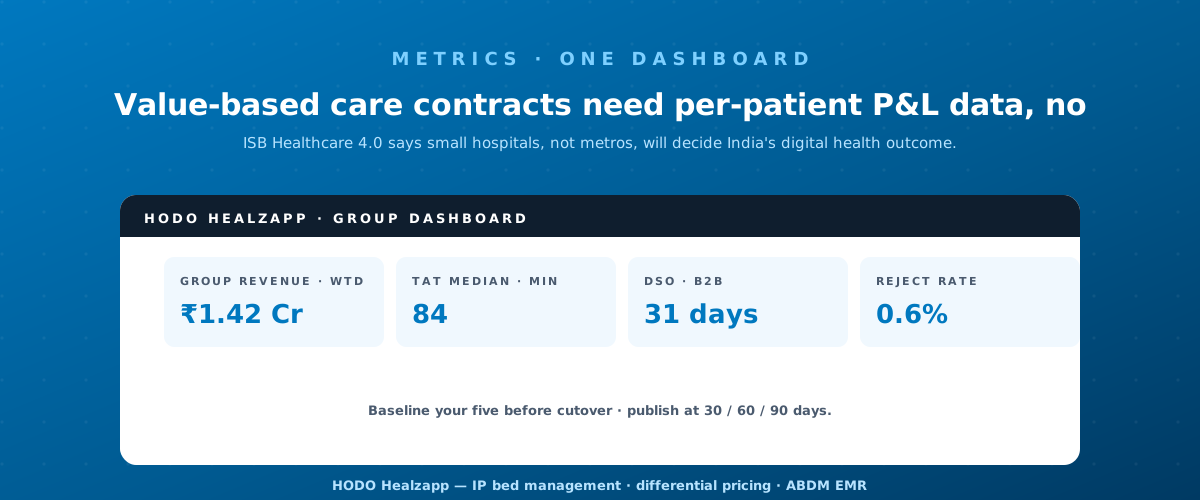
Value-based care contracts need per-patient P&L data, not slogans or dashboards.
The Report-Delivery Problem Nobody Mentions in Board Meetings
One operational detail the ISB panelists returned to repeatedly: patient experience in Indian healthcare is decided less by clinical quality and more by how quickly and cleanly the patient gets their report, bill and follow-up instructions. Hospitals that still hand out paper reports at a counter, or email PDFs from a personal Gmail account, are losing repeat visits to competitors who push reports and bills to WhatsApp within minutes of authorisation. This is a low-cost, high-visibility upgrade, automated SMS, WhatsApp and email delivery of lab reports and discharge summaries, tied to the HIS or LIMS so that nothing is sent before the pathologist or consultant has signed off. For diagnostic chains, this single change typically lifts repeat-visit rates and cuts front-desk phone traffic by a measurable margin within a quarter. For hospitals, it also reduces medico-legal exposure by giving every patient a timestamped, auditable record of what was communicated and when.
What this means for HODO customers
The ISB Healthcare 4.0 conversation maps directly onto what HODO Healzapp already does for 500+ client outlets. ABDM-compliant EMR means the hospital is ready for scheme empanelment and consent-based record sharing on day one, not after a six-month IT project. Multi-outlet scale-up with one-click new-centre setup removes the friction that stalls most chains between their third and seventh location, and Differential pricing keeps corporate, TPA and cash rate cards clean across centres without spreadsheet reconciliation. Together these features let a 50-500 bed hospital or a multi-outlet chain operate with the data discipline that value-based contracting will soon demand.