AtHomeCare is trialling an integrated app to streamline post-discharge care and reduce readmissions, as reported by India Gazette. For operators running doctor-at-home and lab-at-home services, the interesting part is not the clinical claim but the operational one — that stitching visits, vitals, medication reviews and follow-up tests into one tracked workflow changes who comes back to the ward. That is a scheduling and routing argument, and it is testable.
The 30-day window is an operations problem first
Readmission within 30 days of discharge is rarely caused by a single missed clinical decision. It is usually caused by a sequence of small operational failures: the follow-up appointment was booked for day 14 when the patient needed day 3, the prescribed test was never collected, the report reached the hospital but not the treating consultant, and nobody called when the patient stopped answering the phone. Each failure is minor. Together they produce a patient arriving at casualty at 2 am.
An integrated post-discharge app, of the kind being trialled here, is an attempt to collapse those handoffs into one sequence with an owner and a state. The clinical content — wound check, vitals, medication reconciliation — is not new. What is new is that a visit is either scheduled, completed or missed; a sample is either collected, in transit or resulted; a patient is either reachable or flagged for escalation.
For home-visit operators in India, this is the same stack they already need for commercial reasons. Route density, visit completion rate and repeat booking rate decide whether a home-visit business survives at all. Readmission reduction is what the hospital buys; visit discipline is what makes it deliverable.
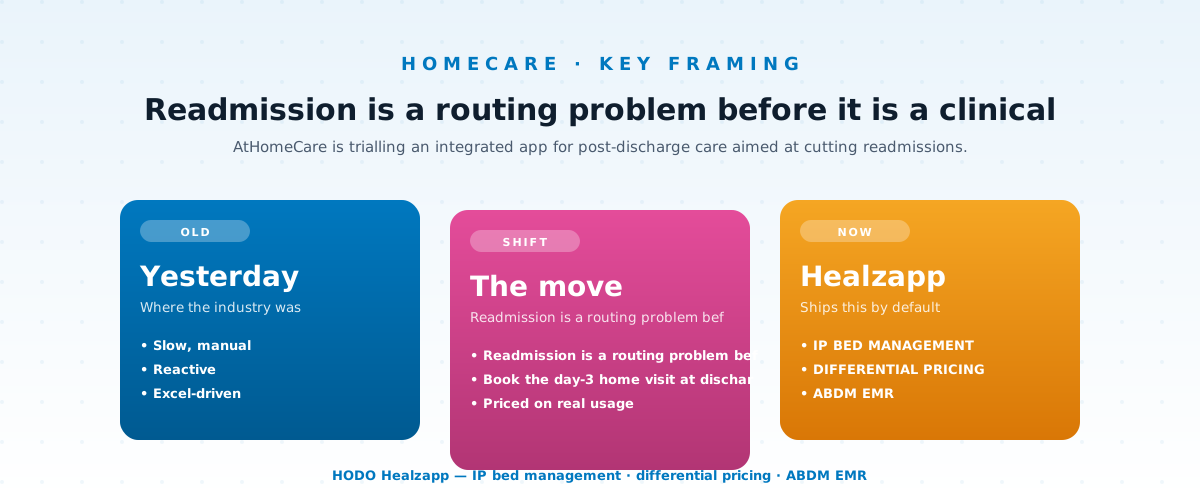
Readmission is a routing problem before it is a clinical one.
Book the follow-up at discharge, not after the gap
The highest-yield change in most post-discharge programmes is moving the booking moment. If the day-3 home visit and the day-7 blood test are both booked while the patient is still on the bed, completion rates climb sharply. If they are booked afterwards — by a call centre chasing a number written on a discharge summary — a third of them quietly disappear.
This has a software implication that operators underestimate. The discharge desk and the home-visit scheduler must be looking at the same appointment calendar, with the same slot availability and the same geography logic. If the hospital books into a spreadsheet and the field team works off WhatsApp messages, no app layer on top will repair it.
Scheduling across doctors, phlebotomists and nurses also has to respect travel. A home-visit calendar that permits three bookings 40 km apart in the same two-hour band is not a calendar, it is a complaint generator. Slotting by pin code cluster, with buffers that reflect actual city traffic rather than map estimates, is the difference between six completed visits a day and four. One number is worth reviewing weekly: the percentage of discharges with a confirmed first follow-up contact inside 72 hours.
Home collection is where the chain breaks
The lab leg of post-discharge care fails more often than the visit leg, because it carries more handoffs. A phlebotomist collects at the patient's home, moves across several addresses, passes samples to a rider or drives to the nearest centre, and the sample is then registered at the lab — often re-labelled by hand. Every step is an opportunity for a mismatch, a temperature excursion or a quiet loss.
Barcoding at the doorstep rather than at the lab closes most of that gap. When the tube is labelled and scanned at the point of collection and linked to the booking, chain of custody becomes a record rather than a recollection. Turnaround time can then be measured from collection, which is what the patient experiences, rather than from registration, which is what flatters the lab.
Report delivery matters as much. A post-discharge patient whose creatinine result is sitting in a portal they have never logged into is, functionally, a patient without a result. Automated delivery to WhatsApp, with the referring consultant copied, converts a test into a decision. For operators using partner labs or franchise collection points, the same discipline must extend to outsourced tests, with anonymised sample tracking so the work can be followed without exposing the patient to the partner.
The unit economics of a post-discharge visit
The usual failure mode in home-visit pricing is benchmarking against a clinic consultation and then discovering the margin has gone after the second missed visit of the day. Post-discharge programmes change the arithmetic in one useful way: the visits are predictable. A hospital discharging 25 patients a day produces a forecastable stream of day-3, day-7 and day-14 contacts, clustered around its own catchment.
That predictability is what makes route density achievable, and route density is the only real lever on cost per visit. Four visits per clinician per day at 18 km of travel each is a different business from seven visits at 6 km each. Cost per completed visit, not cost per booked visit, is the figure to model — the gap between the two is where margin disappears.
Teleconsultation belongs in the same model. Not every day-7 contact needs a clinician at the door. A structured video review, with a clear escalation rule for who converts to a physical visit, lets a fixed field team cover two to three times the patient base. Programmes that hold up treat the physical visit as the expensive exception, not the default setting.
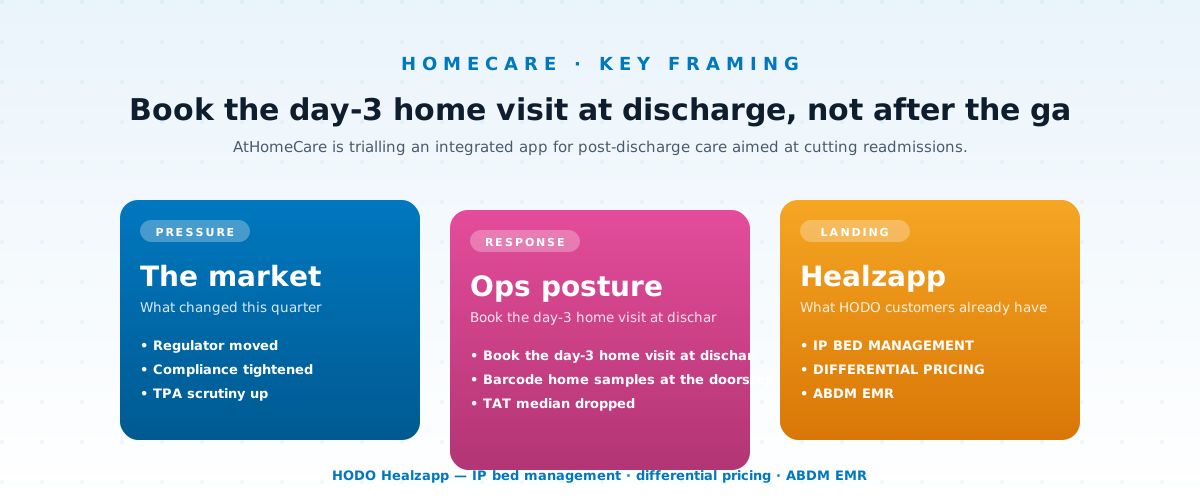
Book the day-3 home visit at discharge, not after the gap.
Who owns the record between discharge and day 30
Integrated apps stall at the data boundary. The home-visit operator records vitals, medication adherence and wound status; the hospital holds the admission record, the discharge summary and the consultant's plan. If those two sets never meet, the field team works blind and the consultant discounts whatever the field team reports.
The practical answer is not a full record merge. It is a shared, condensed view: the discharge summary, the active medication list, flagged risks, and a running log of post-discharge contacts a consultant can read in under a minute. Vendors promising deep bidirectional integration as the first deliverable are worth treating with caution — many programmes die waiting for it. A read-only consultant view plus structured visit notes flowing back is enough to change behaviour.
Governance deserves the same attention. Consent for home visits, for sample collection and for sharing results with the referring hospital should be captured once, at discharge, with a record of who captured it. Operators opening a second or third city usually find that the absence of a consistent consent and escalation protocol blocks them well before demand does.
What this means for HODO customers
Post-discharge programmes are won on scheduling discipline, sample traceability and report delivery rather than on app design. Appointments in HODO Healzapp lets the discharge desk and the home-visit team book into one calendar, so the day-3 contact is set before the patient leaves the bed. Teleconsultation and the Patient Health App absorb the low-acuity follow-ups and give the patient a single place to see what is scheduled next, keeping field clinicians for visits that need a physical examination. On the lab leg, Labzapp's barcoded samples and home-collection workflow with WhatsApp/SMS report delivery closes the distance between a doorstep collection and a result the consultant acts on, while TAT reporting measures the clock the patient actually feels.