The Delhi Medical Association has accused private health insurers of diverting the majority of medical-claims funds away from patient care, according to The New Indian Express. The DMA's charge, routed through IRDAI and picked up widely across trade press this week, puts fresh pressure on India's 100-bed hospitals that already run on thin insurance margins. It also sharpens the operational questions every HIS decision-maker should be asking about their TPA workflow.
What the DMA actually alleged
The DMA's submission argues that a significant share of premium and claim rupees never reaches the treating hospital or the patient, instead getting absorbed by intermediary costs, deductions, and disputed line items. Whether or not IRDAI's final finding matches the DMA's framing, the underlying friction is real for any provider that runs a cashless desk. Raised claims come back short-settled. TPA queries stall discharge for hours, sometimes days. The gap between billed amount and realised amount keeps widening.
For a ~100-bed hospital in a tier-1 or tier-2 city, that gap is the difference between a healthy month and a stressed one. The story also lands at the same time PMJAY rate revisions and state-scheme audits are pushing hospitals to prove line-item traceability. The message from the market is consistent: if a hospital cannot produce a clean audit trail from OP registration through IP discharge summary and pharmacy indent, its realised revenue will shrink.
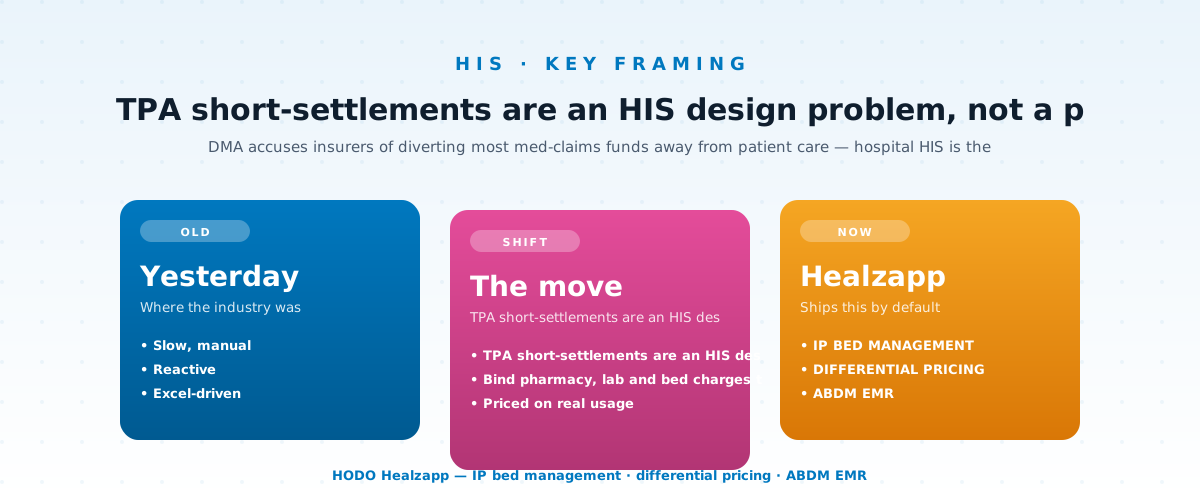
TPA short-settlements are an HIS design problem, not a premium problem.
Where the cashflow leaks show up in a 100-bed hospital
Look at any 100-bed hospital's aged-receivables report and the leaks cluster in familiar places. Discharge summaries leaving the ward without matched pharmacy and lab charges. IP bed charge days that don't reconcile with the nursing station log. Investigations ordered in EMR but never routed to a billable line. Corporate and TPA discounts applied inconsistently across shifts because the front office doesn't have a single source of truth on pre-authorisation.
Each leak is small on its own, a few thousand rupees on one file, sometimes less. Multiplied across 60–80% occupancy and a month of discharges, it becomes the operating margin. The DMA's public complaint gives hospital administrators a fresh mandate to fix the plumbing rather than argue about premiums that no single hospital can influence.
The TPA workflow that needs hardening
The insurance leg is where the biggest wins sit. A hardened TPA workflow does three things at once. It captures pre-authorisation the moment the patient walks in, not two hours before discharge. It binds every downstream charge (pharmacy, radiology, lab, OT, IP bed) to that pre-auth so nothing is billed off-scheme. And it produces a discharge-ready claim file without a manual scramble at the last minute. When this workflow lives inside the HIS, not in a parallel Excel or a WhatsApp group, the query rate from TPAs drops, and short-settlements become visible early enough to contest.
The alternative is what most hospitals actually run: pre-auth in one system, EMR in another, billing in a third, and a claims coordinator stitching PDFs together at 11pm. That model was tolerable when premiums were rising 15% a year and TPAs were less aggressive on line-item scrutiny. It is not tolerable in the environment the DMA is now describing publicly.
What ABDM and NABH readiness look like from the CFO's chair
ABDM compliance and NABH re-accreditation are usually pitched as clinical quality projects. From a CFO's perspective they are cashflow projects. A properly ABDM-integrated EMR gives the hospital a defensible clinical record for every claim, timestamped, digitally signed, and linked to the patient's ABHA. That record is exactly what a TPA or state auditor asks for when a claim is queried. NABH-driven documentation discipline, consent forms, drug charts, nursing notes, is the same evidence base, packaged for a different auditor.
Hospitals that treated ABDM as a 2023 checkbox are now discovering the upside: cleaner audits, faster claim closure, fewer short-settlements. Hospitals that deferred are discovering the downside in this week's headlines. The differentiator is not whether the EMR is technically ABDM-integrated, but whether the clinical team actually uses it as the primary record, because a claim defended on a paper file loses more often than a claim defended on a digitally signed EMR.
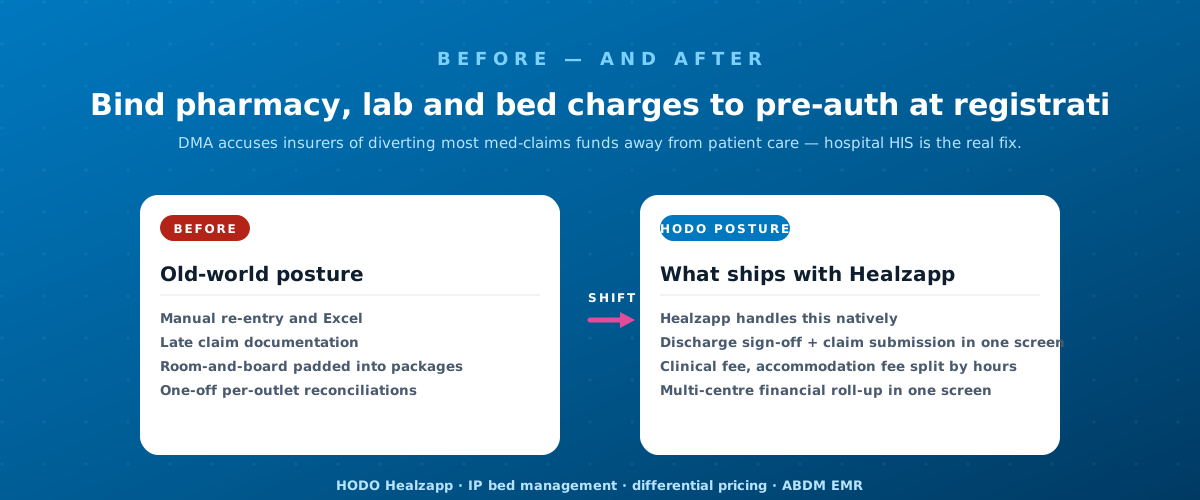
Bind pharmacy, lab and bed charges to pre-auth at registration.
Multi-outlet chains and the scale problem
For Indian hospital groups and diagnostic chains adding centres, this row has a second edge. Each new outlet inherits the parent's TPA panel, discount structure, and claim workflow, but only if the HIS actually propagates those settings. A group opening its fifth or sixth centre cannot afford to re-teach every front office the pre-auth SOP by hand. One-click new-centre setup, a single price master across outlets, and a single TPA rule engine are the difference between a chain that scales cleanly and a chain that leaks a little more at every new location.
The same logic applies to lab chains that run a network of collection centres and referral tie-ins with 100-bed hospitals. Differential pricing per corporate partner and per TPA has to survive the switch to a new centre. When it doesn't, the finance team quietly writes off the difference, and that write-off is exactly the pool the DMA is publicly asking IRDAI to protect.
What this means for HODO customers
The DMA-vs-insurers row is a reminder that hospital economics in India are decided at the intersection of the front office, the ward, and the claims desk. HODO Healzapp is built for that intersection. Billing is bound to IP/OP and to Machine Interfacing, so every investigation and every bed day flows into a single claim file with a defensible audit trail. The ABDM-compliant EMR gives TPAs and NABH auditors the timestamped clinical record they ask for when a claim is queried. And Multi-outlet scale-up with one-click new-centre setup means a group can add its next centre without re-teaching TPA rules from scratch.