Dubai companies are putting real budget behind automation and AI agents, according to a Business News This Week report on why local firms are moving from software licences to systems that actually carry work forward. The reasons it lists will be familiar to anyone running a multi-branch operation in the Emirates: rising salary costs, a workforce that turns over on visa cycles, and coordination overhead that grows faster than headcount. For healthcare founders and operators across the GCC, that reframes the buying question, less about which model, more about what the automation is supposed to remember.
What a Dubai firm is actually buying when it buys "AI agents"
Three different purchases hide behind the same phrase. The first is model access, a chat window for staff, which is now close to a commodity and priced like one. The second is task automation: fixed rules that fire on a trigger, useful but brittle, and already present in most billing and messaging systems. The third is an agent that holds a standing job, carries context between days, and chases an item until someone closes it.
The Dubai pattern described in the report leans towards the third. The businesses investing hardest tend to share a profile: several branches, a multi-nationality team, bilingual customer communication, and a very high volume of small coordination tasks, confirmations, chasers, approvals, renewals, handovers between shifts. None of those tasks are difficult. All of them are expensive in aggregate, because each one needs someone who knows the history.
That distinction matters for a clinic group, lab network or homecare operator evaluating spend. Buying model access and calling it transformation produces a few power users and no institutional change. The operational gain sits in the work that currently depends on one coordinator's recall, and that is a memory problem before it is an AI problem.
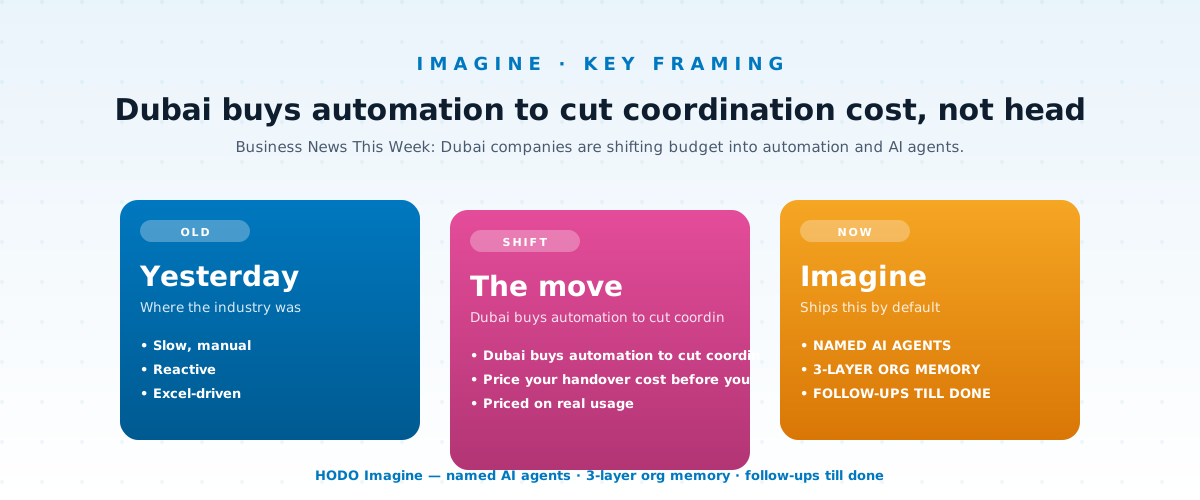
Dubai buys automation to cut coordination cost, not headcount.
The handover cost that never appears in the business case
GCC operations carry a structural feature that most AI business cases ignore: tenure is often tied to visa cycles, so two to three years is a normal run for a clinic coordinator, lab supervisor or insurance desk officer. When that person leaves, the system of record keeps the patients, the bills and the results. It does not keep why a particular insurer rejects a specific code, which referring doctor wants reports by phone, which corporate client negotiated a different rate last year, or which supplier needs chasing twice.
That residue is the handover cost, and it is measurable. Operators should put a number on two things before signing any AI contract. First, time-to-productive for a replacement in each coordination role, the weeks between joining and working unsupervised. Second, the rework rate in the first quarter after a handover: claims resubmitted, appointments double-booked, reports re-sent, renewals missed. In most multi-branch operations these two figures dwarf the annual licence cost of whatever platform is being considered.
Framed that way, the Dubai investment trend reads less like enthusiasm for new technology and more like a hedge against churn. The buyers are trying to make organisational knowledge an asset the company owns rather than something that walks out with a notice period. Any evaluation that does not test for this is testing the wrong thing.
Where automation pays first in a GCC health operation
The highest-volume coordination work in a polyclinic, lab or home-collection business is not clinical. It is insurance pre-approval follow-ups that stall waiting on a document; report delivery that needs a human to confirm it reached the right patient; referral and corporate-partner communication that lives in individual inboxes; licence and staff-credential renewals under DHA or MOHAP-style regimes; supplier and AMC follow-ups; and the daily handover between a morning and evening shift that currently happens verbally.
These are the tasks worth assigning to an agent, for a simple reason: each has a definite closure state. A pre-approval is granted or refused. A report is delivered or not. A renewal is filed or overdue. Work with a closure state can be tracked, and tracked work can be audited, which is how a pilot turns into something that survives the quarter it was funded in.
Clinical and transactional records stay where they belong, in the HIS or LIMS. The agent layer does not replace that system of record, and should not try to. It sits above it, handling the judgement-and-chase work that currently fills WhatsApp threads and personal notebooks. Operators who blur that line usually end up with two half-systems and no reliable source of truth.
Write the job description before writing the prompt
The practical difference between a pilot that dies and an agent that stays in use is whether anyone defined the role. Before configuration, write a one-page brief per agent: the outputs it produces, the cadence it runs on, the data it may read, what it escalates, and the named human it reports to. An agent that reports to everyone reports to no one, and quietly stops being used by the second month.
Brand voice is the second requirement, and in the GCC it is sharper than elsewhere. Patient and partner communication runs in English and Arabic, across WhatsApp, SMS and email, written by staff from a dozen different first-language backgrounds. Consistency here is not cosmetic, it is how a small polyclinic group reads as one organisation rather than four branches improvising. Voice should be defined once at the organisation level and applied by every agent, not re-explained in each prompt by each user.
Third, decide what the agent is allowed to remember and for how long. Daily operational detail, this week's open threads, and permanent organisational knowledge are different things with different retention needs. Collapsing them into one undifferentiated pile is why most internal AI deployments feel useful for a fortnight and vague after that.
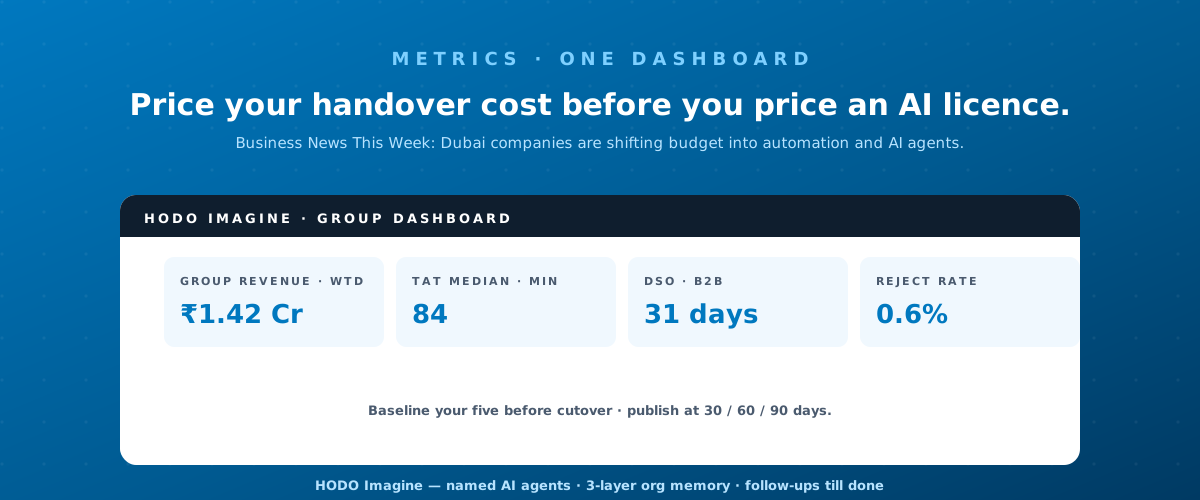
Price your handover cost before you price an AI licence.
Audit deployment by closure, not by usage
Usage dashboards are the wrong instrument. Message counts, prompt volume and active-user percentages all rise during a pilot and tell an operator nothing about whether the business changed. Three measures are more honest. Percentage of flagged items closed within the stated turnaround. Number of items that needed a human to restart them from scratch. And the handover test: after a coordinator exits, how much of their working context can be reconstructed from the organisation's own records rather than from a colleague's memory.
That last test is the one worth running deliberately, in the week after any resignation. It converts an abstract claim about digital transformation into a specific observation about whether the knowledge stayed. It also exposes a common failure mode in which an agent appears productive while every substantive decision is still being carried in one person's head.
What this means for digital transformation
The Dubai automation trend is a procurement signal for health operators and founders across the region: the spend is moving towards systems that hold context and finish work, not towards additional chat licences. imagine is built for that layer, named AI agents with defined jobs and reporting lines, a 3-layer memory spanning today, this week and permanent organisational knowledge, and follow-ups until done so that flagged items close rather than scroll away. Brand voice consistency keeps bilingual patient and partner communication reading as one organisation across branches. It does not replace Microsoft 365, Copilot or ChatGPT; it connects what staff already use to memory the organisation owns, with an audit trail that outlasts any single visa cycle.
See how imagine turns AI into organisational intelligence, explore imagine.