The Dubai Chamber of Digital Economy supported 485 startups during the first half of 2026, Khaleej Times reports, through licensing routes, market-entry guidance, investor access and the ecosystem weight that no founder assembles alone. For the healthtech names inside that cohort, the number marks a starting line rather than a result. What decides the next eighteen months is the operational layer underneath the pitch deck: the system that books a patient, records the encounter, bills the correct payer and delivers a report without a staff member retyping anything.
What ecosystem support covers, and what it leaves to the founder
Chamber-level support is strongest on the things that block market entry. A licence, a free-zone structure, visa quotas, a route to a corporate pilot, a pitch slot in front of regional capital, these are genuinely hard to solve alone, and 485 startups in six months suggests the funnel is working. None of that support, however, specifies how a healthcare service actually runs once the first paying patient arrives.
That gap matters more in healthcare than in most verticals. A fintech or logistics startup can run its first hundred transactions on spreadsheets and a payment link. A healthtech service cannot: the first hundred patients generate consent records, clinical notes, insurance eligibility checks, co-payment splits, report delivery and a licensing trail that a DHA or MOHAP inspection can ask about. Founders who treat all of this as post-funding engineering work usually end up running operations out of WhatsApp groups and three disconnected tools, then discovering that the data needed for their Series A metrics was never captured in a queryable form.
The practical lesson from the Dubai cohort is to separate two build decisions. The differentiated product, the triage logic, the routing engine, the consumer app, the AI layer, is what the startup must own. The ops spine beneath it is a solved problem that is expensive to re-solve, and every month spent rebuilding appointment scheduling is a month not spent on the thing investors are actually paying for.
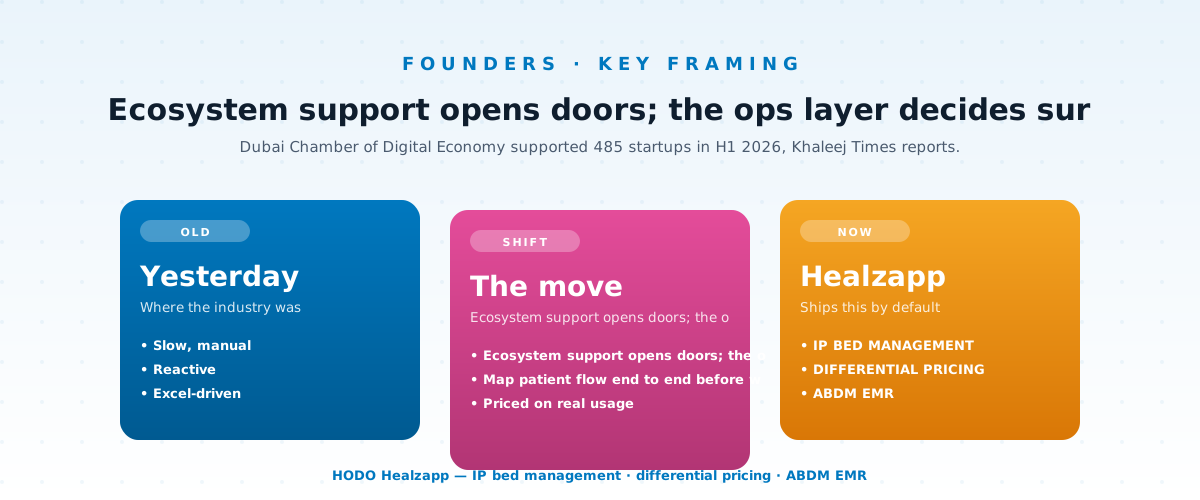
Ecosystem support opens doors; the ops layer decides survival.
Patient flow is the architecture, not a feature list
The most common sequencing error in early healthtech builds is designing screens before mapping flow. A doctor-at-home operator in Dubai, for example, has a flow that runs: enquiry, slot offer against a doctor's real availability, address and parking detail, clinician dispatch, consultation, prescription, payment, follow-up call. A lab-at-home service has a parallel flow with sample collection, chain of custody, analyser result and report release. Each handover in those chains is a place where the service either stays cheap to run or starts leaking staff hours.
Mapping the flow first changes what gets built. It usually reveals that the differentiating software is narrower than assumed, often a routing or scheduling rule set, while the surrounding 80 per cent is standard clinic and lab operations. It also reveals which handovers need automation on day one. Report delivery is the clearest case: a service that sends results manually will hold a staff member hostage to a mobile phone from the day volume reaches thirty patients, and that cost does not fall with scale.
Flow mapping also exposes the reporting question early. If a founder cannot name where visit duration, travel time, repeat-patient rate and cost per visit are recorded, those numbers will be reconstructed from memory during diligence. Capturing them is a design decision made at build time, not a dashboard added later.
Billing and insurance belong in version one
In the GCC, billing is where founder-built systems break first. A polyclinic or home-visit operator in the UAE deals with cash patients, multiple insurers, co-payment rules that differ per plan, corporate accounts with negotiated rates, and currency handling if the service operates across Dubai, Abu Dhabi, Doha and Manama. A simple invoice table cannot express that. Teams that start with one usually rewrite it within a year, after the first month of reconciliation discrepancies between what was charged and what the insurer settled.
Differential pricing is the specific capability founders tend to miss. The same test or home visit carries different prices for a walk-in patient, a corporate contract, an insurance plan and a partner clinic sending referrals. If that logic lives in a staff member's head or a shared sheet, revenue leaks quietly and margin per visit becomes unknowable. Building pricing as structured configuration rather than manual entry is what makes a partner or corporate channel viable at all, and corporate channels are frequently the fastest route to volume for a new GCC service.
The adjacent point is the audit trail. Insurers dispute claims, and the operator who can show the encounter record, the pricing rule applied and the delivery timestamp resolves disputes in days rather than weeks. That record has to be a by-product of normal operations, not a file someone compiles on request.
Scaling a second location should not be a rebuild
The pattern in GCC healthtech is expansion by location or route rather than by raw user growth: a second polyclinic in another emirate, a third collection route, a franchise partner in Qatar. Founder-built systems typically handle this badly because the first version hard-codes assumptions about one site, one price list, one doctor roster, one licence, one set of operating hours.
The test to apply before scaling is simple: how long does opening centre number four take, and how much of that time is software work rather than hiring and licensing? If the answer involves an engineering sprint, the architecture will cap growth. Consolidated reporting is the second half of the same problem. A founder running three centres on three instances spends the end of every month merging numbers instead of reading them, and cross-centre comparisons, cost per visit, clinician utilisation, no-show rate by location, never become routine management information.
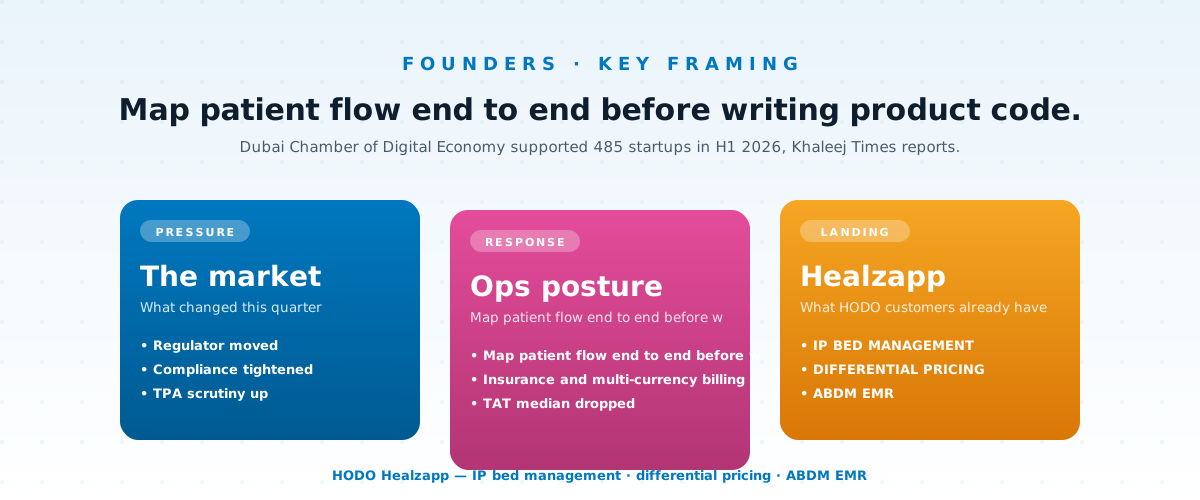
Map patient flow end to end before writing product code.
Buy the spine, build the differentiator
Reference architecture is worth more to an early-stage team than a feature list. HODO has run this layer since 2013 across 500-plus client outlets, 11 million-plus patient visits and 8 million-plus unique patients, in both Indian and GCC regulatory settings. For a founder, the value is not the brand count but the shape: what a working clinic or lab ops system has to contain before it meets its first inspection or its first insurer dispute.
The sequencing that tends to work is to run the service on a proven spine, instrument it for the metrics the business will be judged on, and spend scarce engineering capacity on the layer that no vendor sells, the routing intelligence, the consumer experience, the clinical pathway, the pricing model. Startups that invert this order ship an elegant app on top of operations nobody can audit, and the next funding conversation turns into a data-collection exercise.
What this means for builders
A healthtech service in the UAE is judged on throughput, cost per visit and clean payer reconciliation long before it is judged on product polish. Appointments and Teleconsultation in HODO Healzapp give a doctor-at-home or polyclinic operator a scheduling and consultation spine that already handles multi-doctor rosters, while Billing (incl. multi-currency / GCC patterns) covers insurance, corporate accounts and differential pricing without a custom invoicing build. The Patient Health App and Multi-outlet scale-up with one-click new-centre setup extend the same system to patient-facing access and to the second, third and fourth location, so expansion is a configuration task rather than a release.