Arabian Business reports that Dubai's GDP reached $128.8bn in the first half of 2026, with finance and healthcare named among the expanding sectors. For a polyclinic operator in Deira, Al Barsha or Mussafah, that headline translates into something far more practical than a macro statistic: more insured residents, more corporate panels, more walk-ins, and a labour market where good nurses and receptionists cost more every quarter. Growth is not a reward for clinics. It is a workload.
Demand arrives before capacity does
Economic expansion in the Gulf shows up in a clinic's day before it shows up in its accounts. Population growth and employer-funded cover push more people through the door, and the first bottleneck is almost never the number of doctors on the licence. It is the number of usable consultation slots those doctors actually have, and how many of them get wasted.
Most polyclinics discover this the uncomfortable way. The waiting area is full at 10am and empty at 2pm. A dermatologist's afternoon has four no-shows nobody called ahead. The GP session that runs 40 minutes late pushes the pharmacy queue into closing time. None of this is a capacity shortage in the engineering sense, it is unscheduled capacity, and it is invisible unless somebody is measuring it.
The operational discipline worth adopting is narrow: measure utilisation per consultation room per hour, not per branch per month. A branch running at a comfortable-sounding 70% monthly average can easily be at 110% between 9am and noon and 35% after lunch. Those are two different problems with two different fixes, one needs staggered doctor rosters and overflow slots, the other needs targeted recall and follow-up campaigns to fill the trough. A monthly branch-level number hides both and invites the wrong decision, which is usually to rent more space.
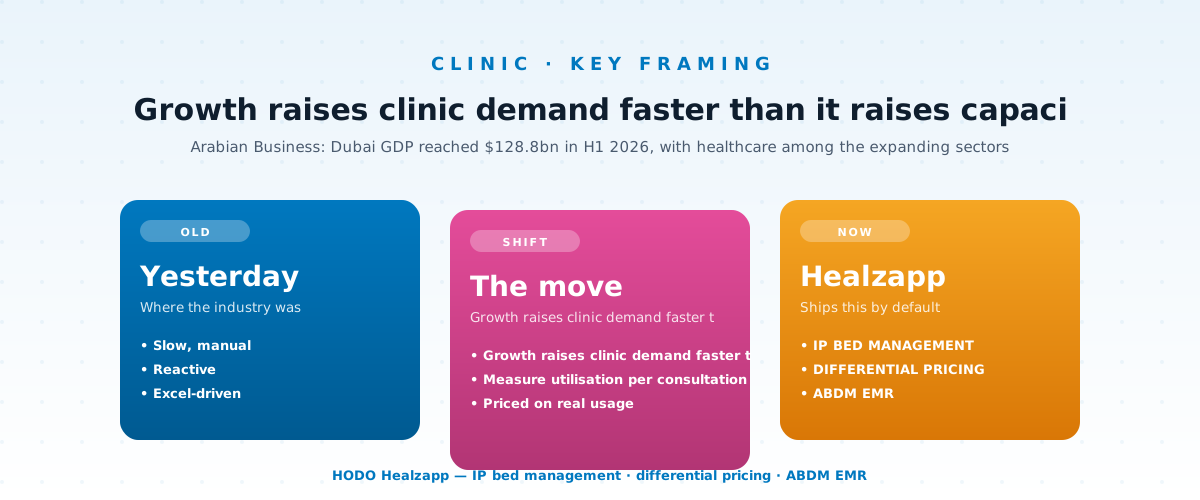
Growth raises clinic demand faster than it raises capacity.
Cost per patient moves faster than revenue in a hot market
When a city's GDP is growing, the inputs a clinic buys grow with it. Commercial rent in prime Dubai and Abu Dhabi locations, salaries for licensed staff, and the cost of retaining a good clinic manager all move upward in the same cycle that brings more patients. Revenue per consultation, meanwhile, is largely set by insurer contracts and a competitive cash-price market. The gap closes quietly.
The number that matters here is cost per patient served, tracked monthly and split by branch and by payer. Fully loaded, rent, salaries, consumables, software, utilities, divided by completed visits. Operators who track it early tend to catch two specific leaks. The first is a service line that looks busy but carries a consumables and machine-time cost the tariff does not cover. The second is administrative time: staff hours spent re-entering the same patient demographics into a scheduling sheet, a billing screen and an insurance portal.
That second leak compounds with growth. A clinic doing 80 visits a day absorbs duplicate data entry. The same clinic at 200 visits a day hires another two administrators to absorb it, and those salaries become permanent. The fix is structural rather than motivational: one patient record that carries through registration, consultation, diagnostics and billing without being retyped. Clinics on a single system routinely report their front desk handling materially higher volume with the same headcount, simply because nothing is entered twice.
Claim lag strains cashflow before footfall does
In the GCC, the majority of polyclinic revenue sits with insurers and third-party administrators, and the clinic's working capital is effectively a function of claim turnaround. Growth makes this sharper, not softer. Doubling monthly volume doubles the receivable sitting in a payer's queue, and a rejection rate that was tolerable at low volume becomes a serious cash problem at scale.
Most rejections in clinic practice are not clinical disputes. They are administrative: eligibility not verified at the counter, a mismatch between the coded diagnosis and the billed service, missing pre-approval for a procedure that required it, or a submission that went out past the payer's window. Each of these is catchable at the point of billing if the system knows the patient's plan, the plan's rules and the clinic's contracted tariff for that payer.
The practice worth building is a weekly ageing review rather than a monthly one, receivables bucketed by payer and by age, with any claim past 30 days treated as an exception that someone owns by name. Clinics that review ageing weekly tend to resubmit inside the window; clinics that review monthly discover expiry. Alongside that, differential pricing per payer and per corporate panel has to live in the system rather than in a manager's memory, because manual tariff selection is where undercharging and rejection both originate.
The second branch is a back-office decision
A growing market tempts every successful single-site polyclinic into a second location, and the decision usually gets analysed as a property question, footfall, catchment, rent per square foot, licensing timeline with DHA or MOHAP. Those matter. What sinks more second branches is the back office.
Two sites running two disconnected systems produce two patient databases, two tariff masters, two sets of reports that do not reconcile, and a finance function that spends the first week of every month assembling a consolidated view by hand. Doctors who rotate between branches cannot see a patient's prior visit. A corporate client with employees using both locations gets two invoices. None of this is fatal, but all of it consumes exactly the management attention that a new site needs.
The alternative is to treat the second branch as a configuration event rather than an implementation project: same patient master, same tariff logic, same reporting spine, with branch-level financials available without a reconciliation exercise. Operators planning three or four sites over a few years should make this test part of their vendor decision now, ask how long a new centre takes to go live on the existing system, and whether consolidated and per-branch reporting come out of the box or out of a spreadsheet.
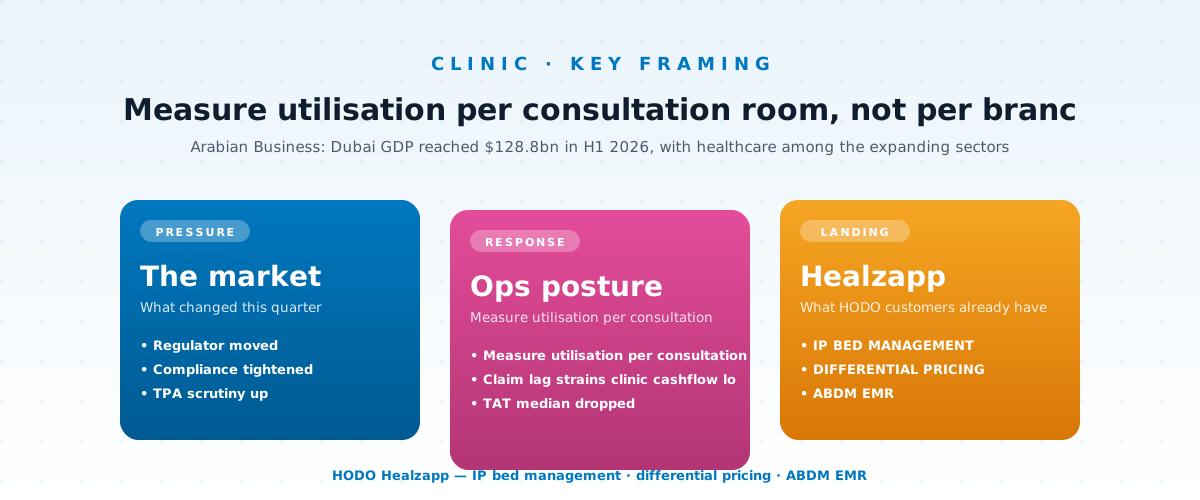
Measure utilisation per consultation room, not per branch.
What this means for HODO customers
Dubai's expansion is genuine, and it will reward the polyclinics that can convert demand into throughput without adding proportional overhead. That is a systems question. Appointments is where room and doctor utilisation becomes visible enough to act on, staggering rosters, filling afternoon troughs, and cutting the no-show gaps that quietly remove capacity. Billing (incl. multi-currency / GCC patterns) carries payer-specific tariffs and differential pricing so claims leave the clinic correctly coded and priced the first time, which is the only durable answer to rejection-driven cashflow pressure. And Multi-outlet scale-up with one-click new-centre setup is what makes branch two a configuration decision rather than a six-month back-office rebuild, with one patient master and per-branch financials from day one.
Growth exposes whatever the operating system was already hiding. The clinics that handle the next two years well will be the ones that fixed scheduling visibility, cost per patient and claim discipline while volumes were still manageable.