Union Health Minister J P Nadda has urged young doctors to make e-prescriptions and ABHA-linked records part of routine practice, in remarks reported by eHealth Magazine. The appeal is addressed to clinicians, but the work it creates lands on hospital operations — registration counters, pharmacy, the lab front office and the HIS that ties them together. For an Indian 100-bed hospital or a lab chain running several collection centres, the real question is not whether e-prescribing is sound practice; it is which existing workflow quietly breaks the moment a prescription has to be digital, identified and retrievable.
The bottleneck sits at registration, not in the consulting room
A doctor can be persuaded to prescribe on a screen in a week. Identifying the patient against an ABHA number is the harder part, and it is a front-desk job. In most hospitals ABHA creation is still treated as an outreach activity — a camp volunteer, a one-off drive, or a clerk scrambling at discharge. By then the prescription has already been printed and handed over, and the record has nothing durable to attach itself to.
The operational fix is unglamorous: ABHA capture becomes a scripted step inside registration, with a defined fallback. Either the number is created or verified at the counter, or the visit is flagged as pending-link and worked off a queue the same week. That pending queue needs an owner and an age limit, otherwise it becomes a permanent backlog nobody reads.
Cost it honestly before committing. A hospital registering 400 outpatients a day that adds 30 seconds per registration has added roughly three hours of counter time across its desks — a staffing line, not a rounding error. That is an argument for deciding where the step belongs: at token issue, at registration, or at billing, where the patient is already stationary and the clerk already has their mobile number on screen. Choosing deliberately is cheaper than letting each counter improvise.
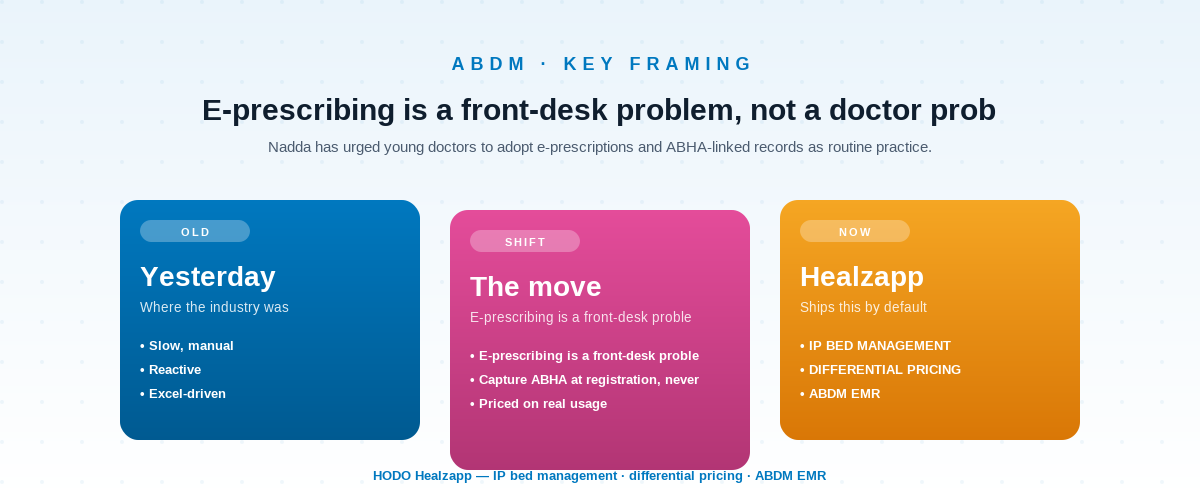
E-prescribing is a front-desk problem, not a doctor problem.
An e-prescription is only useful if pharmacy and lab consume it
Plenty of hospitals already generate a PDF prescription and consider the box ticked. The operational value appears only when the same order is consumed downstream without being typed again. Re-keying is where drug substitution errors creep in, where lab orders drift from what was intended, and where billing leakage hides.
A short audit settles the matter. Count how many pharmacy line items in a day are typed fresh at the counter versus pulled directly from the doctor's order. Count how many lab orders are re-entered into the analyser worklist by hand. In most 100-bed set-ups both numbers are uncomfortably high, and they explain more about turnaround complaints than any staffing theory does.
Closing that gap has knock-on effects worth more than the compliance credit. When orders flow into Pharmacy against live Inventory, the prescriber can see what is actually on the shelf, which cuts outside purchases and the margin that walks out with them. When lab orders reach the analysers through Machine Interfacing, result entry stops being a transcription task and turnaround becomes measurable per test rather than per shift. The ABHA record then gets populated as a by-product of normal work, which is the only way this survives past the first month of enthusiasm.
ABDM readiness is a set of numbers, not a certificate
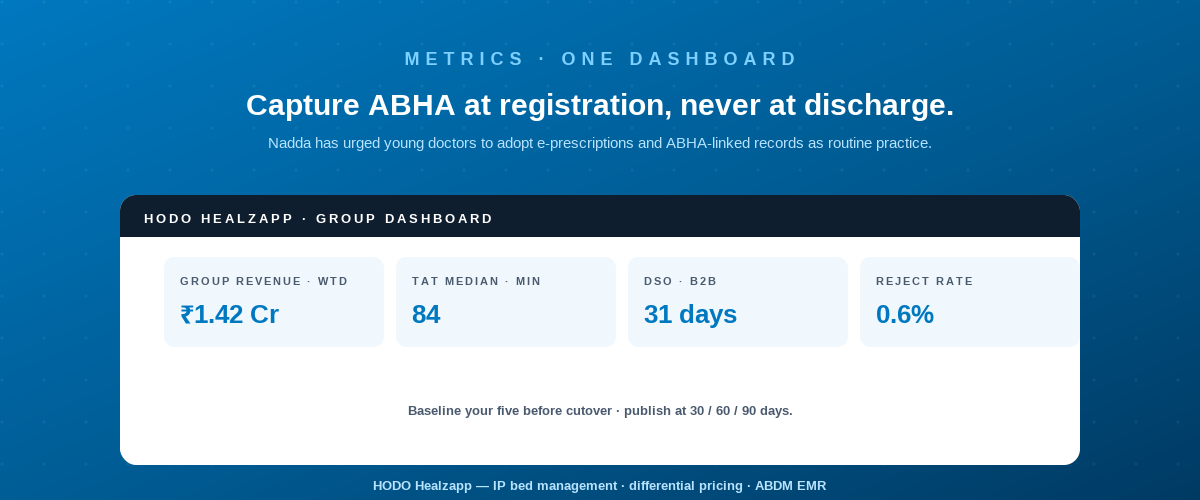
Integration status is a procurement question. Adoption is an operations question, and it needs its own small dashboard reviewed in the monthly MIS meeting. Five figures cover most of it: ABHA linkage rate by registration counter; share of consultations closing with a structured e-prescription rather than free text; share of lab and radiology reports pushed back into the patient record; median time from order to dispense; and the age of the oldest item in the pending-link queue.
Tracked weekly, these numbers expose the usual pattern — one counter at 80 per cent linkage and another at 20 per cent, driven entirely by which clerk was trained properly. That is a supervision problem with a one-week fix, and it is invisible without measurement.
The vendor side of this matters too, and it is worth checking before a HIS replacement rather than after. ABDM integration, NRCeS listing and Telemedicine Registry listing are verifiable claims; HODO is among the first 20 ABDM-integrated HealthTechs in India, is NRCeS listed and is Telemedicine Registry listed. Ask any shortlisted vendor for the same, in writing, with the registry entries. A system that can produce a compliant record but needs 14 clicks to do so will fail NABH documentation review for a different reason entirely: nobody will use it consistently enough to leave a clean trail.
Young doctors will not fight the standard; they will fight the clicks
Resistance to e-prescribing is almost never ideological. It is latency. If structured prescribing takes eleven clicks and a paper pad takes one stroke, a resident running a 60-patient OP block at 11 a.m. will reach for paper, and no circular will change that arithmetic. Adoption is therefore an interface and configuration project: order sets for the top 30 presentations per department, doctor-level favourites, and a history view that does not require scrolling through two years of visits to find last month's dosage.
This is where an EMR with AI-condensed history earns its place — not as a clinical claim, but as seconds saved per consultation at the exact moment the doctor is deciding whether to use the system or bypass it. Multiply a saved 40 seconds across a day's OP load and the business case stops being about compliance.
Teleconsultation is the sensible pilot surface. There is no paper option in a remote consult, so the prescription is digital by default and the ABHA link is usually already captured at booking. Run the workflow there first, fix the order sets with real traffic, then roll it into the OP block. And train during peak hours rather than on a quiet afternoon — a workflow that only holds up at 3 p.m. on a Tuesday has not been tested.
Capture ABHA at registration, never at discharge.
Multi-outlet groups and lab chains pay the compliance cost twice
For a hospital group or a diagnostic chain, every new centre is an opportunity to reinvent the same rules badly. Registration scripts, ABHA capture steps, price lists, referral-doctor mappings and report delivery templates get rebuilt locally, and within a year the group has five different definitions of a completed record. The ABHA linkage rate then varies by outlet for reasons no one can trace.
Standardisation is the only answer that scales. New centres should inherit configuration rather than receive a fresh implementation, differential pricing should be set once per partner or corporate account instead of per branch, and report delivery to patients should run on one channel across outlets. That last point is also an ABDM point: a record the patient cannot retrieve is not a record they own. Lab chains carry the same structure through collection centres and franchisee networks, where partner portals and anonymised sample tracking do the equivalent job on the LIMS side.
What this means for HODO customers
The minister's push converts a clinical habit into an operations requirement, and the hospitals that handle it quietly will be the ones whose registration, pharmacy and lab already run on one rail. In Healzapp, ABDM-compliant EMR carries the identified record and the structured prescription without a parallel paper process, Machine Interfacing removes the transcription step between order and analyser result, and Multi-outlet scale-up with one-click new-centre setup keeps linkage and pricing rules identical as centres are added. WhatsApp/SMS report delivery closes the loop at the patient's end, which is where ABHA adoption either becomes real or stays a dashboard figure.