The Drugs Technical Advisory Board has proposed making registration on the national e-RaktKosh portal compulsory for every licensed blood centre in the country, with donor identity verified through ABHA-Aadhaar authentication, as reported by the Free Press Journal. For the several thousand hospital-attached blood centres in India, a large share of them sitting inside 100-bed to 300-bed private hospitals, this shifts blood banking out of the register-and-requisition era and into the same digital compliance perimeter as ABDM-linked clinical records. The hard part is not the registration. It is everything the registration will expose.
What the DTAB proposal actually changes
Three things move at once if the proposal is notified. First, every licensed blood centre has to be on e-RaktKosh, which means stock position, donation events and issue records become visible to a central system rather than living in a ledger that is reconciled monthly. Second, donor identity gets authenticated against ABHA-Aadhaar instead of a self-declared name, phone number and address. Third, and this is the part most hospitals are underestimating, the deferral register stops being a local document. Once a donor carries a verifiable national identity, a 56-day deferral or a permanent deferral for a reactive transfusion-transmissible infection screen is no longer something the donor can walk away from by visiting a different centre in the next district.
For a hospital that runs an in-house blood centre to support its own surgical and obstetric load, the compliance surface widens considerably. Drug licensing inspections already look at the donor register, the component separation log and the cold-chain record. A centrally registered system adds a fourth axis: does the hospital's own record agree with what the portal says? Discrepancies between a paper register and a portal entry are the sort of finding that stalls a licence renewal. The operational answer is not to maintain two records more carefully. It is to make sure the hospital's primary system is the one producing the portal entry, so there is only one version of the truth.
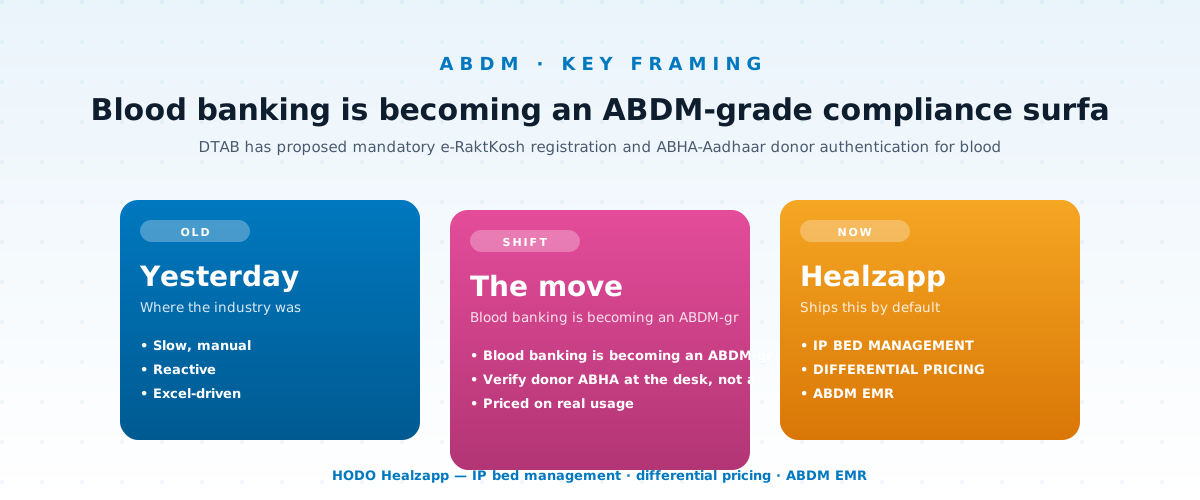
Blood banking is becoming an ABDM-grade compliance surface.
Donor identity is a registration-desk problem first
ABHA-Aadhaar authentication at the donor desk sounds like a small addition to an existing workflow. In practice it changes the throughput maths at the busiest point of the blood centre. Voluntary donation camps, replacement donors sent by a patient's family at 11 pm, and walk-in donors during a shortage all arrive at the same desk, and each one now needs an identity verification step that depends on a network call succeeding.
Hospitals that have already run ABHA creation and linkage at the OP registration counter know the failure modes, demographic mismatch between Aadhaar and the hospital record, mobile numbers that are not linked to Aadhaar, and donors who have an ABHA but cannot remember the address. The centres that handle this without queue collapse are the ones that treat donor registration as the same identity capture problem as patient registration, using the same master index, the same ABHA creation flow and the same staff training, rather than building a parallel process inside the blood bank that only two technicians understand.
There is a second benefit that operators tend to miss. A donor who is properly identified once becomes a donor the hospital can call back. Most hospital blood centres in India have no usable donor database, they have a stack of forms. A verified, de-duplicated donor record with a working mobile number is the raw material for a recall list, which is what actually protects a hospital during a festival-season or dengue-season shortage.
The blood centre is a lab, and its TAT is on the clock
Every unit collected is screened for transfusion-transmissible infections, grouped, cross-matched and often separated into components. That is laboratory work, with analysers, quality control and a turnaround time that is measured against a patient who may be bleeding in the OT. Yet in a surprising number of 100-bed hospitals, TTI results are read off the analyser screen and copied by hand into a register, then copied again into the issue slip.
Each manual transcription is a transfusion-safety risk and an audit gap. Once the portal expects an electronic record of the screening outcome against a nationally identified donor, hand transcription becomes indefensible. The fix is well understood in the pathology lab and simply has not been applied to the blood centre: connect the ELISA or CLIA analyser and the cell counter directly, so the result lands against a barcoded sample without a human retyping it.
The same discipline applies to the component register. A whole-blood unit that becomes packed cells, fresh frozen plasma and platelet concentrate creates three traceable items with three different expiry clocks. Managing those as inventory items with expiry, location and issue history, rather than as handwritten entries, is what makes wastage visible. Wastage is the number most hospital administrators cannot quote when asked, and it is the number a central portal will eventually make public.
Billing, PMJAY and the cost of an untracked unit
Processing charges for blood and components are regulated, differ by component, and are frequently waived or adjusted for PMJAY and state-scheme beneficiaries. When the blood centre maintains its own stack of slips, three things happen: charges are missed, the waiver is applied without documentation, and the claim is filed without the supporting issue record. Rejections of transfusion-related line items are common for exactly this reason, the claim says three units of packed cells, the uploaded documentation shows two issue slips and one illegible photocopy.
Tying the issue record to the patient's bill, at the moment of issue, closes that gap. It also gives the finance team something they usually lack: a cost-per-transfusion figure that includes the collection, the screening kit, the component separation and the wastage attributable to that period. For a hospital running 400 to 800 units a year, the wastage line alone is often the difference between the blood centre being a managed cost and being an unexamined one.
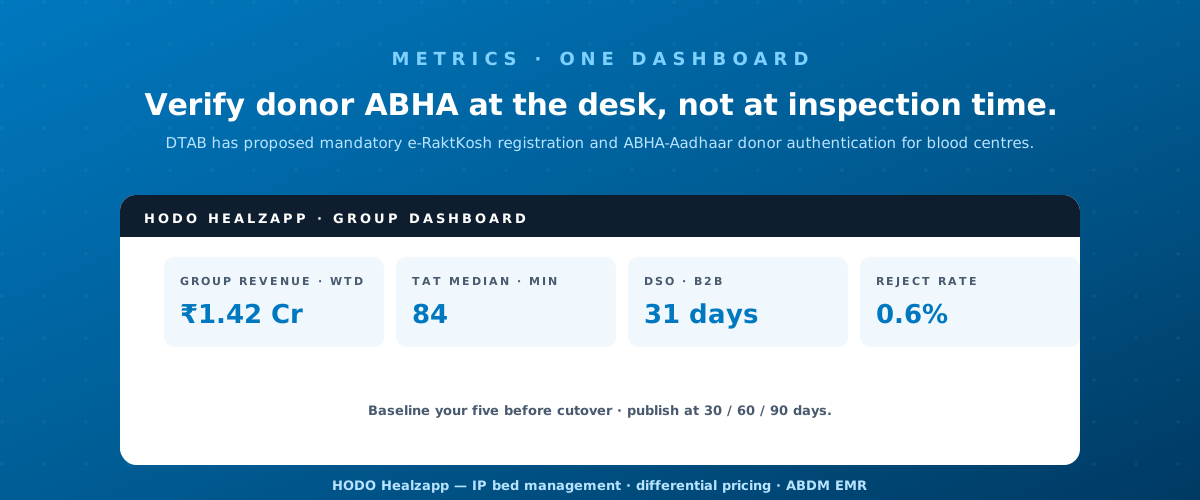
Verify donor ABHA at the desk, not at inspection time.
Sequencing the work before the rule lands
A proposal at DTAB stage is not a notified rule, and the sensible response is not a panic procurement. It is a sequence. Start by moving donor registration onto the hospital's existing patient master so that identity capture, ABHA linkage and de-duplication happen in one place. Next, interface the screening analysers so TTI and grouping results arrive electronically against a barcoded sample. Then bring component stock into the same inventory discipline the pharmacy already uses, with batch, expiry and issue tracking. Finally, connect the issue event to the bill, so that the clinical record, the stock record and the claim all agree.
Hospitals running more than one unit, a flagship with the licensed blood centre and satellite clinics that raise requisitions, should also decide early how requisitions flow between sites, because the portal will see one licensed entity while the operation runs across several.
What this means for HODO customers
Healzapp does not replace a licensed blood centre's statutory records, but it supplies the spine those records depend on. Patient Management gives the hospital a single, de-duplicated identity index, so a donor and a recipient are captured with the same rigour and the same ABHA linkage used at the OP counter. Machine Interfacing removes hand transcription from TTI screening and grouping by pulling analyser output against a barcoded sample. Inventory handles component stock with batch and expiry tracking the same way pharmacy stock is handled, making wastage visible rather than annual. With ABDM-compliant EMR underneath, the transfusion record sits in the same digitally verifiable chain that ABDM and the proposed e-RaktKosh registration are both pointing at.