The BBC reports that worried Indians are turning to start-ups to help care for ageing parents, with adult children in other cities and other countries buying services their joint family once supplied for free. The demand signal in that story is unusually clean for a healthcare category: a paying customer who is not the patient, a need that repeats every month, and a care plan that spans doctor review, nursing, diagnostics and emergency escalation. For founders building in this space, the open question is no longer whether a market exists — it is whether the operating model survives the jump from 50 subscribers to 500.
What the BBC story actually validates
Three things are confirmed by the reporting, and one important thing is not. Confirmed: a remote family member will pay a monthly fee rather than a per-event charge; the home is the preferred site of routine care for an elderly parent who dislikes hospital trips; and the demand is recurring rather than episodic, which is rare in Indian healthcare outside dialysis and chronic care.
Not confirmed: that anybody has solved cost per visit. Most elder-care offerings running in India today are assembled from a call centre, a few WhatsApp groups, a spreadsheet of nurses and phlebotomists, and a partner lab that sends PDFs by email. That assembly genuinely works up to roughly 200–300 subscribers in a single city, because a competent operations manager can hold the whole book in her head. Past that point coordination cost grows faster than revenue. Every exception — a missed visit, a repeat sample after haemolysis, a 2 a.m. call that ends in an ambulance — gets resolved by a human scrolling a chat thread for context that was never written down anywhere queryable. Founders usually read the resulting margin compression as a hiring problem. It is a system-of-record problem.
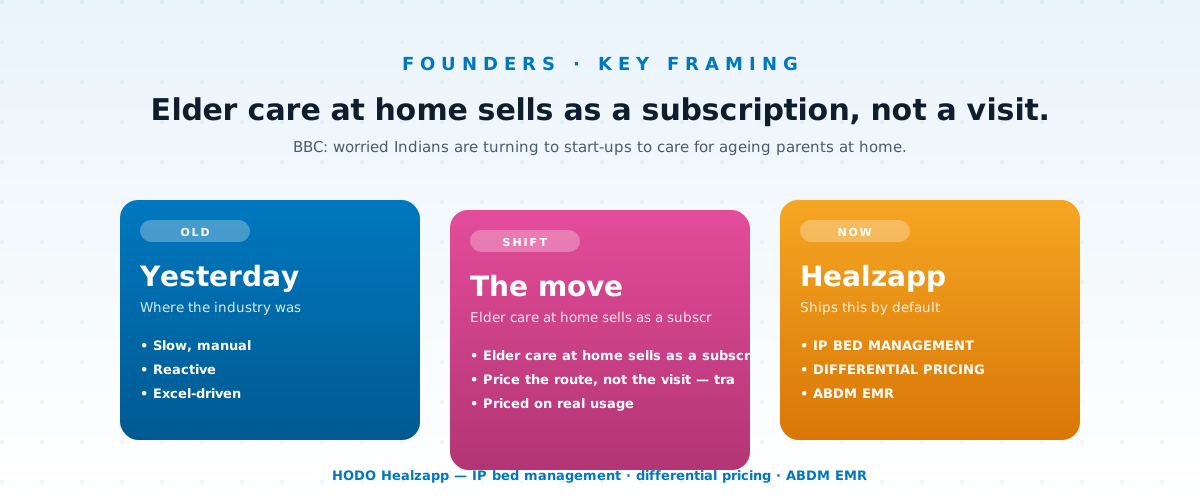
Elder care at home sells as a subscription, not a visit.
The buyer is abroad, the patient is at home
Elder care at home is a two-user product, and the two users want opposite things. The parent wants the fewest possible taps, a familiar face at the door, and a phone number that a person answers. The son or daughter in Dubai or Toronto wants evidence: which nurse came, what the blood pressure reading was, whether the medicine was actually taken, what the lab result said and what changed since last month.
That second user determines churn. Cancellations in subscription homecare are rarely triggered by a clinical failure; they are triggered by silence. A subscriber paying ₹4,000–₹6,000 a month who hears nothing for three weeks assumes nothing is happening. So the visit record has to be written for a non-clinical reader, pushed to the family rather than waiting to be pulled, and attached to one patient identity that both users can see with recorded consent. Billing carries the same split — the card sits overseas while service is delivered in Kerala or Tamil Nadu, so recurring collection, clean receipts and currency handling are product requirements, not finance housekeeping. Founders who treat the remote child as a billing contact rather than a user build a service that quietly loses its payer.
Why per-visit pricing breaks at scale
In home-visit businesses the dominant cost is travel, not clinical time. A nurse covering a dense cluster in Kochi can complete five or six visits a day; the same nurse on the same salary covering scattered addresses across Bengaluru manages two or three. Output halves, cost does not. Any founder who prices per visit on a city-average assumption discovers that gross margin is really a function of address density, and that the worst subscribers are the ones furthest from everybody else.
The practical correction is to price the plan and schedule the route. Sell into clusters deliberately — pin code by pin code, building by building, RWA by RWA — rather than accepting every lead that converts. Then instrument the numbers that actually move margin: visits completed per staff-day, travel minutes per visit, revisit rate, sample rejection rate, and escalations per 100 subscribers per month. Escalation rate is the quiet killer, because one hospital admission can consume a month of operations attention for a plan that earns a few thousand rupees.
There is a second pricing insight hiding in the same data. Visits create the relationship, but diagnostics, pharmacy refills and teleconsultation carry the margin. A plan designed so that routine monitoring pulls a quarterly panel and a monthly medicine refill through the same operator looks very different on a P&L from one that sells visits alone.
One subscriber, four service lines
A single elder-care plan quietly contains four or five distinct businesses: a doctor review delivered as a teleconsult or a home visit, nursing tasks such as wound care or injections, a lab panel collected at home, a medicine refill, and an escalation pathway into a hospital when something goes wrong. In most early-stage operations each of these has its own record. The appointment lives in one tool, the sample lives in the partner lab's system under a different identifier, the prescription is on paper or in a photograph, and the escalation exists only in a call log.
This is where the data model decides the company's ceiling. The fix is unglamorous: one patient identity, with every service line hanging off it, and chain-of-custody established at the door rather than at the lab bench. A sample barcoded in the parent's living room, scanned on handover, and linked to the same subscriber record that holds the last six months of visit notes produces something a doctor can read in thirty seconds and a family can trust. The same discipline makes partner-lab economics legible, because cost per test and turnaround time can finally be attributed to a route and a collection window.
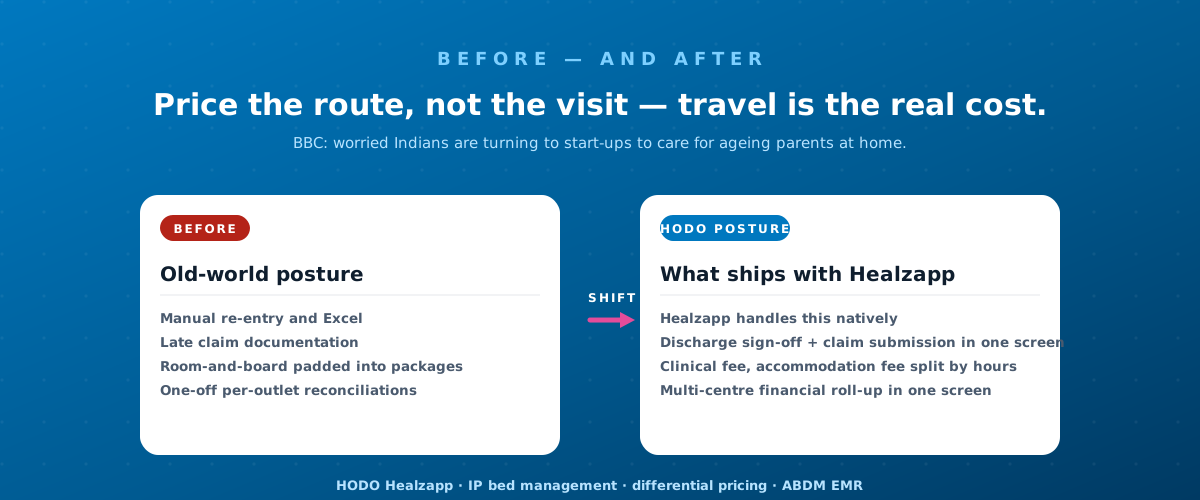
Price the route, not the visit — travel is the real cost.
Build-versus-buy and the regulatory path
Founders should be ruthless about what is actually proprietary here. Demand generation for diaspora buyers, caregiver recruitment and quality, routing and SLA logic, plan design and pricing — those are the differentiators worth engineering. Patient registration, appointment booking, billing, visit documentation, report delivery, inventory and partner logins are commodity infrastructure that still takes twelve to eighteen months to build properly, and that time is taken from the part of the business nobody else can do.
The regulatory path is manageable but specific. Teleconsultation legs follow the Telemedicine Practice Guidelines, including identity verification and prescription norms. Home collection has to terminate in an accredited lab, so the partner's NABL status becomes part of the product. DPDP obligations are sharper than usual here because the person viewing the record is not the data principal — consent for family access needs to be captured, time-stamped and revocable. ABDM linkage is optional for a homecare operator, but it earns its keep when a subscriber is admitted to a hospital that can pull the history. Each of these is cheaper to inherit from an existing platform than to retrofit after an audit.
What this means for builders
The BBC story describes a market that will be won on operations, not on demand. The reference architecture most of these businesses converge on is simpler than it looks: Appointments as the scheduling spine for visits and routes, Teleconsultation for the doctor review leg, and the Patient Health App as the shared record the remote family member actually logs into. Add WhatsApp/SMS report delivery so results reach both parent and child without a coordinator in the loop, and Multi-outlet scale-up with one-click new-centre setup when the second and third city open. Buying that layer frees the founding team to work on routing density, caregiver quality and plan economics — the three variables that decide whether elder care at home becomes a business or stays a service.