BW Disrupt reported this week that Medulance has raised Rs 24 crore to scale its tech-enabled emergency response network across India. For anyone running a ~100-bed hospital, that headline is not really about ambulances. It is about what happens the moment the stretcher rolls through your ER door, and that is where most Indian emergency rooms quietly lose the first ten minutes of a clock-critical case.
What the Medulance round actually signals
The BW Disrupt piece frames the raise as growth capital for a tech-enabled emergency network, GPS-routed ambulances, dispatch software, and tie-ups with hospitals across cities. Read it as a supply-side signal. Response times in Tier-1 and Tier-2 cities are compressing, and the ambulance side of the emergency chain is getting more organised, more data-driven and more consolidated. The last mile, from the pavement to the ER trolley, is being solved by players like Medulance, HelpNow and StanPlus.
That means the bottleneck is moving downstream. A 100-bed hospital in Kochi or Jaipur that historically saw four to six ambulance drops a day is now looking at eight to twelve, plus a higher mix of poly-trauma and cardiac cases arriving with paramedic notes and pre-hospital ECGs. The receiving side of the emergency chain, your ER, is still running on paper triage cards, WhatsApp handovers to the consultant, and a whiteboard for bed status. That mismatch is now the operating gap.
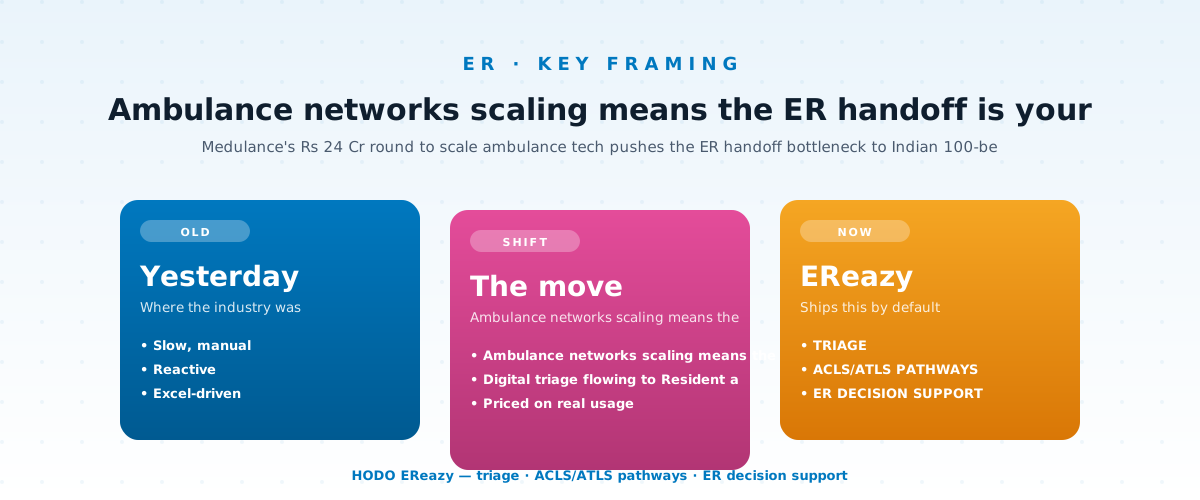
Ambulance networks scaling means the ER handoff is your new bottleneck.
The ER handoff is where minutes disappear
Walk any Indian 100-bed hospital ER at 11pm and time the handoff. The paramedic gives a verbal to the triage nurse, who writes vitals on a card. The receptionist copies the same demographics onto a registration form. The ER resident arrives, reads the card, asks the nurse to repeat the story, and starts an order sheet. Somewhere around minute eight, someone remembers to bleep the consultant on call.
Eight to twelve minutes lost before an ACLS or ATLS pathway is even opened. For a STEMI or a stroke, that window matters. Digital triage that captures vitals and chief complaint once, and pushes it live to the ER Resident screen, the Consultant screen and the registration desk, collapses those minutes without adding staff. The gain is not clinical brilliance. It is removing the duplication that four separate people were adding on paper.
Bed occupancy visibility changes admission decisions
Ask the RMO at 2am how many ICU beds are free and you will usually get a guess based on a whiteboard updated at the last shift change. That guess is wrong roughly a third of the time in mid-sized Indian hospitals, and the cost of being wrong is high: accepting an ambulance patient and then scrambling for a transfer because the last ICU bed was actually taken forty minutes ago.
A live bed occupancy dashboard visible at the triage station, showing ICU, HDU, ward and step-down beds in real time, changes the conversation before the patient is even wheeled in. Stable cases can be redirected. Unstable cases can trigger early inter-hospital transfer coordination while the paramedic is still en route. On a 100-bed footprint, where ICU capacity is thin, this single piece of visibility saves the hospital from the kind of reverse-transfer situation that shows up on Google reviews the next morning.
Midnight billing is a solved problem, if the flow exists
The cash counter is shut. The night receptionist is juggling three admissions, two attenders arguing about advance amounts, and a TPA fax that will not go through. Emergency billing at Indian 100-bed hospitals is where a fair chunk of revenue leaks out, charges added on paper, drug items missed in the rush, TPA and PMJAY pre-authorisation started only the next morning by which time the case has already used the ventilator for six hours.
The fix is unglamorous. HIS-integrated billing means the ER charge sheet is built as the order is entered, investigations, drugs, consumables and procedure charges all flow into a live bill draft that the night receptionist confirms rather than reconstructs. TPA and PMJAY pre-authorisation hooks fire at the point of admission decision, not at 9am when the credit desk opens. This is not a clinical intervention. It is what stops the audit team from finding a Rs 40,000 gap between charge sheet and final bill three days later.
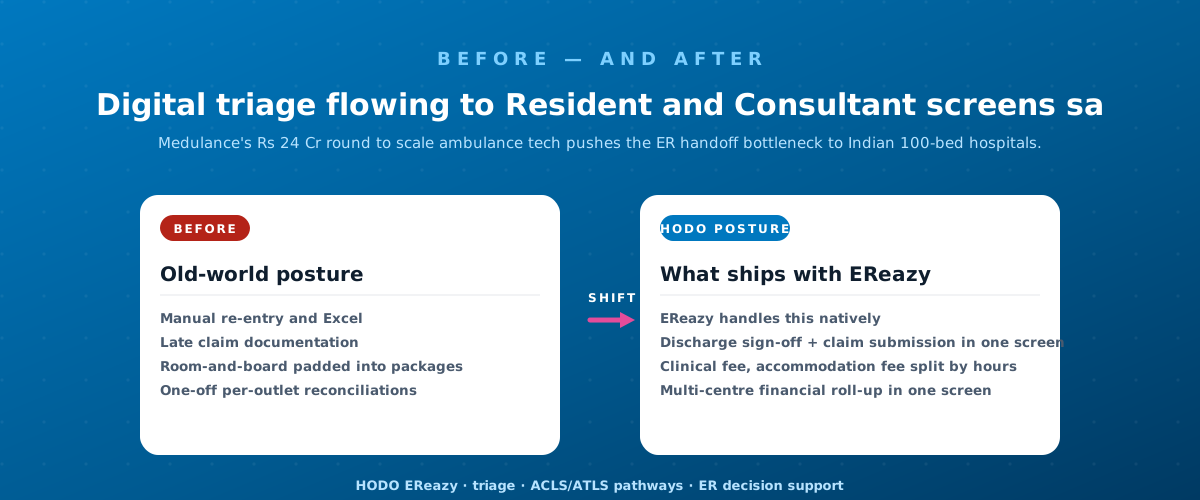
Digital triage flowing to Resident and Consultant screens saves 8-12 min per case.
Role-tailored flows, not one giant EMR screen
Most generic HIS modules make everyone in the ER look at the same screen. That is why triage nurses print out lists, ER residents keep parallel WhatsApp groups, and consultants ask for a verbal summary anyway. The screen fits no one because it tries to fit everyone.
Role-tailored flows split the surface. The Triage Nurse gets vitals capture, chief complaint and colour-coded severity, nothing else. The ER Resident gets order entry, ACLS and ATLS pathway prompts, and the running problem list. The Receptionist gets identity, TPA and insurance status, and consent forms. The Consultant gets a one-screen handover summary with vitals trend, orders placed and pending, and the resident's assessment. Each role sees the field its job actually needs, and the same underlying record is updated once. This is where the ER stops feeling like paper wearing a keyboard.
What this means for HODO customers
If the ambulance layer is getting funded and organised, the receiving ER is where the operational upside now lives for a ~100-bed hospital. The Medulance raise is worth reading as an early-warning signal: patient volume through your ER door is going up, the mix is getting more acute, and the paperwork-and-whiteboard operating model will not hold. Triage, ACLS/ATLS pathway decision support, a live bed occupancy dashboard, HIS-integrated billing and role-tailored flows for Triage Nurse, ER Resident, Receptionist and Consultant are the pieces that turn a chaotic night shift into a measured one. EReazy is built around exactly this receiving-side problem, with Baby Memorial Hospital Kozhikode as the clinical anchor.