
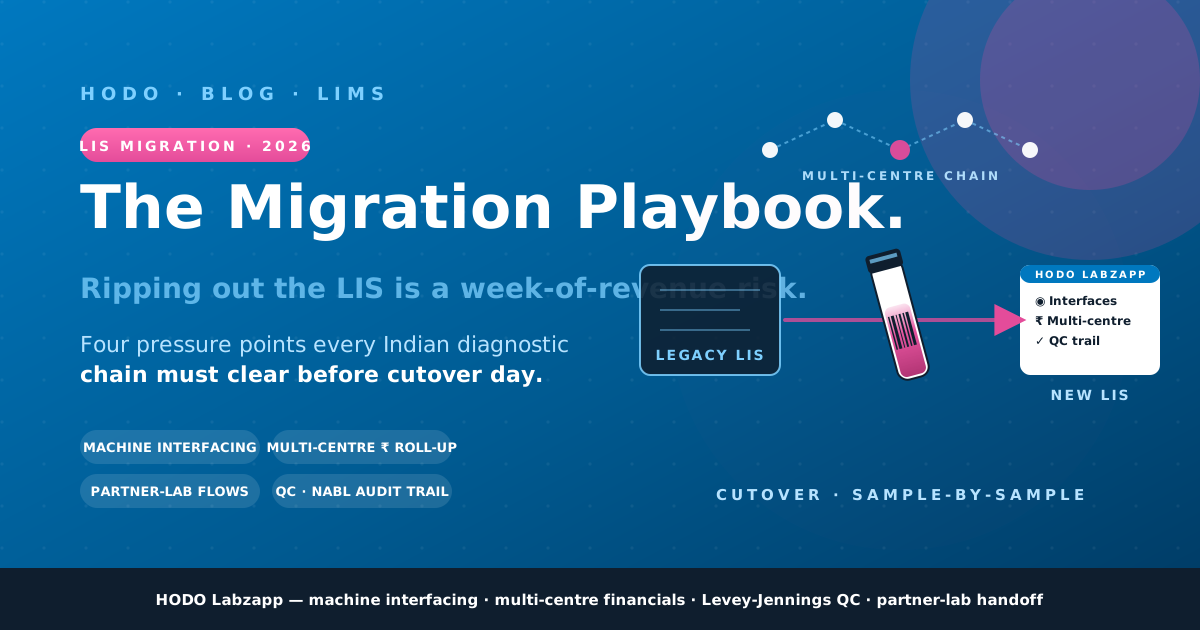
A recent DarkDaily report on Sonora Quest Laboratories' enterprise LIS transition — Scaling at Speed: A Real-World Enterprise LIS Transition at Sonora Quest Laboratories — Customization Strategy, Performance Gains, and Measurable Operational Impact — has put the spotlight back on a question every Indian diagnostic chain owner is grappling with in 2026: how do you swap the software that runs your labs without losing a week of revenue, breaking your NABL audit trail, or scrambling your machine interfaces? The Sonora Quest playbook — heavy customisation, phased rollouts, quantified performance gains — is instructive, but the operational realities in a Chennai, Kochi or Indore lab are different enough that the migration approach has to be re-cut for Indian conditions.
Sonora Quest processes millions of test orders across a distributed footprint, and the DarkDaily framing focuses on three things: how much the LIS had to be customised for their workflow, the throughput and turnaround improvements after cutover, and how the transition was staged so that no single site absorbed the entire operational shock. Indian pathology, radiology and multi-speciality diagnostic chains are heading into the same conversation, just at a different scale and with different pressure points. NABL 112 documentation, ABDM linkage for outpatient reports, GST-compliant billing across states, and the growing volume of B2B collections from hospital partners all sit on top of the LIS. A migration that doesn't plan for those layers ends up producing a technically sound cutover that the finance team and the quality manager both reject in month two.
The takeaway is not that Indian chains should copy the Sonora Quest customisation list. It is that any serious LIMS decision now has to answer four questions upfront — machine interface coverage, multi-centre financial roll-up, partner-lab and referral flows, and how QC data survives the transition. Chains that skip any of these end up paying for the migration twice.
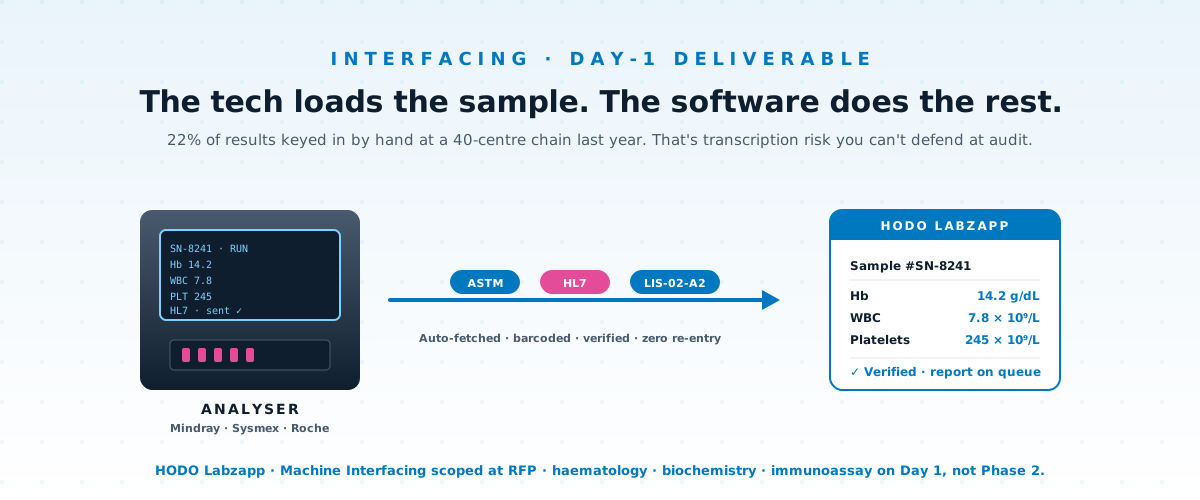
Most lab owners under-estimate how much of their daily TAT loss comes from manual re-entry between analysers and the LIS. In an unaudited walkthrough of a 40-centre South Indian pathology chain last year, close to 22% of results were being keyed in by hand because two haematology analysers and one biochemistry line were not talking to the software. The cost was not just labour — it was a 90-minute median delay on routine reports and a spike in transcription errors that the QC manager could not defend during audit.
A migration is the one moment where interface debt gets paid down. The Sonora Quest case, and every serious enterprise LIS transition, treats analyser integration as a Day-1 deliverable, not a Phase-2 wish list item. For Indian chains running a mix of Mindray, Sysmex, Roche, Beckman and older refurbished units across outlets, the migration RFP should specify interface counts by centre, protocol (ASTM, HL7, LIS-2), and go-live acceptance criteria. Any vendor that treats interfacing as a change request after cutover is quoting a false price.
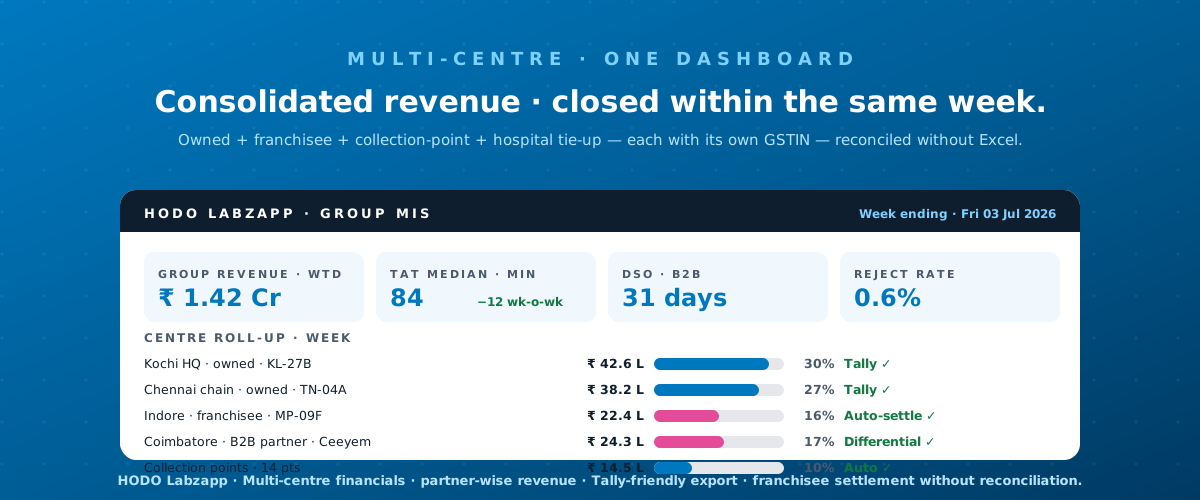
In the Indian market, a diagnostic chain is rarely one legal entity. There is usually a mix of owned centres, franchisees, collection points, and hospital tie-ups — each with its own GSTIN, its own pricing sheet, and its own settlement cycle. A migration that produces clean sample workflows but forces the accounts team back into Excel for consolidation is a partial migration.
The specification the CFO should hand to the vendor before signing is short: partner-wise revenue in one screen, franchisee settlement without manual reconciliation, differential pricing enforced at order entry, and a Tally-friendly export that closes books within the same calendar week. Sonora Quest's post-transition performance gains are quantified because they measured the right things. Indian chains should do the same — pick five metrics (TAT median, TAT 95th percentile, sample rejection rate, days-sales-outstanding on B2B, and cost per test), baseline them before cutover, and publish them at 30, 60 and 90 days.
Indian diagnostic revenue is disproportionately driven by referring physicians and B2B partner labs. A well-run chain in Tier-2 cities can see 40-60% of its volume come through referral doctors who expect their commission statements, patient reports, and MIS dashboards without having to call the lab. When a migration disrupts that flow — even for a week — referrals move to the competitor down the road and do not always come back.
The migration plan therefore needs a specific track for external stakeholders: referral doctors, corporate clients, hospital partners, and outsource labs. Each of these groups should have a login that survives cutover with the same URL, the same credentials handling, and the same report format. Anonymised sample handoff to partner labs — for tests the chain does not run in-house — is a particularly fragile flow, and the DarkDaily coverage of enterprise LIS transitions underscores that partner integrations are among the highest-risk migration items.
Levey-Jennings charts, Westgard rules, calibration logs, corrective action records — the QC trail is what an NABL assessor asks for first. A migration that leaves the historical QC data trapped in the old system, or that resets the LJ charts on Day 1 of the new system, creates a documentation gap that takes months to close. Chains should insist on a QC data import as part of the cutover, not as an optional feature, and should keep the legacy system available in read-only mode for at least one audit cycle. The Sonora Quest playbook implicitly does this — they measured performance because their measurement infrastructure carried across.
For diagnostic, pathology and scan-centre chains evaluating an LIS transition in 2026, HODO Labzapp is built around exactly the four pressure points above. Machine interfacing is scoped at RFP stage rather than as a post-go-live change, so haematology, biochemistry and immunoassay analysers move onto barcoded sample flows on Day 1 instead of month three. Multi-centre financials with differential pricing per partner mean that franchisee, corporate and B2B revenue reconciles without an Excel middle layer, and the CFO sees consolidated numbers in the same view as centre-level P&L. For chains that run partner-lab handoffs, the partner-lab integration with anonymised sample tracking keeps outsourced tests inside the same TAT and QC framework as in-house work — which is what the NABL assessor wants to see and what the referral doctor never wants to notice. Levey-Jennings QC, TAT reporting, referral-doctor portals and automated SMS/WhatsApp/Email report delivery sit on top of Google Cloud Platform hosting, so the migration itself does not become the reason a chain pauses its expansion into the next two districts.
See how Labzapp handles this — book a 30-min demo.
Source of the news hook: Read the source article →
See how Healzapp, Labzapp and EReazy fit your speciality in a free 30-minute demo.
Book a Free Demo