A new medRxiv preprint on an AI Clinical Decision Support System (CDSS) embedded inside eSanjeevani, India's national telemedicine service, has landed at the right moment for ~100-bed hospitals running their own teleconsult desks. It is a prospective implementation study, not a lab benchmark, which is the harder and more useful bar. The Google News surface picked it up this week, and it is worth reading before hospital operators sign off on the next round of AI wiring inside their HIS.
Why the eSanjeevani study matters for private hospitals
Most AI CDSS papers evaluate a model in isolation, accuracy on a curated dataset, F1 scores against a gold standard. The eSanjeevani study is different because it observes what happens when a decision-support system actually sits inside a live consultation, at government scale, with real doctors and real patients. That is the environment a ~100-bed hospital in Kochi, Nashik or Vizag is trying to replicate at smaller volumes on its own HIS.
For hospital operators the interesting number is not model accuracy, it is what the CDSS did to average consultation length, doctor override rate, and follow-up compliance. Those three metrics decide whether an AI overlay adds throughput or steals it. Private hospitals typically discover this the hard way, three months after rollout, when the OP queue is longer than before because doctors are reading suggestions they do not trust. eSanjeevani's scale means the study has enough consultations to separate real workflow gains from vendor demo footage, which is rare for Indian CDSS evidence.
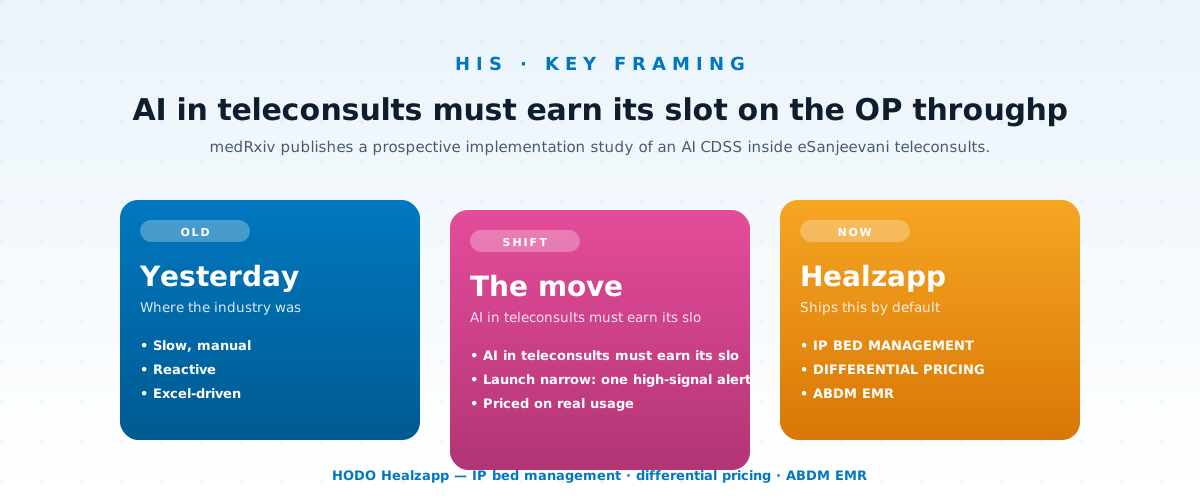
AI in teleconsults must earn its slot on the OP throughput screen.
Teleconsult throughput is the real constraint
A ~100-bed hospital with a teleconsult desk usually runs one to three doctors doing 30–60 remote consults a day, mostly follow-ups and second opinions from feeder towns. The bottleneck is almost never diagnostic reasoning, it is history-taking, documentation, and coordination with the physical OP. A CDSS that saves a doctor 45 seconds per consult by pre-summarising history and flagging medication interactions is worth more than one that suggests a diagnosis the doctor was going to reach anyway.
This is where the eSanjeevani study is instructive: implementation studies expose which part of the consultation the AI actually shortened. Hospital CTOs evaluating vendors this quarter should ask for exactly this data, not accuracy, but time saved per consult and how that time was redistributed. If a CDSS shifts three minutes of documentation onto the doctor to justify one minute of AI reading, it has moved the queue backwards. Teleconsult stations are usually the fastest-scaling revenue line inside a mid-sized Indian hospital, and any AI layer must earn its slot on that screen or come off it.
Where the CDSS pattern breaks, and where it holds
Implementation studies also surface the boring failures, the ones that keep AI features from becoming part of routine care. Alert fatigue is the biggest: if the CDSS fires suggestions on 80% of consults, doctors stop reading them by week two. Model drift is the second: rules trained on urban tertiary data behave differently on the rural taluk patient mix eSanjeevani mostly serves. The third is override behaviour, when a doctor rejects an AI suggestion, does the system learn, complain, or silently store the disagreement for audit?
For private hospitals adopting a similar pattern on their own HIS, the design lesson is to launch narrow. One or two high-signal alerts, contraindicated drug in pregnancy, missing screening for a chronic patient, beat a generalised diagnostic advisor. Narrow, high-precision, low-frequency alerts survive contact with a real OP desk. Broad, medium-confidence, high-frequency alerts get switched off within a quarter, usually informally, by the doctor who mutes them without telling anyone in IT.
AI-condensed history is the lower-risk starting point
Not every AI feature inside a teleconsult needs to be diagnostic. The safer, higher-ROI starting point is history summarisation, turning a patient's last twelve visits, three lab reports and current medication list into a paragraph the doctor can read in fifteen seconds. This does not carry the medico-legal weight of a diagnostic suggestion, and the doctor still owns the decision. But it directly attacks the throughput problem the eSanjeevani study is really about.
Hospitals running Healzapp use exactly this pattern, an AI-condensed history sitting at the top of the consult screen, pulled from prior EMR entries across IP, OP and lab. It is a lower-risk AI feature to defend to a hospital board because it never overrules the doctor; it only compresses reading time. Once that is stable and doctors stop opening the full timeline for routine follow-ups, the hospital has earned the right to try narrower, more clinical suggestions layered on top.
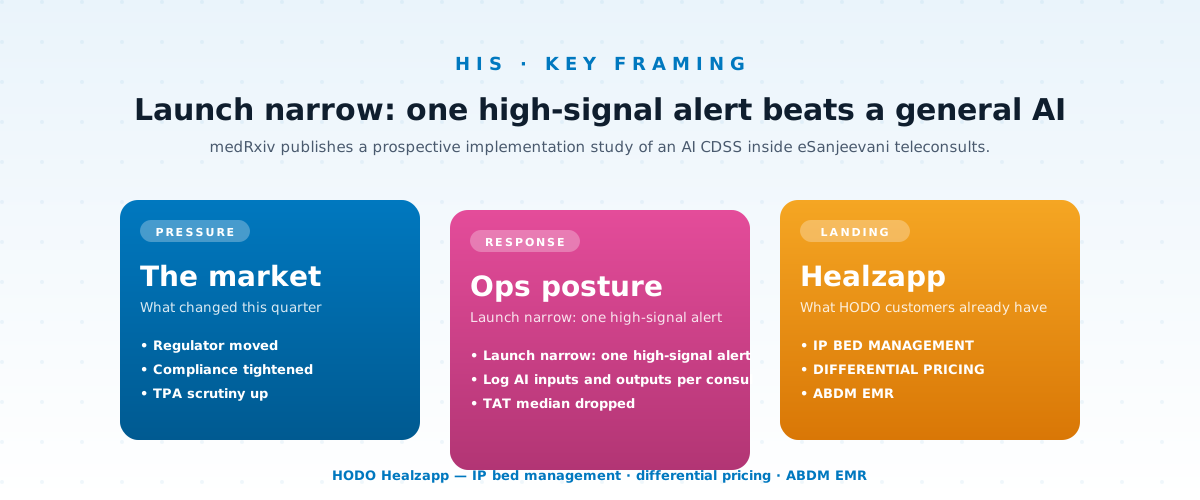
Launch narrow: one high-signal alert beats a general AI advisor.
ABDM, consent, and audit, the non-negotiables
Any AI feature added to a teleconsult in India now has to sit inside the ABDM consent envelope. The patient's health records that feed the CDSS are consented artefacts, and the AI's use of them is itself an act that should be logged. Hospitals treating this as a compliance afterthought are the ones who will have to rip out AI features when the next NRCeS or ABDM audit note lands.
Practically, this means three things. One, the CDSS input, which prior records were shown to the AI, must be logged per consult, not per session. Two, the AI's output must be stored alongside the doctor's final note so an auditor can reconstruct whether the doctor read, accepted, or overrode it. Three, patient consent language should mention AI-assisted decisions in plain terms, not buried in a policy PDF. eSanjeevani, being government-run, has the compliance stack pre-baked; private hospitals do not, and this is often where a promising deployment quietly stalls.
What this means for HODO customers
For ~100-bed hospitals and Indian clinic chains already running a teleconsult desk, the eSanjeevani study is a useful benchmark to argue for narrow, throughput-focused AI features rather than a clinical AI moonshot. Three Healzapp modules are the natural landing points.
Teleconsultation is the surface where any CDSS overlay must live, one screen, one queue, one audit trail, so time-saved measurements are apples-to-apples. EMR (AI-condensed history) is the lower-risk AI feature that saves doctor reading time without carrying diagnostic liability, and is the pattern most likely to survive the first quarter of doctor pushback. ABDM-compliant EMR is what keeps the whole stack defensible when the audit letter arrives, patient consent, record-level access logs, and the AI's own inputs and outputs stored inside the patient record rather than in a separate vendor console.
Start narrow, measure time saved per consult, and widen the AI's remit only when the doctors themselves ask for it.