
Fortis Healthcare has entered into a management contract to run Apollo Modi Hospital, per The Economic Times. The arrangement — where one operator runs a facility owned by another entity — is quietly becoming the default expansion route for large Indian hospital chains, and it changes what administrators need to demand from their IT stack.
A management contract is not an acquisition, not a lease, not a joint venture. The owning entity keeps the asset — the land, the building, the licence — while the operator brings clinical protocols, brand, procurement muscle and, critically, the operating system. Fortis' arrangement at the Modi facility follows the same pattern Apollo, Manipal and Aster have used at smaller regional units for years. It lets a chain add beds without the capital burden of a greenfield build or an outright buy-out.
For administrators, that sounds like the easy path. It usually is not. The operator inherits an existing HIS, existing referral relationships, existing TPA empanelments and a staff roster with its own way of doing things. The contract typically demands standardisation within twelve to eighteen months, and that clock starts on day one. Fee structures are usually tied to EBITDA improvement, so every month of drift in the transition eats directly into the operator's payout and into the owner's confidence.
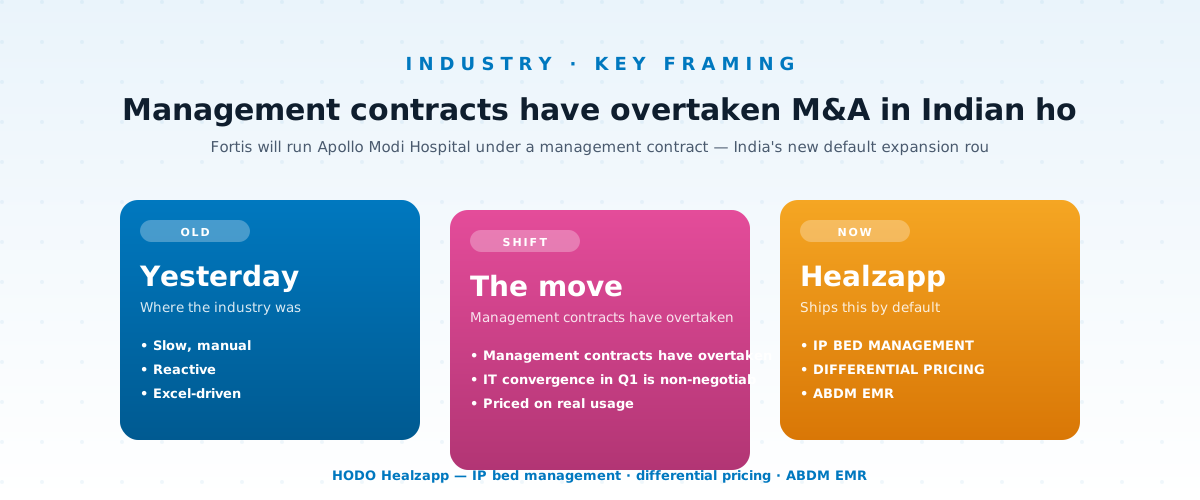
The numbers explain it. A 200-bed greenfield hospital in a tier-two city costs Rs 200-300 crore and takes four to five years to break even. An acquisition of a distressed unit still absorbs the legacy debt and any pending medico-legal claims. A management contract sidesteps both — the operator collects a fixed fee plus a share of EBITDA and walks away in seven to ten years if the numbers do not work.
For the owning family, it is a way to keep the asset appreciating while a professional operator does the hard work of margin repair. Regional operators from Kerala, Punjab and Gujarat have been signing these deals with mid-tier owners for the last three years. Fortis at Apollo Modi is the same play at a bigger scale.
The catch is that the operator's brand is on the door from day one, but the systems underneath may take a year to converge. Every day of that transition is a day of billing leakage, coding errors, and TPA claim rejections that eat into the very EBITDA the contract is meant to protect.
Term sheets for management contracts obsess over management fee percentages, capex ownership and clinical governance. They rarely spell out how the two IT stacks will merge. In practice, most operators run three years of dual systems: the legacy HIS at the taken-over unit, the operator's HIS at the flagship, and a spreadsheet-driven reconciliation layer between them.
That kills the whole point of the contract. Central procurement cannot work if the inventory codes do not match. Referral routing cannot work if the patient master indices are separate. Consolidated MIS to the board is either late or wrong. The finance team ends up with two Tally instances that do not reconcile, and the CFO signs off audited financials that everyone knows are approximate.
The chains that get this right have done one thing early: rolled the acquired unit onto the same HIS as the parent within the first quarter, even if the clinical workflows take longer to standardise. Common billing, common patient IDs, common inventory codes — those three are non-negotiable.
Once the IT layer is unified, the real work begins. A newly managed unit typically has different pricing tiers for the same procedure, different TPA contracts, and different consultant fee structures. Harmonising those without triggering consultant exits or patient complaints is a six-month project.
Pricing has to be surgical. The Modi unit will have local corporate contracts that Fortis will not want to renegotiate immediately, but those rates have to flow through the operator's central billing without manual override every time. Same with referral commissions to local GPs and specialists — the operator cannot yank those on day one without losing the referral base that fills the beds.
Bed occupancy dashboards, OT utilisation, and TAT for diagnostics have to be visible to the central operations team from week one. Without that visibility, the operator cannot demonstrate value to the owning family, and the contract renegotiation in year three becomes ugly.
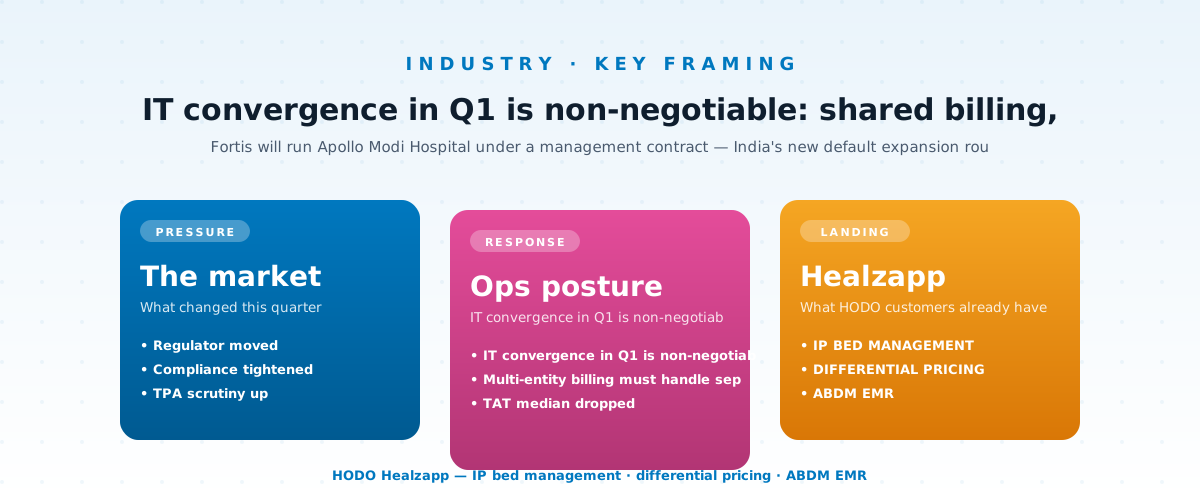
The unit under management often has its own PAN, its own GST registration, and its own hospital licence. Invoices, GST filings and TPA claim submissions continue in the owning entity's name, even as the operator runs the show. The billing engine has to support multi-entity invoicing without staff logging in and out of separate systems.
TPA cashflow is where this hurts. Star, Bajaj, Care and the government schemes each want claim submissions in specific formats tied to the empanelled entity. If the operator's HIS can only bill under one entity, the acquired unit's TPA cashflow stalls, and forty percent of hospital revenue goes with it. The chains that have solved this run multi-entity billing with partner logins that let each empanelled TPA see only their patients, at the correct entity, with the correct rate card.
For chains taking over facilities under management contracts, the operational reality is that the IT stack decides how fast the deal pays back.
Multi-outlet scale-up with one-click new-centre setup in Healzapp is designed for exactly this: the taken-over unit becomes a new centre in the same instance, keeping its own entity for billing and TPA purposes but sharing the patient master, inventory catalogue and consultant roster with the parent.
Differential pricing lets each managed unit keep its local corporate and TPA rate cards without duplicating the price list a dozen times. The operator's central team sees consolidated MIS while the local team continues billing at contracted rates.
Tally integration and Corporate-partner logins close the loop on finance and empanelment — the CFO gets clean multi-entity books, and TPAs see their patients at the correct entity without middleware or manual reconciliation.
See how Healzapp handles this — book a 30-min demo.
See how Healzapp, Labzapp and EReazy fit your speciality in a free 30-minute demo.
Book a Free Demo